
1. Introduction
This manual provides detailed instructions for the installation, operation, and maintenance of your RAINPOT 4-Channel FHD Dash Cam. Please read this manual thoroughly before using the device to ensure proper functionality and to maximize your user experience. This dash cam is designed to provide comprehensive video surveillance for your vehicle, enhancing driving safety and providing evidence in case of incidents.
2. Package Contents
Verify that all items listed below are present in your package. If any items are missing or damaged, please contact customer support.

Image: A visual representation of the package contents, including the main dash cam unit, rear camera, 64GB TF memory card, car charger, rear camera extension cable, bracket, user manual, adhesive tape, and screws.
- 1 x RAINPOT 4-Channel FHD Dash Cam
- 1 x Rear Camera
- 1 x 64GB TF Memory Card
- 1 x Car Charger (with 11.48ft/3.5 meters cable)
- 1 x Rear Camera Extension Cable (18ft/5.5 meters)
- 1 x Suction Cup Mount Bracket
- 1 x User Manual (this document)
- 1 x Adhesive Tape
- 2 x Screws
3. Product Overview and Features
The RAINPOT 4-Channel FHD Dash Cam is an advanced vehicle recording system designed for comprehensive coverage and enhanced safety.

Image: The main dash cam unit with its adjustable front lens and two side cameras, a separate rear camera, and a 64GB TF memory card, illustrating the complete system.
Key Features:
- 4-Channel Recording: Simultaneously records FHD 1080P video from the front, and 480P from the rear, left, and right cameras, providing 360° coverage without blind spots.
- Adjustable Front Lens: Allows for precise angle adjustment to capture desired details.
- Superior Night Vision: Equipped with 8 infrared LED lights and WDR (Wide Dynamic Range) technology for clear footage in low-light conditions.
- G-Sensor: Built-in G-sensor detects sudden collisions and automatically locks critical footage to prevent overwriting.
- Seamless Loop Recording: Automatically replaces the oldest files when the memory card is full, ensuring continuous recording.
- Parking Monitoring: In parking mode, the dash cam automatically records when motion is detected, providing round-the-clock protection. (Requires a hardwire kit or external battery for continuous power supply, not included).
- Easy Installation: Suction mount design facilitates quick and straightforward setup.
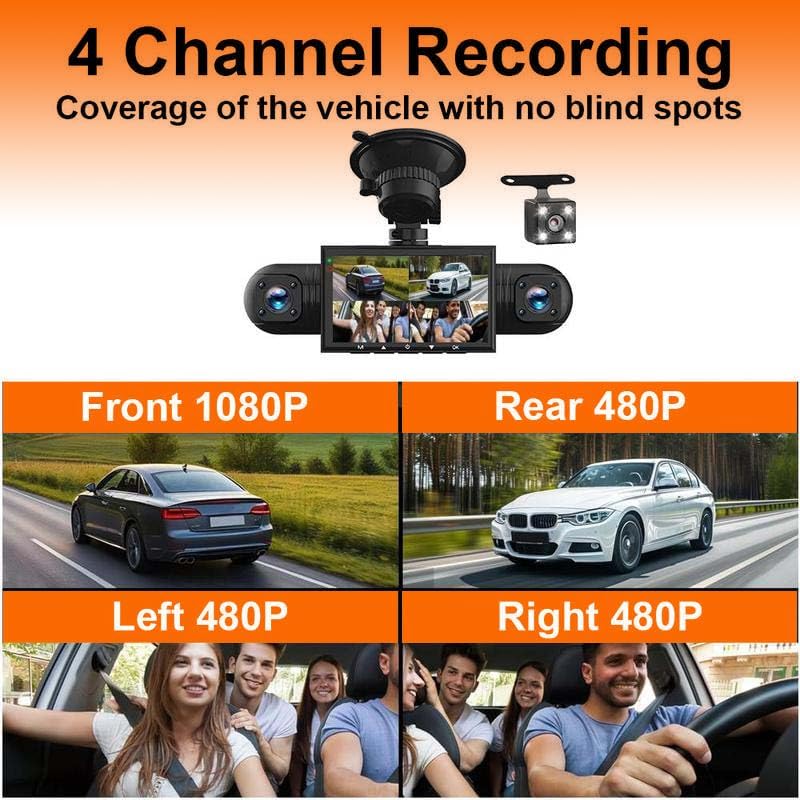
Image: This graphic demonstrates the four distinct camera views: Front (1080P), Rear (480P), Left (480P), and Right (480P), highlighting the comprehensive 360-degree coverage provided by the dash cam system.

Image: An infographic detailing the main features of the FHD Quad Camera, including its 1080P Full HD resolution, wide-angle lenses (160-180 degrees), audio recording capability, support for 64G Micro SD card, G-Sensor lock, Parking Monitor, Loop Recording, 3-inch screen, and 4-channel camera system.
4. Setup and Installation
Follow these steps to properly install your dash cam system.
4.1 Main Unit Installation (Suction Cup Mount)
- Clean the windshield thoroughly where you intend to mount the dash cam. Remove any protective film from the suction cup.
- Attach the suction cup mount to the clean windshield. Twist the bracket to lock it securely in place.
- To remove, twist the bracket to unlock it, then gently pull the small silicone pad to release the suction from the windshield.
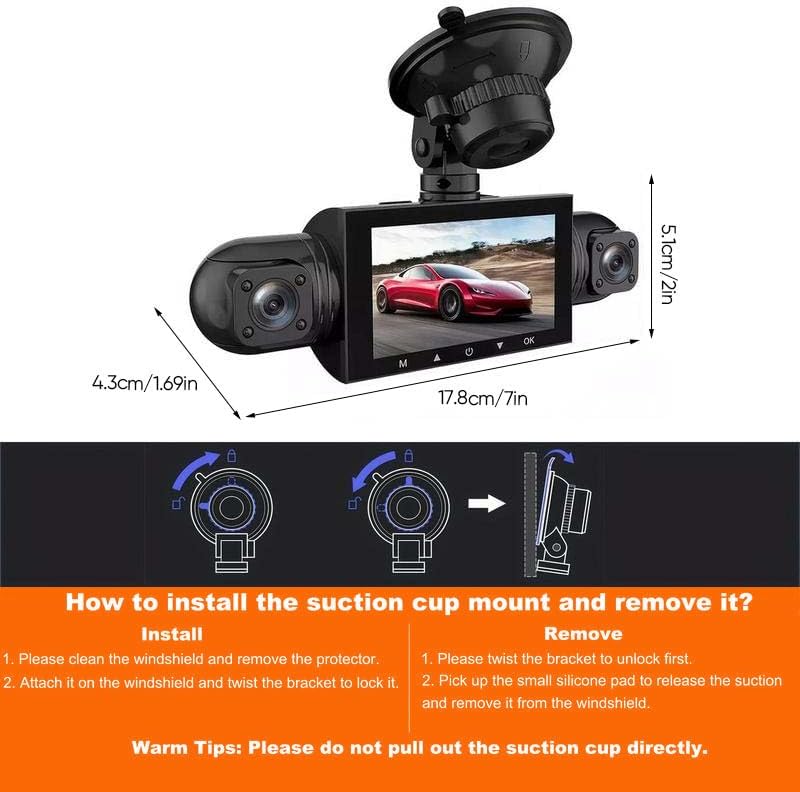
Image: A step-by-step visual guide on how to install the dash cam using the suction cup mount by cleaning the windshield and twisting to lock, and how to remove it by twisting to unlock and pulling the silicone pad.
4.2 Rear Camera Installation
The rear camera can be installed in two positions: inside the vehicle or outside. Choose the position that best suits your needs.

Image: A diagram showing a car with two potential rear camera installation points: Position A (inside the rear window) and Position B (outside, near the license plate). It also includes a wiring diagram connecting the rear camera to the main dash cam unit and the car's reversing lamp's positive anode.
- Choose Installation Position: You can install the rear camera inside the vehicle (Position A) or outside (Position B).
- Connect Rear Camera Cable: Connect the rear camera's red cable to the positive wire of your vehicle's reversing lamp. This enables the parking assist feature.
- Connect to Main Unit: Route the rear camera extension cable to the main dash cam unit and plug it into the designated AV-IN port.
Note: Due to variations in vehicle models, professional assistance may be required for rear camera wiring. The provided diagram is for reference only.
4.3 Power Connection
Plug the car charger into your vehicle's cigarette lighter socket and connect the other end to the dash cam's power input. The device will typically power on automatically when the vehicle starts.
5. Operating Instructions
Understand how to use the key functions of your dash cam.
5.1 Loop Recording
The dash cam features seamless loop recording. When the memory card reaches its full capacity, the system automatically overwrites the oldest unlocked files to ensure continuous recording without manual intervention.

Image: A visual representation of the auto loop recording function, showing a film strip where older footage is replaced by newer footage once the storage capacity of the SD card is reached.
5.2 G-Sensor (Collision Detection)
The built-in G-sensor detects sudden impacts or collisions. In such an event, the dash cam automatically records and locks the current video segment, preventing it from being overwritten by loop recording. This ensures critical incident footage is preserved.

Image: This graphic illustrates the G-sensor functionality, showing a dash cam and two cars, with text explaining that the G-sensor automatically records and locks video in the event of an emergency shock or collision, preventing the file from being overwritten.
5.3 Parking Monitoring
When the parking monitoring feature is enabled, the dash cam will automatically begin recording if it detects motion or impact while your vehicle is parked. This provides surveillance even when you are away from your car. For continuous parking monitoring, a hardwire kit or external battery pack (not included) is required to supply constant power to the dash cam.
5.4 Night Vision
The dash cam is equipped with 8 IR LED lights and WDR technology to enhance video clarity in low-light conditions, ensuring clear recordings during nighttime driving.
6. Settings and Maintenance
Important information regarding device settings and memory card management.

Image: A warning box containing critical information about the dash cam, including instructions for time setting, how to use the reset hole for system crashes, memory card tips (supporting 16-64G C10 TF cards), and instructions on how to format the memory card, especially when the gravity sensing function is active.
6.1 Time Setting
In video standby mode, long press the "OK" button to enter the time setting menu. Select "date/time" to adjust the current date and time.
6.2 Reset Hole
If the device crashes or buttons become unresponsive, making it unusable, press and hold the power button for 10 seconds. Alternatively, use a pointed object to insert into the "R" (reset) hole to restart the machine. After resetting, the device should function normally.
6.3 Memory Card Tips
- The dash cam supports 16-64GB memory cards, specifically C10 high-speed cards.
- This package includes a C10 64GB TF memory card.
- Video playback can be done directly on the device or by inserting the memory card into a card reader and viewing on a computer. A separate card reader may be required.
6.4 Format Memory Card
If the gravity sensing function is active, it is recommended to format the memory card approximately every 15 days. This is because when the car experiences vibration during driving, the G-sensor may lock video files, which are then retained permanently and not overwritten by loop recording. To format the memory card, select "Format" in the system settings and confirm with "OK".
6.5 Battery Information
The built-in battery is 150mAh. It is primarily for saving time and system settings and can only hold a charge for 3-5 minutes. Always use the original car charger for operation.
7. Troubleshooting
This section addresses common issues you might encounter with your dash cam.
- Device not powering on: Ensure the car charger is securely plugged into both the dash cam and the vehicle's cigarette lighter socket. Check if the vehicle's power outlet is functioning.
- Device freezes or becomes unresponsive: Use the reset hole or hold the power button for 10 seconds to restart the device as described in Section 6.2.
- Video files are not being overwritten: If the G-sensor is frequently triggered (e.g., due to rough roads), many files might be locked. Format the memory card regularly (every 15 days) as described in Section 6.4.
- Poor video quality at night: Ensure the camera lenses are clean. The dash cam utilizes IR LEDs and WDR technology for night vision; however, extreme darkness may still limit visibility.
- Memory card full error: Ensure loop recording is enabled. If it is, format the memory card. Ensure you are using a C10 high-speed memory card within the supported 16-64GB range.
- Rear camera not displaying: Check all cable connections for the rear camera, ensuring they are secure and correctly plugged into the main unit's AV-IN port.
8. Specifications
| Brand | RAINPOT |
| Model Name | EC89825-25US |
| Product Dimensions | 8 x 7.13 x 4.72 inches (8"D x 7.13"W x 4.72"H) |
| Video Capture Resolution | Front: 1080p, Rear/Left/Right: 480p |
| Connectivity Technology | HDMI, USB |
| Special Features | Loop Recording, Night Vision, Parking Monitor, G-Sensor |
| Mounting Type | Windshield Mount (Suction Cup) |
| Color | Black |
| Supported Memory Card | 16-64GB TF Card (Class 10 recommended) |
| Manufacturer | RAINPOT |
| Date First Available | March 17, 2025 |
9. Warranty and Support
RAINPOT products are designed for reliability and performance. For specific warranty details, please refer to the warranty card included with your purchase or contact RAINPOT customer support directly. Keep your purchase receipt as proof of purchase for warranty claims.
For technical assistance, troubleshooting, or general inquiries, please visit the official RAINPOT website or contact their customer service department. Contact information can typically be found on the product packaging or the brand's official online presence.