
BUXFMHT Sewing Machine 608A
BUXFMHT Mini Sewing Machine User Manual
Model: Sewing Machine 608A
1. Introduction
This manual provides comprehensive instructions for the safe and efficient operation, maintenance, and troubleshooting of your BUXFMHT Mini Sewing Machine. Please read this manual thoroughly before first use to ensure proper functionality and to prevent damage.
2. Safety Instructions
Always adhere to the following safety precautions to prevent injury or damage to the machine:
- Ensure the power adapter is disconnected when not in use, or when performing maintenance, cleaning, or changing accessories.
- Keep fingers away from the needle, especially during operation.
- Do not allow children to operate the machine without adult supervision.
- Use only the specified power adapter provided with the machine.
- Do not operate the machine if it is wet or if the power cord is damaged.
- Place the machine on a stable, flat surface during operation.
3. Package Contents
Verify that all items are present in the package:
- BUXFMHT Mini Sewing Machine
- Foot Pedal
- Power Adapter
- Sewing Kit (includes thread spools, spare needles, needle threader, scissors, ruler, thimble)
- Instruction Manual
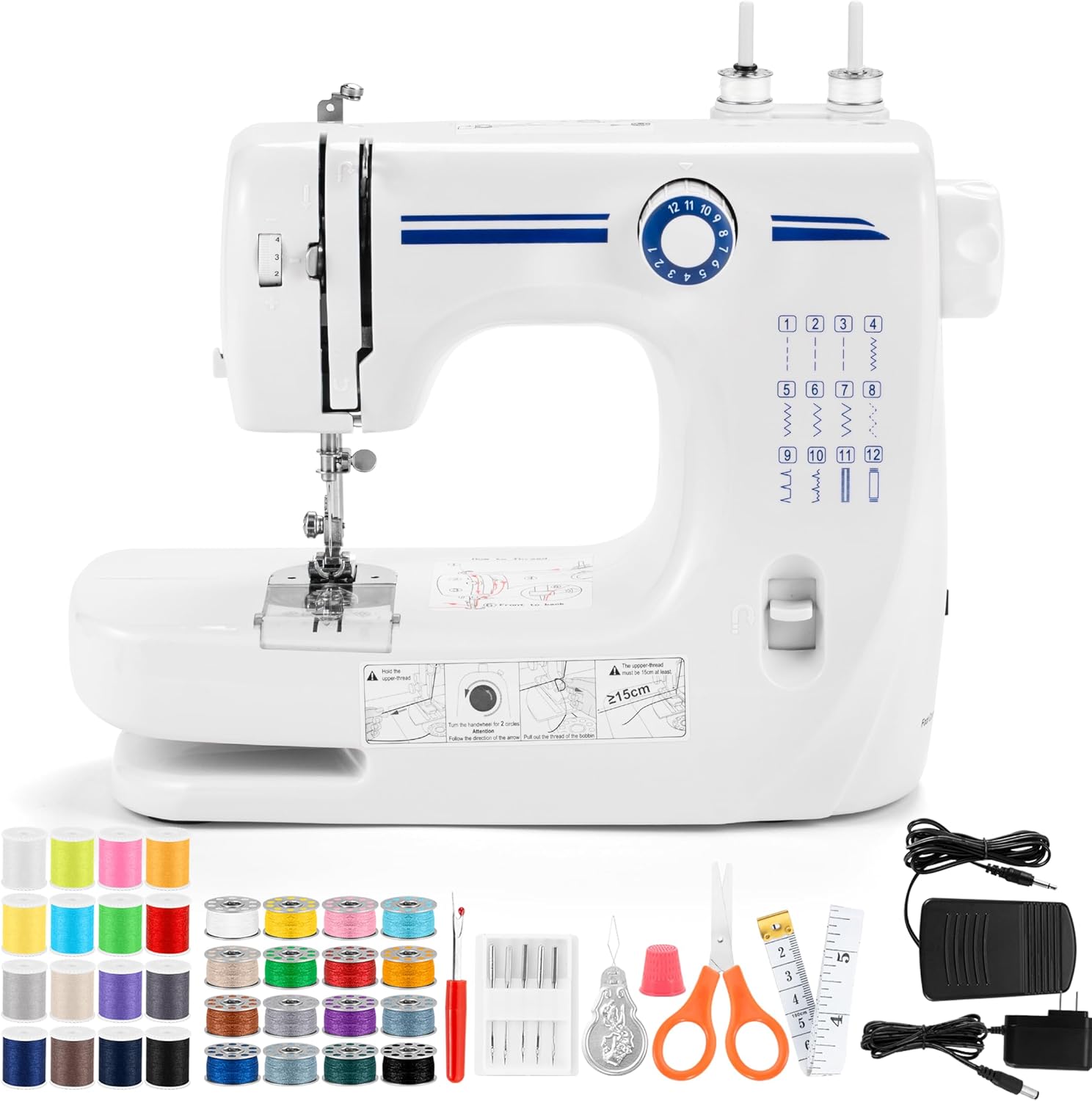
Image: The BUXFMHT Mini Sewing Machine shown with its complete set of accessories, including various colored thread spools, needles, scissors, a foot pedal, and power adapter.
4. Product Overview
Familiarize yourself with the main components of your sewing machine:

Image: A detailed diagram labeling key components of the sewing machine, including winding thread guides, pattern selecting dial, thread cutter, presser foot, bottom bobbin, spool pin, hand wheel, ON/OFF switch, adapter jack, and foot pedal jack.
- Winding Thread Guide: Guides the thread during bobbin winding.
- Pattern Selecting Dial: Used to choose from 12 built-in stitch patterns.
- Thread Cutter: Conveniently cuts threads after sewing.
- Presser Foot: Holds the fabric firmly in place during sewing.
- Bottom Bobbin: Holds the lower thread.
- Reverse Sewing Function: Allows for reverse stitching to reinforce seams.
- Spool Pin: Holds the upper thread spool.
- Hand Wheel: Manually raises and lowers the needle.
- ON/OFF Switch: Powers the machine on or off.
- Adapter Jack: Connects the power adapter.
- Foot Pedal Jack: Connects the foot pedal for speed control.
- LED Lighting: Illuminates the sewing area for better visibility.
5. Setup
5.1 Power Connection
- Insert the power adapter into the adapter jack on the back of the machine.
- Plug the other end of the adapter into a suitable power outlet.
- (Optional) Connect the foot pedal to the foot pedal jack for hands-free speed control.
5.2 Threading the Machine
Proper threading is crucial for smooth operation and consistent stitches.
- Winding the Bobbin:
- Place an empty bobbin onto the bobbin winder spindle.
- Guide the thread from the spool pin through the bobbin winding tension disc.
- Wrap the thread around the bobbin a few times, then push the bobbin winder spindle to the right.
- Turn on the machine (or press the foot pedal) to wind the bobbin. Stop when the bobbin is full.
- Cut the thread and return the spindle to the left.
- Inserting the Bottom Bobbin:
- Open the bobbin cover plate.
- Insert the wound bobbin into the bobbin case, ensuring the thread unwinds in the correct direction (usually counter-clockwise).
- Guide the thread through the tension spring and out the slot.
- Close the bobbin cover plate.
- Threading the Upper Thread:
- Raise the presser foot and the needle to its highest position using the hand wheel.
- Place a thread spool onto the spool pin.
- Guide the thread through the upper thread guide.
- Follow the numbered threading path indicated on the machine, ensuring the thread passes through the tension discs and the take-up lever.
- Thread the needle from front to back.

Image: Illustration showing the correct method of threading the needle from front to back. Incorrect threading (left) and correct threading (right) are depicted.
- Bringing Up the Bobbin Thread:
- Hold the upper thread lightly with your left hand.
- Turn the hand wheel towards you to lower the needle, then continue turning to raise it again. The upper thread will catch the bobbin thread, forming a loop.
- Pull the loop to bring the bobbin thread up through the needle plate hole.
- Pull both upper and bobbin threads under the presser foot and towards the back of the machine, leaving about 4 inches of thread.

Image: Illustration demonstrating the importance of having at least 4 inches of both upper and bobbin threads extended before starting to sew to prevent issues.
6. Operating Instructions
6.1 Selecting Stitch Patterns
The machine offers 12 built-in stitch patterns. Rotate the Pattern Selecting Dial to choose the desired stitch (1-12).

Image: A visual representation of the 12 available stitch patterns, including straight lines, blind hems, decorative stitches, and buttonhole stitches.
6.2 Adjusting Sewing Speed
The machine has two speed modes: Low (L) and High (H).
- Use the Button Control switch (L/O/H) on the machine to select the speed. 'O' is off.
- Alternatively, use the Foot Pedal for variable speed control.

Image: Close-up of the sewing machine's button control for speed selection (L/O/H) and the foot pedal, illustrating the two methods of controlling sewing speed.
6.3 Starting to Sew
- Place the fabric under the presser foot.
- Lower the presser foot lever to hold the fabric firmly.
- Turn the hand wheel to lower the needle into the fabric at the starting point.
- Turn on the machine using the ON/OFF switch or press the foot pedal to begin sewing.
- Guide the fabric gently as it feeds through the machine.

Image: Illustration showing the correct position of the presser foot, pressing against the fabric, and the needle inserted into the fabric before starting to sew. Incorrect position (left) and correct position (right) are depicted.
6.4 Reverse Sewing
To reinforce stitches at the beginning and end of a seam, press and hold the reverse sewing button/lever. The machine will sew backward. Release the button/lever to resume forward sewing.
6.5 Double Needle Sewing
This machine supports double needle sewing for stronger and more decorative seams. To use this feature, replace the single needle with a double needle and thread both needles according to the instructions for upper threading.

Image: A split image illustrating the two sewing modes: Double Thread Sewing (showing the bobbin area for lower thread) and Double Needles Sewing (showing the two spool pins for upper threads), highlighting the machine's versatility.
6.6 Automatic Winding Function
The machine features an improved automatic winding function for bobbins, reducing thread snagging and knotting during the winding process.

Image: A collage showing the automatic winding function, reverse sewing function, thread cutter, LED lighting, multi-layer fabrics sewing capability, and replaceable presser foot, demonstrating various features of the machine.
6.7 Cantilever Design
The cantilever design of the machine facilitates easier sewing of cylindrical items such as cuffs, collars, and pant legs, as well as children's clothing.
6.8 Fabric Compatibility
The machine is designed to handle various fabric types. Refer to the table below for guidance on fabric thickness and elasticity.

Image: A chart detailing fabric compatibility, indicating which types of fabrics (Cotton/Linen, Silk/Wool, Polyester, Elastic) are easy to sew, not smooth to sew, or difficult to sew based on their thickness (Regular, Thick, Thin, Hard, Soft).
| Fabric Type | Cotton/Linen | Silk/Wool | Polyester | Elastic |
|---|---|---|---|---|
| Regular | ✓ | ✗ | ✓ | △ |
| Thick | ✓ | ✗ | ✓ | △ |
| Thin | ✓ | ✗ | ✗ | ✓ |
| Hard | ✓ | ✗ | ✓ | △ |
| Soft | ✗ | ✗ | ✗ | ✓ |
| Legend: ✓ = Easy to Sew, △ = Not Smooth to Sew, ✗ = Difficult to Sew Notes: 1. Definition of fabric thickness: Thin (two layers thickness ≤ 0.35mm), Thick (two layers thickness ≥ 0.8mm), Regular (two layers thickness between 0.35mm and 0.8mm). 2. Definition of elastic cloth: If a 100mm x 30mm cloth extends to or over 108mm under 0.5KG tension force, it is defined as elastic. 3. Hard fabric examples: Jeans, fine canvas. 4. Soft fabric examples: Towel, duster. | ||||
7. Maintenance
Regular maintenance ensures the longevity and optimal performance of your sewing machine.
- Cleaning: Regularly clean lint and dust from the bobbin area and feed dogs using a small brush. Disconnect power before cleaning.
- Oiling: Refer to the specific oiling points in the detailed manual if provided. Generally, a few drops of sewing machine oil are applied to moving metal parts.
- Needle Replacement: Replace needles frequently, especially when sewing different fabric types or if the needle becomes bent or dull. Ensure the flat side of the needle faces the back when inserting.
- Storage: Store the machine in a dry, dust-free environment when not in use.
8. Troubleshooting
This section addresses common issues you might encounter:
| Problem | Possible Cause | Solution |
|---|---|---|
| Machine not starting | Power not connected; ON/OFF switch off; Foot pedal not connected/faulty. | Check power connection; Turn ON/OFF switch to L or H; Ensure foot pedal is securely connected. |
| Skipped stitches | Incorrect needle insertion; Bent or dull needle; Improper threading; Incorrect needle size for fabric. | Re-insert needle correctly; Replace needle; Re-thread machine; Use appropriate needle for fabric type. |
| Thread breaking | Incorrect tension; Poor quality thread; Improper threading; Bent needle; Thread snagging. | Adjust tension dial; Use good quality thread; Re-thread machine carefully; Replace needle; Check for obstructions in thread path. |
| Uneven stitches / Fabric puckering | Incorrect tension; Incorrect stitch length; Fabric not fed smoothly. | Adjust tension; Select appropriate stitch length; Guide fabric gently without pulling or pushing. |
| Bobbin thread tangling | Improper bobbin winding; Incorrect bobbin insertion; Upper thread not correctly threaded. | Re-wind bobbin evenly; Re-insert bobbin correctly; Ensure upper thread is correctly threaded through all guides. |
If problems persist after attempting these solutions, please contact customer support.
9. Specifications
| Feature | Detail |
|---|---|
| Model Number | Sewing Machine 608A |
| Brand | BUXFMHT |
| Stitch Patterns | 12 Built-In Patterns |
| Speed Modes | Dual Speed (Low/High) |
| Sewing Modes | Single Needle, Double Needle |
| Reverse Sewing | Yes |
| Lighting | LED Light |
| Winding Function | Automatic |
| Design Feature | Cantilever Design |
| Product Dimensions | 30 x 20 x 20 inches (76.2 x 50.8 x 50.8 cm) |
| Item Weight | 5.5 pounds (2.5 kg) |
| Material | Thickened PP material shell, stainless steel components |
| UPC | 727370925534 |
10. Warranty and Support
BUXFMHT provides a 12-month quality guarantee for this sewing machine. If you encounter any issues or have questions, please contact BUXFMHT customer service. They aim to respond and resolve inquiries within 24 hours.
For support, please refer to the contact information provided with your purchase or visit the official BUXFMHT store on Amazon: BUXFMHT Amazon Store.
Important Note: The sewing machine package includes a fabric piece used by the manufacturer for testing threading. This is not an indication of a used product. Please read the instruction manual carefully before operating the machine for the first time to prevent damage due to improper operation.
Ask a question about this manual
Ask about setup, troubleshooting, compatibility, parts, safety, or missing instructions. Manuals+ will review the question and use this page’s manual context to help answer it.