
1. Introduction
This manual provides essential information for the safe and effective use of the HiXiMi 3.2V 50Ah LiFePO4 (Lithium Iron Phosphate) battery cell. It covers product specifications, safety precautions, setup, operation, and maintenance. Please read this manual thoroughly before using the battery cells.
These cells are designed for DIY battery pack assembly and require a Battery Management System (BMS) for proper and safe operation. A BMS is NOT included with these cells.
2. Safety Information and Precautions
WARNING: Improper handling of LiFePO4 cells can lead to fire, explosion, or severe injury. Always follow safety guidelines.
- BMS Requirement: A suitable LiFePO4 Battery Management System (BMS) is mandatory for charging and discharging these cells. Do not operate without a BMS.
- Voltage and Polarity: Always verify correct voltage and polarity before connecting cells in series or parallel. Incorrect connections can cause damage or hazards.
- Short Circuit Prevention: Avoid short-circuiting the battery terminals. Use insulated tools and ensure busbars and nuts are securely fastened without touching other terminals.
- Temperature: Operate and store cells within the specified temperature ranges. Charging temperature: 0°C to 55°C (32°F to 131°F). Discharge temperature: -20°C to 60°C (-4°F to 140°F).
- Physical Damage: Do not puncture, drop, crush, or disassemble the cells. Damaged cells can be dangerous.
- Water Exposure: Keep cells away from water and moisture.
- Children and Pets: Keep batteries out of reach of children and pets.
- Disposal: Dispose of batteries according to local regulations. Do not dispose of in general waste.
3. Product Features
- Cell Type: 3.2V 50Ah LiFePO4 (Lithium Iron Phosphate) battery cell.
- High Cycle Life: Designed for over 5000 cycles, offering a long service life.
- Grade A Cells: Brand new, A-grade cells with matched internal resistance, voltage, and capacity for optimal performance in DIY packs.
- DIY Compatibility: Supports multiple series or parallel connections for custom battery pack configurations.
- Included Accessories: Comes with busbars and M6 nuts for connection.
- Wide Application: Suitable for off-grid solar power systems, RVs, marine applications, energy storage, and backup power supplies.

Image: Key features of the LiFePO4 battery cells, including Grade A quality, over 6000 cycles, included accessories, matched cells, long service life, and a 5-year quality promise.
4. Specifications
| Parameter | Value |
|---|---|
| Nominal Voltage | 3.2V |
| Nominal Capacity | 50Ah |
| Working Voltage Range | 2.5V ~ 3.65V |
| Max. Continuous Discharge Rate | 1C (50A) |
| Max. Continuous Charging Rate | 1C (50A) |
| Internal Resistance | <1.5mΩ |
| Charging Temperature Range | 0°C ~ 55°C (32°F ~ 131°F) |
| Discharge Temperature Range | -20°C ~ 60°C (-4°F ~ 140°F) |
| Dimensions (L x W x H) | 119mm x 29mm x 149mm (4.68in x 1.14in x 5.86in) |
| Weight per cell | 0.96kg (2.11lb) |

Image: Detailed dimensions of a single 3.2V 50Ah LiFePO4 cell, showing length, width, and height measurements.
5. Setup and Installation
These LiFePO4 cells are intended for building custom battery packs. Proper setup is critical for safety and performance.
- Cell Inspection: Upon receipt, inspect each cell for any physical damage. Verify that all cells are brand new and in good condition.
- Voltage and Internal Resistance Matching: All cells are supplied with matched internal resistance, voltage, and capacity. However, it is recommended to verify these parameters before assembly.
- BMS Integration: A Battery Management System (BMS) is essential. Select a BMS appropriate for your desired battery pack configuration (e.g., 4S for 12V, 8S for 24V, 16S for 48V) and total capacity. The BMS will protect against overcharge, over-discharge, overcurrent, and temperature extremes, and balance cell voltages.
- Series and Parallel Connections:
Cells can be connected in series to increase voltage or in parallel to increase capacity. Use the provided busbars and M6 nuts for secure connections.
- Series Connection: Connect the positive terminal of one cell to the negative terminal of the next. This increases the total voltage (e.g., four 3.2V cells in series create a 12.8V pack).
- Parallel Connection: Connect positive terminals together and negative terminals together. This increases the total capacity (e.g., two 50Ah cells in parallel create a 100Ah cell block).
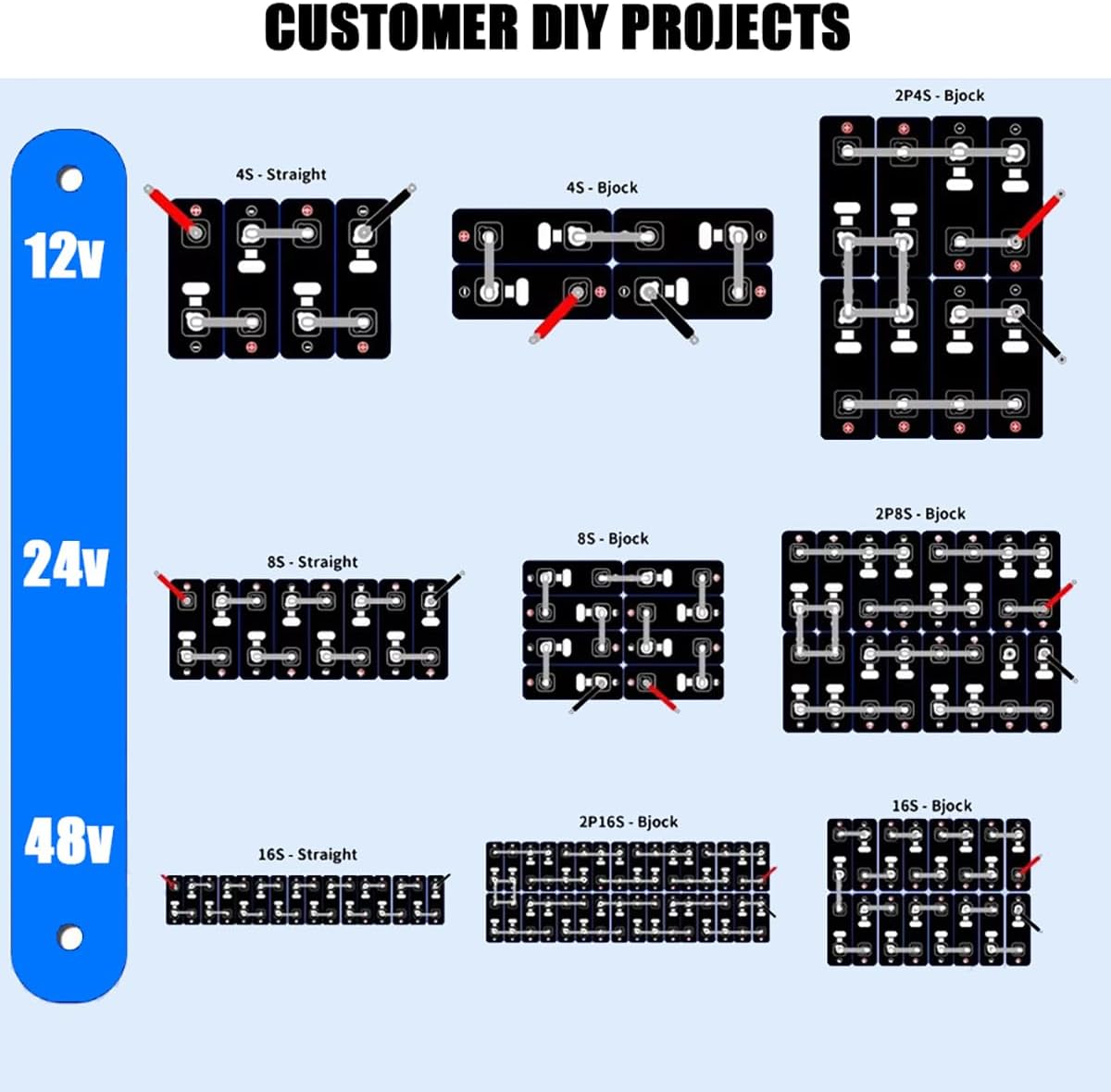
Image: Diagrams illustrating various series and parallel connection methods for building 12V, 24V, and 48V battery packs using LiFePO4 cells.
- Secure Connections: Ensure all busbar and nut connections are tight and secure to minimize resistance and prevent overheating. Use appropriate torque.
- Insulation: Properly insulate all exposed terminals and connections to prevent accidental short circuits.
- Enclosure: House the assembled battery pack in a suitable, non-conductive enclosure that provides protection from environmental factors and physical damage. Ensure adequate ventilation if required by the BMS or application.
6. Operating Instructions
Once your battery pack is assembled with a BMS, follow these guidelines for operation:
- Initial Charge: Before first use, fully charge the battery pack using a LiFePO4 compatible charger. The BMS will manage the charging process and cell balancing.
- Charging Parameters:
- Charging Voltage: As determined by your BMS for the specific series configuration (e.g., 14.4V for a 4S 12V pack).
- Max. Charging Current: Do not exceed 1C (50A per 50Ah cell block).
- Charging Temperature: 0°C to 55°C (32°F to 131°F).
- Discharging Parameters:
- Min. Discharge Voltage: The BMS will cut off discharge when any cell reaches its minimum voltage (typically 2.5V).
- Max. Discharge Current: Do not exceed 1C (50A per 50Ah cell block).
- Discharge Temperature: -20°C to 60°C (-4°F to 140°F).
- Monitoring: Regularly monitor the battery pack's voltage, current, and temperature, especially during the initial cycles, to ensure the BMS is functioning correctly.
7. Maintenance
Proper maintenance extends the life and ensures the safety of your LiFePO4 battery pack.
- Regular Inspection: Periodically inspect the battery pack for any signs of physical damage, loose connections, or corrosion.
- Terminal Cleaning: Keep terminals clean and free of debris.
- Storage: If storing the battery pack for an extended period, ensure it is charged to approximately 50-70% of its capacity. Store in a cool, dry place within the recommended temperature range. Avoid extreme temperatures.
- BMS Functionality: Ensure your BMS is always operational and correctly configured.
8. Troubleshooting
This section addresses common issues you might encounter. Always prioritize safety and consult a qualified professional if unsure.
| Problem | Possible Cause | Solution |
|---|---|---|
| Battery pack not charging | BMS protection triggered (over-discharge, over-temperature), charger fault, loose connections. | Check BMS status indicators. Verify charger functionality and connections. Allow cells to warm up if too cold. |
| Battery pack not discharging (no power output) | BMS protection triggered (over-discharge, overcurrent, over-temperature), loose connections. | Check BMS status. Recharge the pack if over-discharged. Reduce load if overcurrent. Allow cells to cool down if too hot. Verify connections. |
| Individual cell voltage imbalance | BMS balancing issue, prolonged storage, or initial cell mismatch. | Ensure BMS balancing function is active. Perform a full charge cycle to allow BMS to balance cells. If persistent, inspect individual cells. |
| Overheating during charge/discharge | Excessive current, poor ventilation, internal short, or faulty cell. | Immediately disconnect power. Reduce charge/discharge current. Ensure adequate ventilation. Inspect cells for damage. |
9. Warranty and Support
HiXiMi provides a 5-year quality promise for these LiFePO4 battery cells. For warranty claims or technical support, please contact your retailer or HiXiMi customer service with your purchase details.
Please note that the warranty may be voided by improper installation, misuse, or failure to use a suitable Battery Management System (BMS).
10. Applications
These versatile LiFePO4 cells are suitable for a wide range of applications, including:
- Off-grid solar power systems
- Recreational Vehicles (RVs)
- Marine and boat applications
- Energy storage systems
- Camping and outdoor activities
- Fish finders
- House alarm security systems
- Emergency lighting
- Uninterruptible Power Supplies (UPS)
- Backup power supplies
- Motive power for electric vehicles and lawn mowers

Image: Visual representation of various applications for LiFePO4 battery cells, including RVs, marine, outdoor activities, solar, energy storage, power backup, and electric vehicles.