
1. Introduction
This manual provides detailed instructions for the proper use, installation, and maintenance of your DIYmall 11KG Mini All-Metal Digital Servo. This high-torque, coreless motor micro servo is designed for precision control in RC cars, robots, and other hobby applications requiring a 270-degree range of motion. Please read this manual thoroughly before operation to ensure optimal performance and longevity of your servo.
2. What's in the Box
Upon opening the package, verify that all components are present:
- 1 x DIYmall 11KG Mini All-Metal Digital Servo (270 Degree)
- Mounting screws
- Plastic servo horns (various types)

Image: The DIYmall 11KG Mini All-Metal Digital Servo shown with its included mounting screws and plastic servo horns.
3. Setup and Installation
Follow these steps for proper installation of your servo:
- Mounting the Servo: Securely attach the servo to your RC car or robot chassis using the provided mounting screws. Ensure the servo is firmly in place to prevent movement during operation.
- Connecting the Servo Horn: Select the appropriate plastic servo horn for your application and attach it to the servo's output shaft.
- Wiring Connection: Connect the servo's three-wire cable to your receiver or control board. The standard color coding is:
- Brown: Ground (-)
- Red: Positive Power (+)
- Orange: Signal

Image: Close-up of the servo's connector wires, indicating Brown for Ground, Red for Positive, and Orange for Signal.
- Power Supply: Ensure your power supply (battery or BEC) provides the correct operating voltage (4.8V-8.4V) for the servo.
4. Operating Instructions
The DIYmall 11KG Digital Servo operates based on Pulse Width Modulation (PWM) signals. It is programmable and offers a running degree of 270° ±3°.
- Signal Period: 20ms
- Pulse Width Range: 500µsec to 2500µsec
- Neutral Position: 1500µsec
- Rotating Direction: Counterclockwise (when pulse width is between 1000µsec and 2000µsec)
To operate, connect the servo to a compatible RC receiver or microcontroller (e.g., Arduino) that can generate PWM signals within the specified range. Adjust the pulse width to control the servo's position within its 270-degree range.
Video: This video demonstrates the 270-degree angle testing of the DIYmall 11KG servo, showing its range of motion when controlled by a pulse width signal.
Video: A demonstration of the DIYmall 11KG all-metal micro servo in action, showcasing its movement and build quality.
5. Maintenance
To ensure the longevity and reliable performance of your servo, consider the following maintenance tips:
- Keep Clean: Regularly clean the servo's exterior to prevent dust and debris from entering the mechanism.
- Check Connections: Periodically inspect all wiring connections for looseness or damage.
- Gear Inspection: While the servo features metal gears, excessive force or impacts can cause wear. If you notice unusual noise or play, inspect the gears.
- Avoid Overloading: Do not exceed the servo's specified stall torque to prevent damage to the motor and gears.
- Storage: Store the servo in a dry, cool environment within the recommended storage temperature range of -30°C to 80°C.
6. Troubleshooting
If you encounter issues with your servo, refer to the following common problems and solutions:
| Problem | Possible Cause | Solution |
|---|---|---|
| Servo not responding | Incorrect wiring, insufficient power, faulty signal, damaged servo. | Check all wiring connections (Ground, Power, Signal). Ensure power supply voltage is within 4.8V-8.4V. Verify signal source is functioning correctly. Test with a different servo if possible. |
| Servo jitters or moves erratically | Noisy signal, power fluctuations, mechanical binding. | Ensure signal wires are not near high-current wires. Check power supply stability. Inspect for any physical obstructions preventing smooth movement. |
| Servo lacks strength or stalls easily | Under-voltage, excessive load, worn gears. | Verify power supply voltage is adequate for the load. Reduce the mechanical load on the servo. Inspect gears for wear. |
| Unusual noise from servo | Damaged gears, motor issue, foreign object. | Disassemble carefully to inspect gears for damage or foreign objects. If noise persists, the motor may be faulty. |
7. Specifications
Detailed technical specifications for the DIYmall 11KG Mini All-Metal Digital Servo (270 Degree):
Environmental Conditions:
- Storage Temperature Range: -30°C to 80°C
- Operating Temperature Range: -25°C to 70°C
- Humidity Range: 65% ±10%
- Splash Water Resistance: IP65
Mechanical Specifications:
- Size: 23.0 x 26.3 x 12mm
- Weight: 22g ±5%
- Gear Type: 5 Metal
- Bearing: 2BB
- Horn Gear Spline: 25T; Diameter: 5.0mm
- Case Material: Aluminum alloy
- Connector Wire: 250mm ±5mm
- Motor: Coreless high-speed motor

Image: A table detailing the electrical and control specifications of the servo, including idle current, operating voltage, speed, torque, and pulse width ranges.
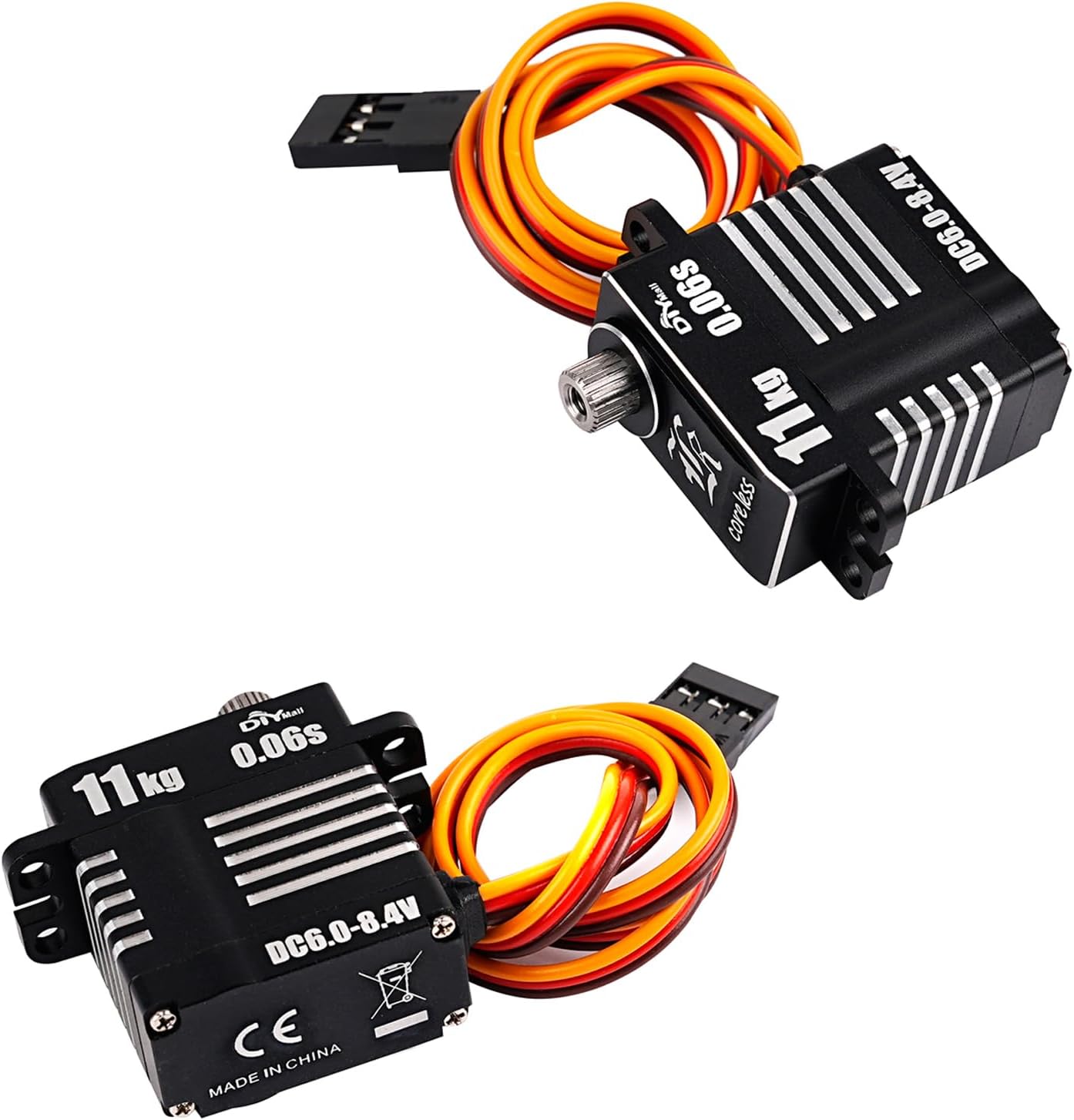
Image: Technical drawing showing the precise dimensions of the DIYmall 11KG Mini All-Metal Digital Servo.
Electrical Specifications:
- Idle Current: <40mA
- Operating Voltage: 4.8V / 6.0V / 7.4V / 8.4V
- No Load Speed:
- 0.11sec/60° (4.8V)
- 0.09sec/60° (6.0V)
- 0.07sec/60° (7.4V)
- 0.06sec/60° (8.4V)
- Running Current:
- 160mA (4.8V)
- 180mA (6.0V)
- 220mA (7.4V)
- 250mA (8.4V)
- Peak Stall Torque:
- 6.5kg.cm (4.8V)
- 8.5kg.cm (6.0V)
- 11.5kg.cm (7.4V)
- 13.5kg.cm (8.4V)
- Stall Current:
- 1600mA ±10% (4.8V)
- 2000mA ±10% (6.0V)
- 2200mA ±10% (7.4V)
- 2500mA ±10% (8.4V)
Control Specifications:
- Command Signal: Pulse Width Modulation (PWM)
- Amplifier Type: Digital controller
- Pulse Width Range: 500µsec to 2500µsec
- Neutral Position: 1500µsec
- Running Degree: 270° ±3° (when 500µsec to 2500µsec)
- Dead Band Width: 3µsec
- Rotating Direction: Counterclockwise (when 1000µsec to 2000µsec)
8. Warranty and Support
For warranty information and technical support, please refer to the DIYmall official website or contact their customer service directly. Keep your purchase receipt as proof of purchase.