
1. Safety Information
Please read all instructions and warnings carefully before installation, operation, or maintenance of the Y&H 4.2KW 24VDC Solar Hybrid Inverter. Failure to follow these instructions may result in electric shock, fire, severe injury, or death. Keep this manual for future reference.
- Installation must be performed by qualified personnel.
- Ensure all power sources are disconnected before performing any wiring or maintenance.
- Do not disassemble the inverter. There are no user-serviceable parts inside.
- Ensure proper grounding of the unit.
- Protect the unit from direct sunlight, rain, snow, and excessive dust.
- Verify correct battery voltage and polarity before connecting.
2. Product Overview
The Y&H 4.2KW 24VDC Solar Hybrid Inverter is an all-in-one solution combining the functions of an inverter, solar charger, and battery charger to provide uninterruptible power support. It features a 120A MPPT charge controller, pure sine wave output, and built-in safety mechanisms like an air switch and lightning protection.
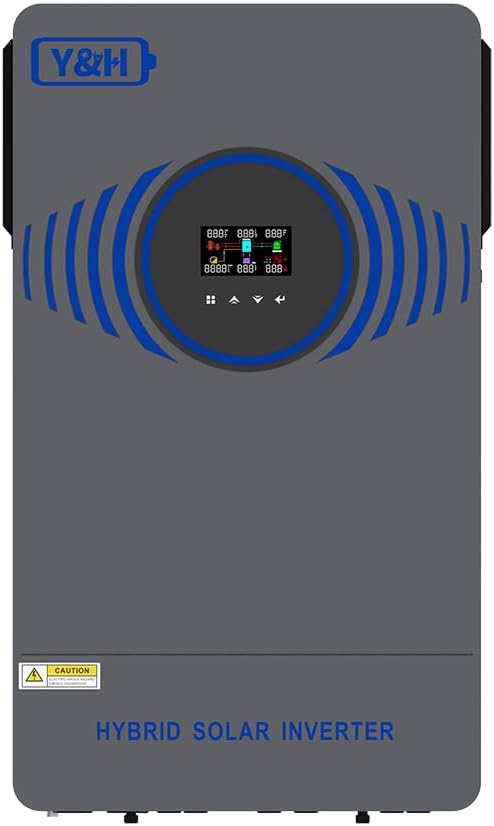
Figure 2.1: Front view of the Y&H 4.2KW 24VDC Solar Hybrid Inverter, showcasing the display and branding.

Figure 2.2: Dimensions of the Y&H 4.2KW 24VDC Solar Hybrid Inverter. The unit measures approximately 70cm (27.56in) in height, 44cm (17.32in) in width, and 23cm (9.06in) in depth.
3. Installation and Setup
3.1 Port Introduction
Familiarize yourself with the various ports and indicators on the inverter for proper connection and operation.

Figure 3.1: Diagram illustrating the various ports and indicators on the Y&H 4.2KW 24VDC Solar Hybrid Inverter, including LCD display, status indicators, function buttons, power switch, AC in switch, surge protector, battery switch, lightning protector, PV in switch, main output, second output, AC input, battery input, PV input, anti-dust kit, cloud communication, RS-232 port, and battery communication RS-485 port.
3.2 Wiring and Technical Specifications
Proper wiring is crucial for the safe and efficient operation of the inverter. Refer to the diagram below for connection details.
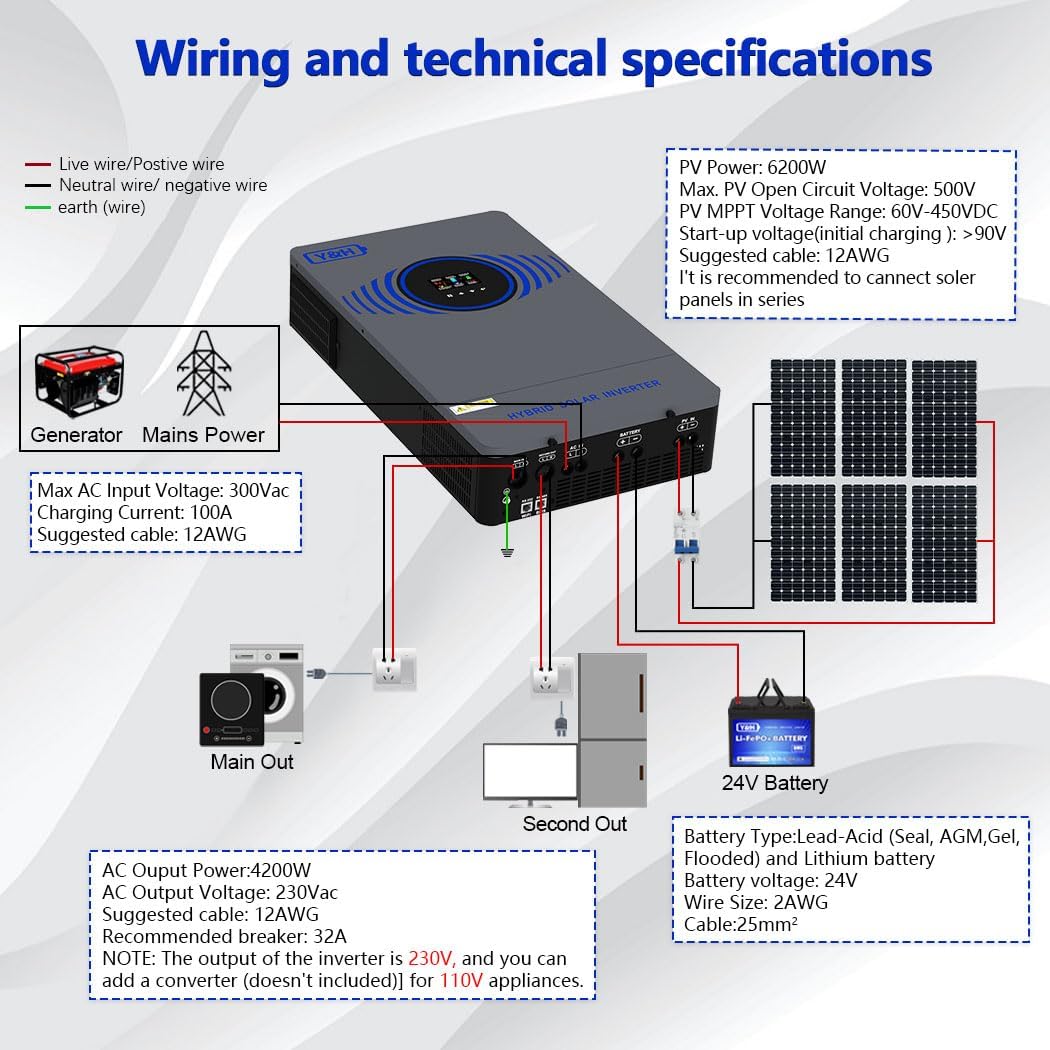
Figure 3.2: Wiring diagram for the Y&H 4.2KW 24VDC Solar Hybrid Inverter, showing connections for solar panels, battery, generator/mains power, and dual AC outputs (Main Out and Second Out). Key specifications include PV power 6200W, Max. PV Open Circuit Voltage 500V, PV MPPT Voltage Range 60-450VDC, AC Output Power 4200W, AC Output Voltage 230Vac, and compatibility with Lead-Acid (Seal, AGM, Gel, Flooded) and Lithium batteries.
- PV Array: Max. PV Array Power: 6200W. Max. PV Open Circuit Voltage: 450Vdc. PV Array MPPT Voltage Range: 60~450Vdc. Starting voltage >90V. Suggested cable: 12AWG. It is recommended to connect solar panels in series.
- Battery Connection: Nominal DC Input Voltage 24V. Max. Charging Current: 120A. Compatible with 24V Lithium/Lead Acid Batteries (Seal, AGM, Gel, Flooded). Wire Size: 2AWG. Cable: 25mm².
- AC Input: Max AC Input Voltage: 300Vac. Charging Current: 100A. Suggested cable: 12AWG. The AC input features a built-in air switch and surge protector for safety and convenience.
- AC Output: AC Output Power: 4200W. AC Output Voltage: 230Vac. Recommended breaker: 32A. Note: The output of the inverter is 230V. A converter (not included) is required for 110V appliances.
- Cold Start Function: The inverter supports cold start function at 23V.
3.3 Battery Management System (BMS) Communication
The inverter supports BMS communication to optimize charging and maximize lithium battery life. It is compatible with PYLON/PACE BMS systems.
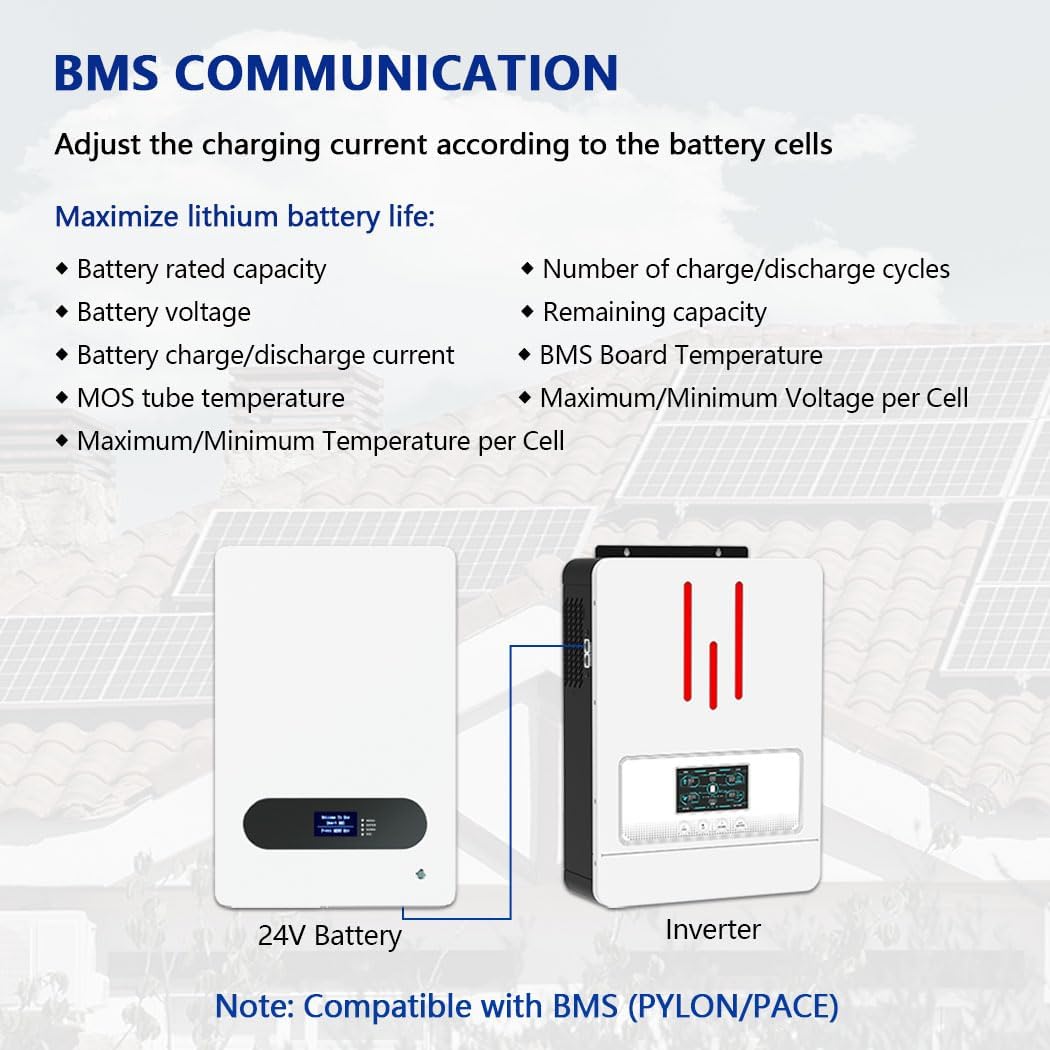
Figure 3.3: Diagram illustrating BMS communication between the inverter and a 24V battery. This communication allows the inverter to adjust charging current based on battery cell data, including rated capacity, voltage, charge/discharge current, MOS tube temperature, number of cycles, remaining capacity, BMS board temperature, and maximum/minimum voltage per cell.

Figure 3.4: Illustration of seamless connection with multiple battery types, including AGM, GEL, FLD, LI (Lithium), and SLD. For Lithium batteries, BMS communication requires PylonTech BMS.
4. Operating Instructions
4.1 Working Modes
The inverter supports both On-grid and Off-grid working modes, providing flexibility for various power needs.
- Off-Grid Mode: The inverter can function as an energy storage device without connection to the utility grid.
- On-Grid Mode: The inverter can be used to reduce household electricity bills by feeding excess solar power back to the grid (where applicable and permitted).
4.2 Charging Modes
The inverter offers three distinct charging modes to optimize battery charging based on available power sources.

Figure 4.1: Diagram illustrating the three charging modes (CSO Solar First, OSO Only Solar, SNU Solar and Utility) and three discharge modes (SBU Solar First, USB Utility First, SBU Priority).
- Solar First (CSO): Prioritizes solar power for charging.
- Solar & Utility (SNU): Uses both solar and utility power for charging.
- Only Solar (OSO): Charges batteries exclusively from solar power.
4.3 Dual Load Output Power
The inverter features dual output ports: a Main OUT and a Second OUT. The operation of these ports is dependent on the battery voltage.
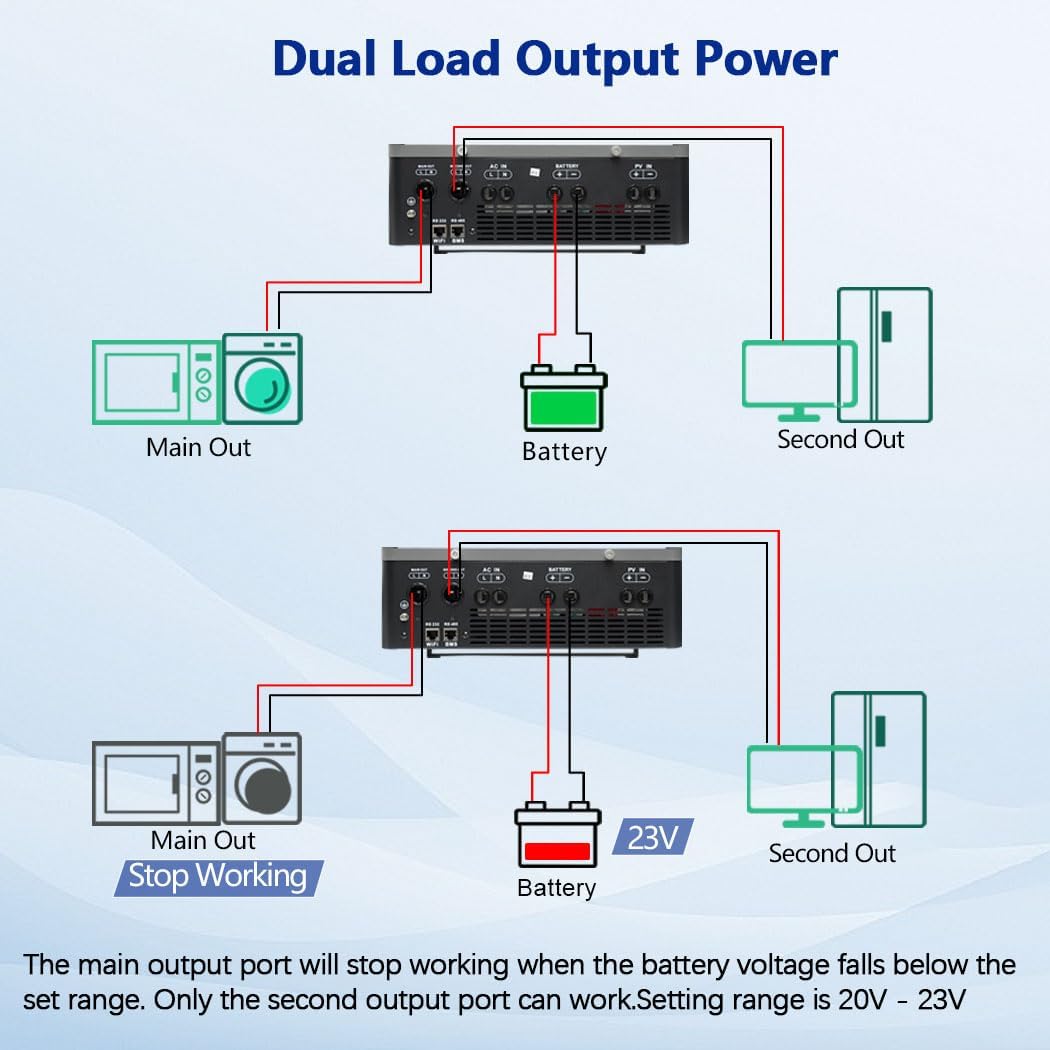
Figure 4.2: Diagram showing the dual load output functionality. When battery voltage is within the set range, both Main Out and Second Out ports are active. If the battery voltage falls below the set range (e.g., 23V), the Main Out port stops working, and only the Second Out port remains active.
- The setting range for the battery voltage is from 20.0V to 23.0V for the 4.2KW model, with an increment of 0.1V per click.
- When the battery voltage falls below the set range, the Main OUT port will stop working. Only the Second OUT port will continue to operate.
- For areas with frequent power outages or loads that cannot be interrupted, you can set the battery voltage to 23V to retain more battery capacity for emergencies. If the battery voltage is higher than 23V, the Main OUT port will continue to work normally.
4.4 Applications
The Y&H Solar Hybrid Inverter is versatile and can power a wide range of household and office loads.

Figure 4.3: Illustration depicting the inverter's ability to power various household appliances, including refrigerators, lamps, televisions, fans, air conditioning, microwaves, washing machines, rice cookers, and kettles.

Figure 4.4: Examples of application scenarios for the inverter, including solar home systems, boats, farms (power supply for outdoor tools), outdoor camping, and RVs.
5. Maintenance
Regular maintenance ensures the longevity and optimal performance of your Y&H Solar Hybrid Inverter.
- Cleaning: Periodically clean the exterior of the inverter with a dry, soft cloth. Do not use liquid cleaners or solvents. Ensure ventilation openings are free from dust and debris.
- Connections: Annually inspect all electrical connections for tightness and signs of corrosion. Loose connections can lead to overheating and poor performance.
- Environment: Ensure the inverter is installed in a well-ventilated area, free from excessive moisture, dust, and direct sunlight. Maintain proper operating temperatures.
- Battery Health: Monitor battery voltage and health regularly, especially if using lead-acid batteries. Follow battery manufacturer's guidelines for maintenance.
6. Troubleshooting
This section provides basic troubleshooting steps for common issues. For more complex problems, contact customer support.
6.1 Common Issues and Solutions
| Problem | Possible Cause | Solution |
|---|---|---|
| Inverter not turning on | No DC input from battery/solar; Battery voltage too low; Power switch off | Check battery connections and voltage; Ensure solar panels are producing power; Turn on power switch. |
| No AC output | Overload; Short circuit; Battery voltage too low (Main OUT); AC output breaker tripped | Reduce load; Check for short circuits; Check battery voltage and settings; Reset AC output breaker. |
| Battery not charging | Solar panels not connected/producing; AC input not present; Charging mode incorrect; Faulty battery | Verify solar panel connection and sunlight; Check AC input connection; Select appropriate charging mode; Test battery. |
| Error code on LCD | Specific system fault | Refer to the inverter's display for the specific error code and consult the full manual (if available) or contact customer support. |
6.2 Comprehensive Protection
The inverter is equipped with multiple protection features to ensure safe operation.

Figure 6.1: Overview of the inverter's comprehensive 360-degree protection, including Short Circuit Protection, Over-Load Protection, Over Current Protection, Backfill Protection, Over Voltage Protection, Over-Temperature Protection, Under Voltage Protection, and Over Charge Protection.
7. Specifications
Detailed technical specifications for the Y&H 4.2KW 24VDC Solar Hybrid Inverter.
| Feature | Specification |
|---|---|
| Model Number | SUN-4.2KW-HV |
| Wattage | 4000W (4.2KW) |
| Nominal DC Input Voltage | 24VDC |
| Max. PV Array Power | 6200W |
| Max. PV Open Circuit Voltage | 450Vdc |
| PV Array MPPT Voltage Range | 60~450Vdc |
| Max. Charging Current | 120A (MPPT) |
| AC Output Voltage | 220V / 230V AC (Pure Sine Wave) |
| Battery Compatibility | 24V Lithium/Lead Acid Batteries (Seal, AGM, Gel, Flooded) |
| Item Weight | 31 pounds |
| Package Dimensions | 27 x 17 x 9 inches |
| Power Source | Solar and Battery Powered |
| Recommended Uses | Home |
8. Warranty and Support
Y&H is committed to providing reliable products and customer satisfaction. For warranty information, technical support, or service inquiries, please refer to the contact information provided with your purchase or visit the official Y&H website.
Y&H has over 9 years of experience in inverter production and sales, backed by a professional technical team and production workshop. Your satisfaction is their top priority.
For additional resources and product information, you may visit the Y&H Store on Amazon.