
PAMBEE Portable Fuel Caddy with Siphon Pump
PAMBEE 15 Gallon Portable Fuel Tank User Manual
Model: Portable Fuel Caddy with Siphon Pump
Introduction
Thank you for choosing the PAMBEE 15 Gallon Portable Fuel Tank. This manual provides essential information for the safe and efficient operation, maintenance, and troubleshooting of your new fuel caddy. Please read this manual thoroughly before use and retain it for future reference.
This portable fuel tank is designed for the safe storage and transfer of gasoline, diesel, kerosene, and light oils. Its robust construction and user-friendly features make it ideal for refueling various vehicles and equipment, including cars, ATVs, lawnmowers, boats, and generators.
Safety Information
WARNING: Flammable Liquids. Read all safety warnings and instructions before use. Failure to follow the warnings and instructions may result in fire, explosion, serious injury, or death.
- Always use in a well-ventilated area, away from ignition sources, open flames, sparks, and heat.
- Do not smoke while handling fuel.
- Wear appropriate personal protective equipment, including gloves and eye protection.
- Ensure all connections are secure and leak-free before and during operation.
- Do not overfill the tank. Leave adequate space for fuel expansion.
- Keep out of reach of children and pets.
- Store the fuel tank in a cool, dry place, away from direct sunlight and extreme temperatures.
- Dispose of fuel and tank according to local regulations.
Product Components
Familiarize yourself with the main components of your PAMBEE Portable Fuel Tank:

Image: Overview of the fuel tank highlighting key components such as the top handle, HDPE material, fuel hose holder, and ball valve.
- Main Tank Body: Constructed from high-density polyethylene (HDPE) for durability and corrosion resistance.
- Fuel Cap: Securely seals the tank opening.
- Top Handle: Integrated handle for easy lifting and maneuvering.
- Wheels: Two 6-inch durable wheels for convenient transport across various terrains.
- Fuel Hose: 10-foot automotive-grade rubber hose for flexible reach.
- Siphon Pump/Nozzle: Manual siphon pump integrated into the nozzle for controlled fuel transfer.
- Hose Holder: Integrated storage for the fuel hose when not in use.
- Brass Shut-off Valves: Two valves (one at the tank, one at the hose) to prevent leaks and ensure safe disconnection.
- Pressure Relief Valve: Copper valve to manage internal tank pressure.
Setup
Before first use, ensure all components are present and undamaged. No complex assembly is required for the main unit.
- Inspect the Tank: Check the tank body, hose, and all connections for any signs of damage or leaks. Do not use if damaged.
- Secure Connections: Ensure the fuel hose is securely connected to the tank's outlet. The brass shut-off valves should be in the closed position until ready for use.
- Ventilation: Always operate and fill the tank in a well-ventilated outdoor area.
Operating Instructions
The PAMBEE fuel tank supports two modes of operation: siphon and gravity-driven refueling.
Refueling Process (Siphon Mode)

Image: Visual instructions for connecting the hose, opening valves, operating the siphon pump, and closing valves.
- Position the Tank: Place the fuel tank on a stable, level surface. For siphon mode, the tank should ideally be at the same level or slightly lower than the receiving tank.
- Connect Hose: Connect the fuel hose to the tank's outlet and ensure it is tightened securely.
- Open Valves: Carefully open the tank valve and the hose valve.
- Open Pressure Relief Valve: Open the copper pressure relief valve counter-clockwise. Be careful when opening it, as it affects the oil discharge speed.
- Initiate Siphon: Insert the nozzle into the receiving fuel tank. Squeeze the handle on the nozzle several times to start the gasoline flow. Once flow begins, continue pressing the handle to maintain the flow.
- Stop Flow: To stop the fuel flow, release the handle.
- Close Valves: After refueling, carefully close the copper pressure relief valve clockwise. Then, close both the tank valve and the hose valve.
- Store Hose: Re-hang the hose on the attached hanger for neat storage.
Gravity Drive Refueling
For gravity-driven refueling, the fuel tank must be positioned higher than the receiving tank. This method allows for a continuous flow without manual pumping.
- Elevate the Tank: Place the fuel tank on a secure, elevated platform or surface, ensuring it is higher than the vehicle or equipment you are refueling.
- Connect Hose: Connect the fuel hose to the tank's outlet and ensure it is tightened securely.
- Open Valves: Carefully open the tank valve and the hose valve.
- Open Pressure Relief Valve: Open the copper pressure relief valve counter-clockwise.
- Start Flow: Insert the nozzle into the receiving fuel tank. Fuel will begin to flow due to gravity.
- Monitor Flow: Continuously monitor the refueling process to prevent overfilling.
- Stop Flow: To stop the fuel flow, release the handle on the nozzle.
- Close Valves: After refueling, carefully close the copper pressure relief valve clockwise. Then, close both the tank valve and the hose valve.
- Store Hose: Re-hang the hose on the attached hanger.

Image: The 15-gallon fuel tank positioned for refueling a car, demonstrating its large capacity and ease of use.
Maintenance
Regular maintenance ensures the longevity and safe operation of your fuel tank.
- Cleaning: Clean the exterior of the tank with a damp cloth. Do not use harsh chemicals that may damage the HDPE material.
- Hose Inspection: Periodically inspect the fuel hose for cracks, kinks, or wear. Replace if any damage is observed.
- Valve Check: Ensure the brass shut-off valves operate smoothly and seal completely.
- Storage: When not in use, store the tank in a cool, dry, well-ventilated area, away from direct sunlight and extreme temperatures. Ensure the tank is empty or properly sealed to prevent vapor release.
- Emptying for Storage: If storing for an extended period, it is recommended to empty the tank of fuel to prevent degradation of fuel or tank material.
Troubleshooting
| Problem | Possible Cause | Solution |
|---|---|---|
| No fuel flow in siphon mode. |
|
|
| Slow fuel flow. |
|
|
| Fuel leak from connections. |
|
|
| Difficulty moving the tank. |
|
|
Specifications
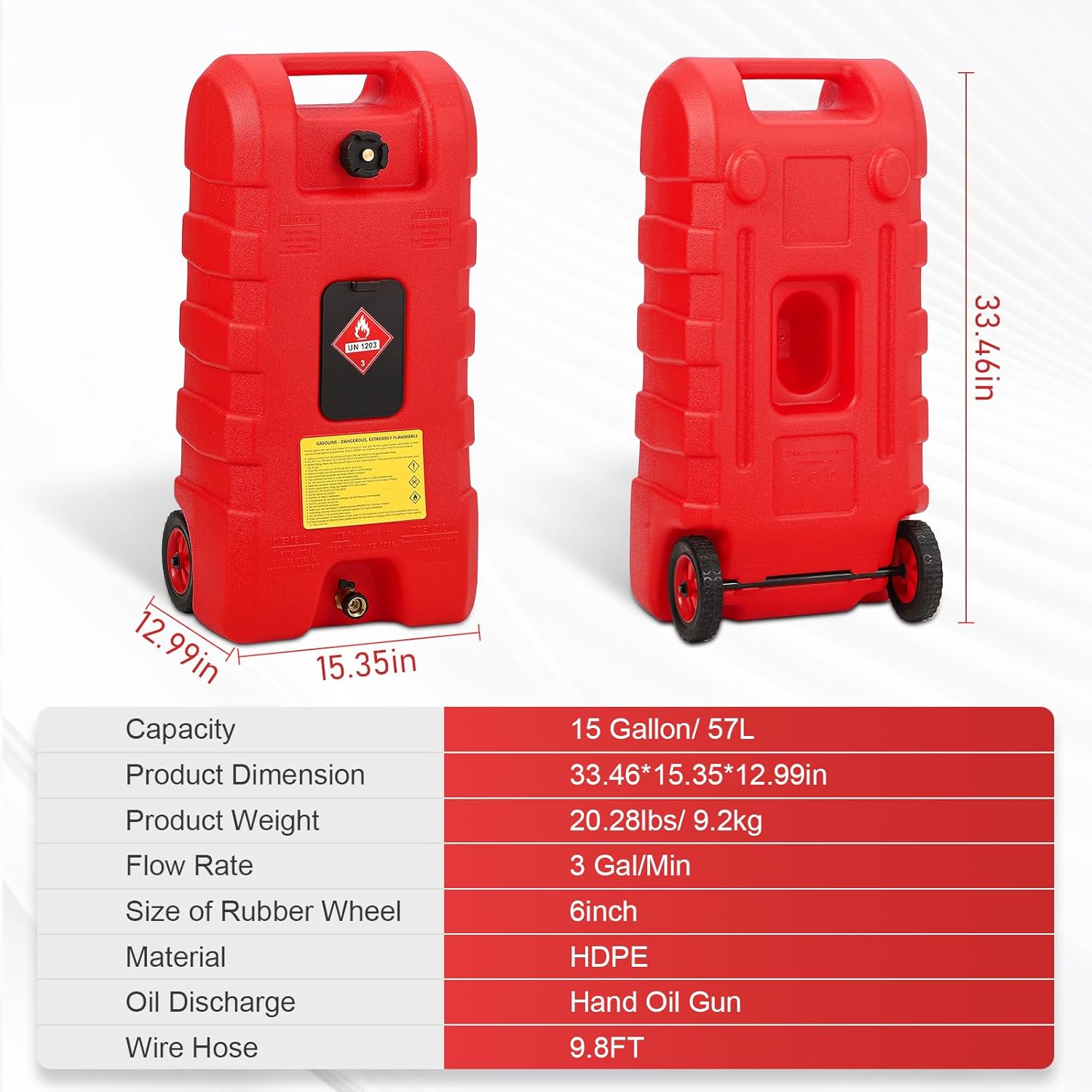
Image: Detailed product specifications and dimensions of the PAMBEE 15 Gallon Portable Fuel Tank.
| Feature | Detail |
|---|---|
| Capacity | 15 Gallons / 57 Liters |
| Product Dimensions (L x W x H) | 16.14 x 16.14 x 34 inches (approx. 33.46"H x 15.35"W x 12.99"D) |
| Item Weight | 23.1 pounds (9.2 kg) |
| Material | High Density Polyethylene (HDPE) |
| Flow Rate (Siphon Mode) | Up to 3 Gallons per Minute |
| Wheel Size | 6 inches |
| Hose Length | 10 feet (approx. 9.8 feet) |
| Oil Discharge Method | Hand Oil Gun (Siphon Pump) |
Warranty and Support
For warranty information or technical support, please contact PAMBEE customer service through the retailer where the product was purchased or visit the official PAMBEE website. Please have your purchase receipt and product model information ready when contacting support.
PAMBEE is committed to providing high-quality products and customer satisfaction. If you encounter any issues not covered in this manual, please do not hesitate to reach out for assistance.
Ask a question about this manual
Ask about setup, troubleshooting, compatibility, parts, safety, or missing instructions. Manuals+ will review the question and use this page’s manual context to help answer it.