
1. Introduction
This manual provides detailed instructions for the safe and effective operation and maintenance of your SPECSTAR 1/3 HP 5 CFM 1-Stage HVAC Vacuum Pump and 4 Way AC Manifold Gauge Set with Leak Detector. This kit is designed for automotive and residential air conditioning and refrigeration systems, compatible with refrigerants such as R134a, R12, R22, R502, and R410a.
Video: Overview of the SPECSTAR 5 CFM Single Stage HVAC Air Vacuum Pump, highlighting its features and components.
2. Safety Information
Always observe basic safety precautions when using this product to reduce the risk of fire, electric shock, or personal injury.
- Wear appropriate personal protective equipment, including safety glasses and gloves, when handling refrigerants or operating the pump.
- Ensure adequate ventilation in the work area to prevent the accumulation of refrigerant vapors.
- Do not operate the vacuum pump in wet conditions or expose it to rain.
- Verify that the power supply matches the pump's requirements (110V/60Hz).
- The vacuum pump features a thermally protected motor that shuts down if it overheats. Allow it to cool before resuming operation.
- An anti-backflow valve prevents oil backflow into the system during sudden shutdowns.
- Keep children and bystanders away from the work area.
3. What's in the Box
The following items are included in your SPECSTAR HVAC Vacuum Pump and AC Manifold Gauge Set kit:
- 1 × 5 CFM Vacuum Pump
- 1 × ±1.6% Accuracy Manifold Gauge
- 1 × 5 FT High Strength 4-Color Hoses (Red, Blue, Yellow, Black)
- 1 × Leak Detector
- 1 × 0.35 qt/330 ml Bottle of Vacuum Pump Oil
- 2 × R410a Fitting Adapters (1/4” male to 5/16” female)
- 1 × Fitting Adapter (1/4” male to 1/2” female)
- 1 × R134a Self Sealing Can Tap
- 1 × R134a Puncture Can Tap
- 2 × Quick Coupler Adapter
- A Pair of Gloves
- 1 × Screwdriver
- 1 × Valve Core Tool
- 3 × Top Pins
- 4 × Sealing Gasket
- 1 × PTFE Tape
- 4 × O-ring
4. Specifications
| Feature | Specification |
|---|---|
| Model | VH1693 |
| Flow Rate (FAD) | 5 CFM (142 L/min) |
| Motor Power | 1/3 HP (250 W) |
| Ultimate Partial Vacuum | 2 Pa |
| Ultimate Total Vacuum | 150 Microns |
| Duty Cycle | 30-40 min |
| Voltage/Frequency | 110V/60 Hz |
| Intake Fitting | 1/4" SAE male and 1/2" ACME male |
| Manifold Gauge Accuracy | ±1.6% |
| Hose Working Pressure | 800 psi |
| Hose Burst Pressure | 4000 psi |
| Compatible Refrigerants | R134a, R12, R22, R502, R410a |
| Dimensions | 12 x 4.8 x 9.1 inches |
| Item Weight | 26.2 pounds |
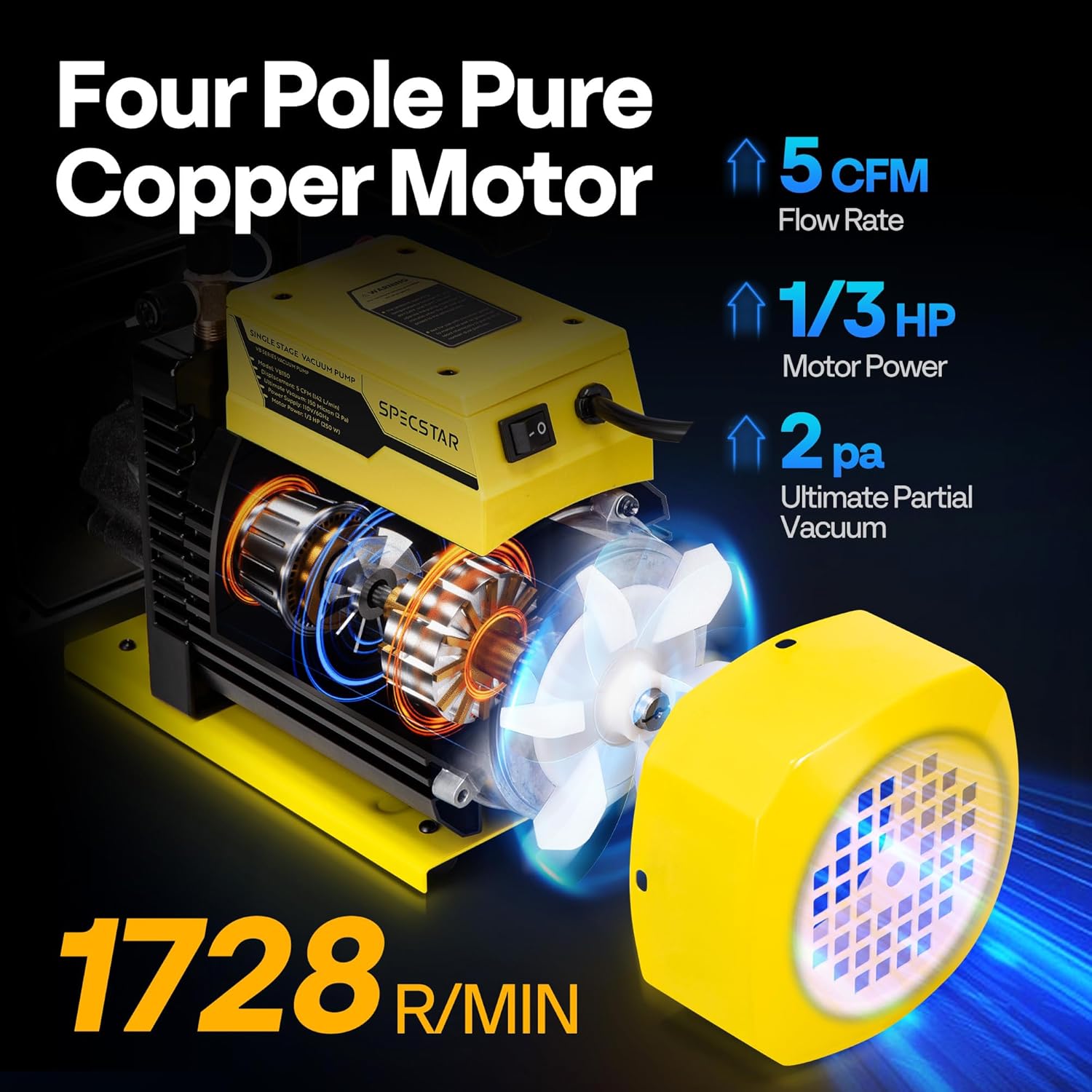
Image: Detailed specifications and dimensions of the SPECSTAR Vacuum Pump and Manifold Gauge Kit.
5. Setup
5.1. Vacuum Pump Oil Filling
- Remove the oil mist trap from the vacuum pump.
- Add the provided vacuum pump oil until the oil level reaches the middle of the sight glass. The optimal oil quantity is between 275 ml (MIN) and 330 ml (MAX).
- Reinstall the oil mist trap securely.

Image: Illustration of the vacuum pump's oil-filling ports and exhaust port with a built-in cotton filter.

Image: The transparent oil window and bottom drain valve on the vacuum pump for easy oil level monitoring and maintenance.
5.2. Manifold Gauge and Hose Connection
- Hang the manifold gauge set using its convenient hook.
- Remove the dust caps from the manifold ports.
- Connect the 4-color hoses to the manifold body: blue to the low-pressure port, black to the vacuuming port, yellow to the refrigeration port, and red to the high-pressure port.
- Connect the blue and red quick couplers to their matching gauge hoses. Turn the quick coupler knobs counterclockwise to close them.

Image: The high-precision manifold gauge with ±1.6% accuracy, featuring dual unit display for low and high pressure.

Image: The four color-coded high-strength hoses, featuring three reinforced nylon barriers for durability and leak-proof sealing.
6. Operating Instructions
Video: Comprehensive guide on using the SPECSTAR Vacuum Pump Kit for automotive and HVAC AC system maintenance, including vacuuming, charging, and leak detection.
6.1. Automotive AC System Vacuuming and Charging
- Connect Hoses: Connect the blue quick coupler to the low side of the auto A/C system and the red quick coupler to the high side. Connect the black hose from the manifold gauge to the vacuum pump inlet port.
- Prepare Refrigerant Can: Turn the can tap counterclockwise to retract the pin. Connect the refrigerant can to the can tap, then connect the yellow hose from the manifold gauge to the can tap.
- Open Valves: Turn the red and blue quick coupler knobs clockwise to open. Open the red, yellow, black, and blue valves on the manifold gauge set.
- Vacuuming: Switch on the vacuum pump. When the pressure reaches -1 bar, continue vacuuming for 10-15 minutes to ensure thorough evacuation.
- Leak Check: After vacuuming, turn the blue, black, yellow, and red valves clockwise to close. Disconnect the yellow hose from the vacuum pump to prevent backflow, then switch off the vacuum pump. Maintain pressure for 5-10 minutes. Watch the low-pressure gauge; if the needle stays still, there is no leak.
- Charge Refrigerant: Turn the can tap clockwise to pierce the refrigerant can. Loosen the valve at the yellow hose port and press the valve core repeatedly to purge air from the hose. Turn the yellow and blue valves counterclockwise to open. Turn on the A/C in cooling mode. Charge refrigerant to the amount specified on the A/C nameplate.
- Completion: Turn the yellow and blue valves clockwise to close. Turn the can tap counterclockwise to close. Turn red and blue quick couplers counterclockwise to close and remove. Charging is complete.
6.2. HVAC Unit Vacuuming and Charging
- Connect Hoses: Connect the blue hose to the A/C low-pressure port (a 1/4" SAE to 5/16" SAE adapter is required for R410a systems). Connect the black hose from the manifold gauge to the vacuum pump inlet port. Connect the yellow hose to the refrigerant cylinder liquid (red) port. Place the refrigerant cylinder on an electronic scale.
- Open Valves: Turn the blue, black, and yellow valves counterclockwise to open. Turn the red valve clockwise to close.
- Vacuuming: Switch on the vacuum pump. When the pressure reaches -1 bar, continue vacuuming for 10-15 minutes.
- Leak Check: After vacuuming, turn the yellow, blue, and black valves clockwise to close. Disconnect the yellow hose from the vacuum pump to prevent backflow, then switch off the vacuum pump. Maintain pressure for 5-10 minutes. If the needle stays still, there is no leak.
- Charge Refrigerant: Open the cylinder liquid valve. Press the valve core repeatedly to fully purge air from the hose. Zero the electronic scale. Turn the blue and yellow valves counterclockwise to open. Turn on the A/C in cooling mode. Monitor the scale and charge refrigerant until the weight matches the A/C label.
- Completion: Turn the blue and yellow valves clockwise to close. Turn the cylinder valve clockwise to close. Quickly remove the blue hose from the low side of the outdoor unit. Charging is complete.
6.3. Using the Leak Detector
The included leak detector is ultra-sensitive for quick refrigerant leak detection.
- Turn the sensitivity knob to a suitable degree.
- Detection begins six seconds after turning on the detector.
- Move the probe slowly around potential leak points. The buzzer will escalate in frequency and the 2-color indicator light will change when a leak is detected.
- To pinpoint the leak, turn the sensitivity knob to '0' to stop the buzzer.

Image: The VIVOHOME Leak Detector, featuring adjustable sensitivity and a 2-color indicator light for detecting refrigerant leaks.
7. Maintenance
7.1. Oil Level Check and Replacement
Regularly check the oil level in the vacuum pump using the transparent oil window. Ensure the oil level is between the MIN and MAX marks. If the oil appears cloudy or discolored, it should be replaced. To replace the oil, drain the old oil using the bottom drain valve and refill with new vacuum pump oil as described in the Setup section.
7.2. Cleaning
Keep the vacuum pump and manifold gauge set clean and free from dust and debris. Wipe down surfaces with a dry cloth. Ensure the exhaust filter is clear to maintain optimal performance.
8. Troubleshooting
8.1. Leak Detector Issues (Insensitive, False Alarms, or Malfunction)
If your VIVOHOME Leak Detector exhibits insensitivity, false alarms, or general malfunction, consider the following:
- Cause: Improper operation or failure to install four batteries.
- Recommendation: Check if all batteries are properly installed. Replace the batteries if they are low on power.
- Cause: Insufficient power or aging of the detection head.
- Recommendation: Replace the batteries. After turning on the detector in a well-ventilated environment for a few minutes, repeatedly confirm leak points using both low and high sensitivity settings.
- General Recommendation: Do not rely solely on one tool. Use a combination of methods such as listening, smelling, and adding soapy solution to determine if there is a leak.
Video: Troubleshooting common issues with the VIVOHOME Leak Detector, including insensitivity, false alarms, and general malfunction.
9. Warranty and Support
For warranty information, technical support, or service inquiries, please refer to the contact information provided with your product packaging or visit the official SPECSTAR website. Keep your purchase receipt as proof of purchase for any warranty claims.