
urge medical Foldable Electric Wheelchair B0DMN3ZWPC
urge medical Foldable Electric Wheelchair User Manual
Model: B0DMN3ZWPC
1. Introduction
This manual provides essential information for the safe and effective operation, maintenance, and care of your urge medical Foldable Electric Wheelchair. Please read this manual thoroughly before using the wheelchair to ensure proper function and to prevent injury or damage. Retain this manual for future reference.
The urge medical Foldable Electric Wheelchair is designed to provide mobility assistance for individuals requiring support for movement. It features a powerful motor, long-range battery, and a foldable design for portability.
2. Safety Guidelines
WARNING: Failure to follow these safety instructions may result in serious injury or damage to the wheelchair.
- Always ensure the wheelchair is fully unfolded and locked into position before use.
- Do not exceed the maximum weight capacity of 330 lbs (150 kg).
- Operate the wheelchair on stable, level surfaces whenever possible. Exercise extreme caution on uneven terrain, inclines, or declines. The maximum climbing angle is 13 degrees.
- Always use the seat belt provided.
- Keep hands and clothing clear of moving parts, especially wheels and motors.
- Do not operate the wheelchair under the influence of alcohol or medication that may impair your judgment or ability to operate the device safely.
- Ensure the battery is fully charged before extended use.
- Avoid exposing the wheelchair to extreme temperatures or moisture.
- Regularly inspect the tires, brakes, and all moving parts for wear or damage.
3. Product Components
Familiarize yourself with the various parts of your electric wheelchair.

Figure 3.1: Wheelchair Components Overview
This image displays the key components of the electric wheelchair, including the push handles, storage bag with glow-in-the-dark strip, nursing brake, 250W*2 motors (one on each side), 6A*2 batteries (one on each side), and anti-roll wheels.
- Intelligent Controller: Joystick for directional control and speed adjustment.
- Push Handles: For manual assistance or pushing the wheelchair.
- Storage Bag: Located on the backrest, includes a glow-in-the-dark strip for visibility.
- Nursing Brake: Manual brake for attendants.
- Motors: Dual 250W motors provide power to the rear wheels.
- Batteries: Two 12V batteries (6A each) provide power for operation.
- Anti-Roll Wheels: Small wheels at the rear to prevent tipping backward.
- Footrests: Adjustable platforms for foot support.
- Detachable Breathable Cushion: Provides comfort and is removable for cleaning.
4. Assembly and Setup
The wheelchair typically arrives partially assembled. Follow these steps for initial setup.
4.1 Unfolding the Wheelchair
- Place the folded wheelchair on a flat, stable surface.
- Gently pull the backrest upwards while simultaneously pushing the armrests outwards until the frame locks into place.
- Ensure all locking mechanisms are securely engaged before use.

Figure 4.1: Unfolded and Folded Wheelchair
This image illustrates the wheelchair in its operational, unfolded state and its compact, folded state for transport or storage.
4.2 Battery Installation
The wheelchair requires two 12V batteries. Ensure they are correctly installed and connected.
- Locate the battery compartments, typically under the seat or on the sides of the frame.
- Insert the batteries, ensuring correct polarity (+/-).
- Connect the battery cables securely.
5. Operating Instructions
5.1 Power On/Off
Locate the power button on the intelligent controller. Press and hold to turn the wheelchair on or off.
5.2 Joystick Control
The joystick controls the direction and speed of the wheelchair.
- Forward: Push the joystick forward.
- Backward: Pull the joystick backward.
- Left/Right: Push the joystick left or right.
- The further you push the joystick, the faster the wheelchair will move, up to a maximum speed of 4 mph.
5.3 Speed Adjustment
Use the speed control buttons on the intelligent controller to adjust the maximum speed setting. Start at a low speed and gradually increase as you become comfortable.
5.4 Braking System
The wheelchair features an intelligent electromagnetic braking system and a manual nursing brake.
- Electromagnetic Brake: When the joystick is released, the electromagnetic brake automatically engages, bringing the wheelchair to a smooth and safe stop. This system prevents the wheelchair from rolling on inclines or declines when stationary.
- Manual Nursing Brake: For attendants, a manual brake is available on the push handles for additional control.

Figure 5.1: Electromagnetic Braking and Climbing Capability
This image illustrates the electromagnetic braking system, which stops the wheelchair smoothly when the joystick is released. It also shows the wheelchair's ability to climb inclines up to 12 degrees.

Figure 5.2: Automatic Braking
This image depicts a user releasing the joystick, which activates the automatic braking system, ensuring a safe stop.
5.5 Electric vs. Manual Mode
The wheelchair can be operated in two modes:
- Electric Mode: Engaged when the power is on and the joystick is used.
- Manual Mode: To use the wheelchair as a traditional manual wheelchair, turn off the power. This disengages the motors, allowing an attendant to push the wheelchair.
6. Folding and Transport
The wheelchair is designed for quick and easy folding for transport and storage.
- Ensure the wheelchair is powered off.
- Remove any items from the storage bag.
- Follow the reverse steps of unfolding, typically by pulling a release lever and pushing the armrests inwards while lowering the backrest.
- Once folded, the wheelchair can stand independently for easy storage.
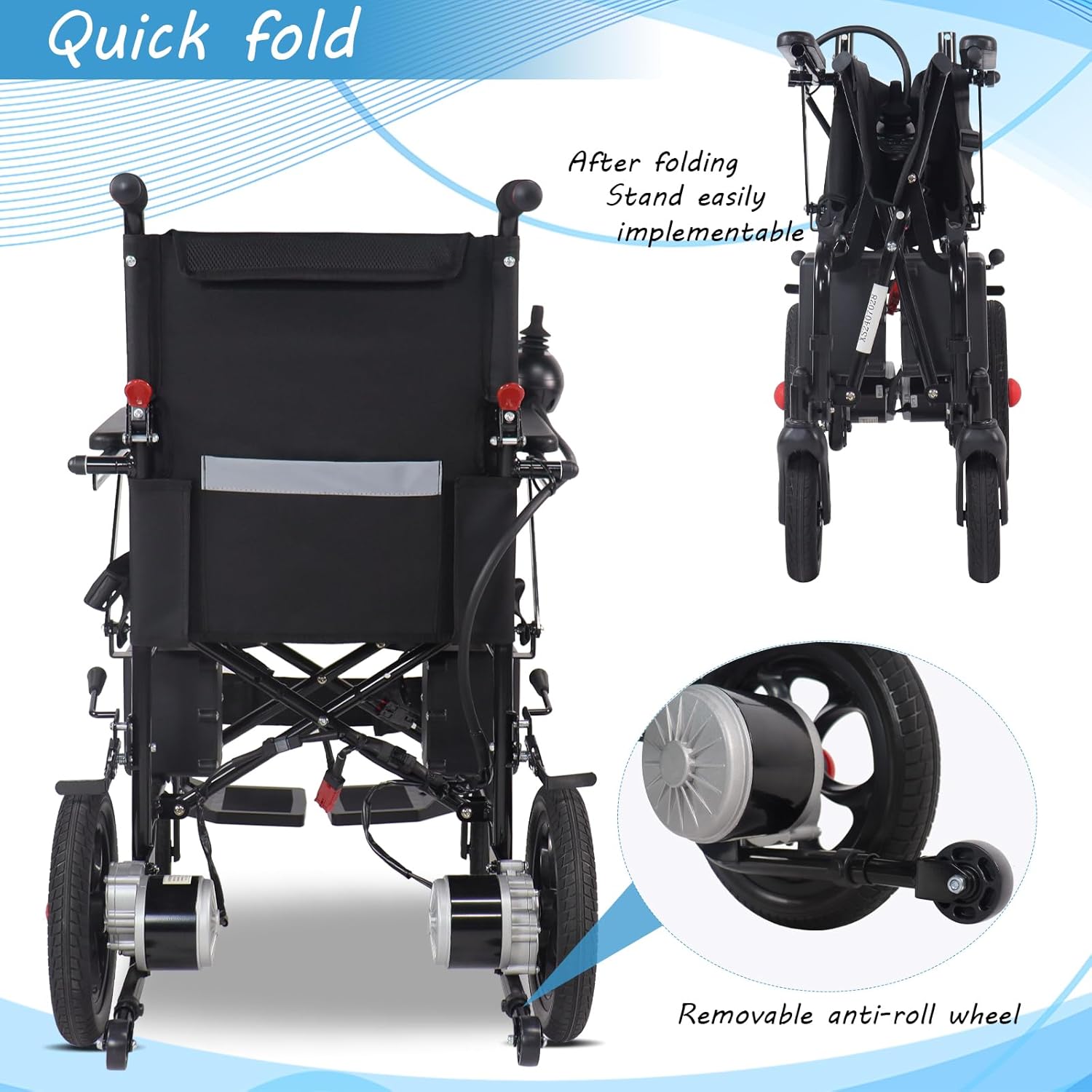
Figure 6.1: Quick Fold Feature
This image demonstrates the quick fold capability of the wheelchair, allowing it to stand easily after folding. It also highlights the removable anti-roll wheel.

Figure 6.2: Transporting the Folded Wheelchair
This image shows a user easily pushing the wheelchair in its folded state and carrying it, demonstrating its portability.
7. Battery Management
7.1 Charging the Batteries
The wheelchair is equipped with two 12V batteries. To charge:
- Ensure the wheelchair is powered off.
- Connect the charger to the charging port on the wheelchair.
- Plug the charger into a standard electrical outlet.
- Monitor the charging indicator lights on the charger. Disconnect once fully charged.
A full charge provides a range of up to 12-15 miles, depending on terrain and user weight.
7.2 Battery Care
- Avoid completely draining the batteries before recharging.
- Store the wheelchair and batteries in a cool, dry place.
- If storing for an extended period, charge the batteries periodically (e.g., once a month) to maintain their lifespan.
8. Maintenance and Care
8.1 Cleaning
- Wipe down the frame with a damp cloth and mild detergent.
- The detachable cushion can be removed for cleaning according to its care label.
- Avoid spraying water directly onto electrical components.
8.2 Regular Inspection
- Check tire pressure regularly (for pneumatic front wheels).
- Inspect all nuts, bolts, and fasteners for tightness.
- Examine electrical cables for any signs of wear or damage.
- Ensure the brakes are functioning correctly.
- Lubricate moving parts as recommended by a qualified technician.
9. Troubleshooting
This section addresses common issues you might encounter.
| Problem | Possible Cause | Solution |
|---|---|---|
| Wheelchair does not power on. | Battery not charged or connected; Power button not pressed correctly. | Ensure batteries are fully charged and properly connected. Press and hold the power button firmly. |
| Wheelchair moves slowly or inconsistently. | Low battery charge; Speed setting too low; Obstruction in wheels. | Charge batteries. Increase speed setting on the controller. Check wheels for obstructions. |
| Brakes are not engaging or releasing properly. | Joystick not fully released; Brake mechanism issue. | Ensure joystick is in neutral position. If issue persists, contact support. |
| Wheelchair makes unusual noises. | Loose components; Motor issue; Obstruction. | Inspect for loose parts. Check for obstructions. If noise continues, seek professional assistance. |
10. Technical Specifications
Detailed specifications for the urge medical Foldable Electric Wheelchair.

Figure 10.1: Wheelchair Dimensions and Weight
This image provides a visual representation of the wheelchair's dimensions when unfolded and folded, along with key weight specifications.
| Feature | Specification |
|---|---|
| Brand | urge medical |
| Model | B0DMN3ZWPC |
| Motor Power | 500W (Dual 250W motors) |
| Battery Type | 2 x 12V batteries (included) |
| Max Range | Up to 12-15 miles |
| Max Speed | 4 mph |
| Max Climbing Angle | 13 degrees |
| Weight Capacity | 330 lbs (150 kg) |
| Net Weight | 70.5 lbs (32 kg) |
| Front Wheel Size | 7 inches (pneumatic) |
| Rear Wheel Size | 12 inches (pneumatic) |
| Seat Width | 17 inches |
| Material | Carbon Steel |
| Unfolded Dimensions | 38 x 37 x 17 inches (approx.) |
| Folded Dimensions | 32 x 28 x 14 inches (approx.) |
11. Warranty and Support
For warranty information, please refer to the documentation provided at the time of purchase or contact urge medical customer service. For technical support or assistance with your wheelchair, please reach out to the manufacturer's customer service department.
Ask a question about this manual
Ask about setup, troubleshooting, compatibility, parts, safety, or missing instructions. Manuals+ will review the question and use this page’s manual context to help answer it.