
1. Introduction
This manual provides essential information for the safe and efficient operation of your Oasesenergy 24V 200Ah LiFePO4 Lithium Battery. Please read this manual thoroughly before installation and use to ensure optimal performance and longevity of the battery. This battery is designed for various applications including solar energy systems, RVs, campers, trolling motors, and marine use.
2. Safety Instructions
Always observe the following safety precautions to prevent injury or damage to the battery and connected equipment.
- Do not short-circuit the battery terminals.
- Do not expose the battery to fire, high temperatures, or direct sunlight.
- Do not immerse the battery in water or other liquids.
- Do not disassemble, puncture, or modify the battery.
- Use only compatible chargers designed for LiFePO4 batteries.
- Ensure proper ventilation during charging and discharging.
- Keep the battery away from children and pets.
- Wear appropriate personal protective equipment (PPE) such as gloves and eye protection when handling the battery.
- In case of fire, use a Class D fire extinguisher. Water can exacerbate a lithium battery fire.
3. Product Features
- High Performance LiFePO4 Cells: Built with Grade-A prismatic 205Ah LiFePO4 cells, offering higher energy density, increased power, enhanced stability, and superior safety compared to traditional batteries.
- Extended Lifespan: Provides more than 10 times the lifespan of comparable SLA batteries, with 4000-15000 cycles.
- Lightweight Design: Weighs approximately 1/3 of a comparable lead-acid battery, simplifying handling and transport.
- Smart 200A BMS Protection: Equipped with a Battery Management System (BMS) that ensures consistent and long-lasting performance. Includes integrated high and low-temperature protection to prevent irreversible damage.
- Wide Operating Temperature Range: Supports operation from -4°F (-20°C) to 140°F (60°C) and charging from 32°F (0°C) to 113°F (45°C).
- Bluetooth APP Monitoring: Features a built-in Bluetooth module for real-time monitoring of battery data (SOC, voltage, current, temperature) via a mobile application within a 5-10 meter range.
- DIY Capacity Expansion: Supports both parallel and series connections for increased capacity and voltage. Can be connected up to 4 in parallel and 2 in series (4P2S) to achieve a 48V (51.2V) 820Ah battery bank, providing a maximum of 41.98 kWh energy.
- Versatile Applications: Ideal for RV travel, camping, motor and marine towboats, emergency power supply, and off-grid solar home systems.
4. Specifications
| Parameter | Value |
|---|---|
| Nominal Voltage | 25.6V |
| Nominal Capacity | 200Ah (205Ah cells) |
| Energy | 5248Wh |
| Max. Load Power | 5120W |
| BMS | 200A |
| Terminal Type | M8 |
| Operating Temperature (Discharge) | -4°F to 140°F (-20°C to 60°C) |
| Operating Temperature (Charge) | 32°F to 113°F (0°C to 45°C) |
| Dimensions (L x W x H) | 523mm x 269mm x 222mm (approx.) |
| Weight | 40KG (approx.) |
| Cycle Life | 4000-15000 cycles |

Image: Oasesenergy 25.6V 200Ah LiFePO4 Battery showing key specifications like Max. Energy (5248Wh), BMS (200A), Max. Load Power (5120Wh), dimensions (523mm x 269mm x 222mm), weight (40KG), and M8 terminal specifications.
5. Setup and Installation
5.1 Unpacking and Initial Inspection
Carefully remove the battery from its packaging. Inspect the battery for any visible damage. If damage is found, contact customer support immediately and do not attempt to use the battery.
5.2 Connection
The Oasesenergy 24V 200Ah LiFePO4 battery uses M8 terminals. Ensure all connections are secure and properly tightened to prevent arcing and ensure efficient power transfer.
- Single Battery Connection: Connect the positive (+) terminal of the battery to the positive input of your load/charger and the negative (-) terminal to the negative input.
- Parallel Connection (for increased capacity): Connect positive terminals together and negative terminals together. Ensure all batteries are at a similar state of charge before connecting in parallel.
- Series Connection (for increased voltage): Connect the positive terminal of one battery to the negative terminal of the next. For a 48V system, connect two 24V batteries in series. Ensure all batteries are of the same model and capacity.
When connecting batteries in series and parallel, it is crucial to follow the manufacturer's guidelines for maximum configurations (e.g., 4P2S for 48V 820Ah). Incorrect wiring can lead to severe damage or safety hazards.
5.3 Mounting
Mount the battery in a stable, dry, and well-ventilated area. Ensure it is secured to prevent movement or vibration, especially in mobile applications like RVs or boats. Avoid mounting in direct sunlight or areas prone to extreme temperatures.
6. Operating Instructions
6.1 Charging
Use a LiFePO4 compatible charger with appropriate voltage and current settings. The recommended charging temperature range is 32°F (0°C) to 113°F (45°C). The integrated BMS will protect the battery from charging outside this range.
6.2 Discharging
The battery can be discharged within the temperature range of -4°F (-20°C) to 140°F (60°C). The 200A BMS provides protection against over-discharge, overcurrent, and short circuits.

Image: Internal view of the Oasesenergy LiFePO4 battery highlighting Grade A cells and the 200A Smart BMS, which provides Overcharge, Overdischarge, Overcurrent, Short Circuit, and High Temperature Protection.
6.3 Bluetooth APP Monitoring
Download the Oasesenergy Bluetooth application to your smartphone. Connect to the battery via Bluetooth to monitor real-time data such as State of Charge (SOC), voltage, current, and temperature. This feature allows for convenient monitoring within a 5-10 meter range.
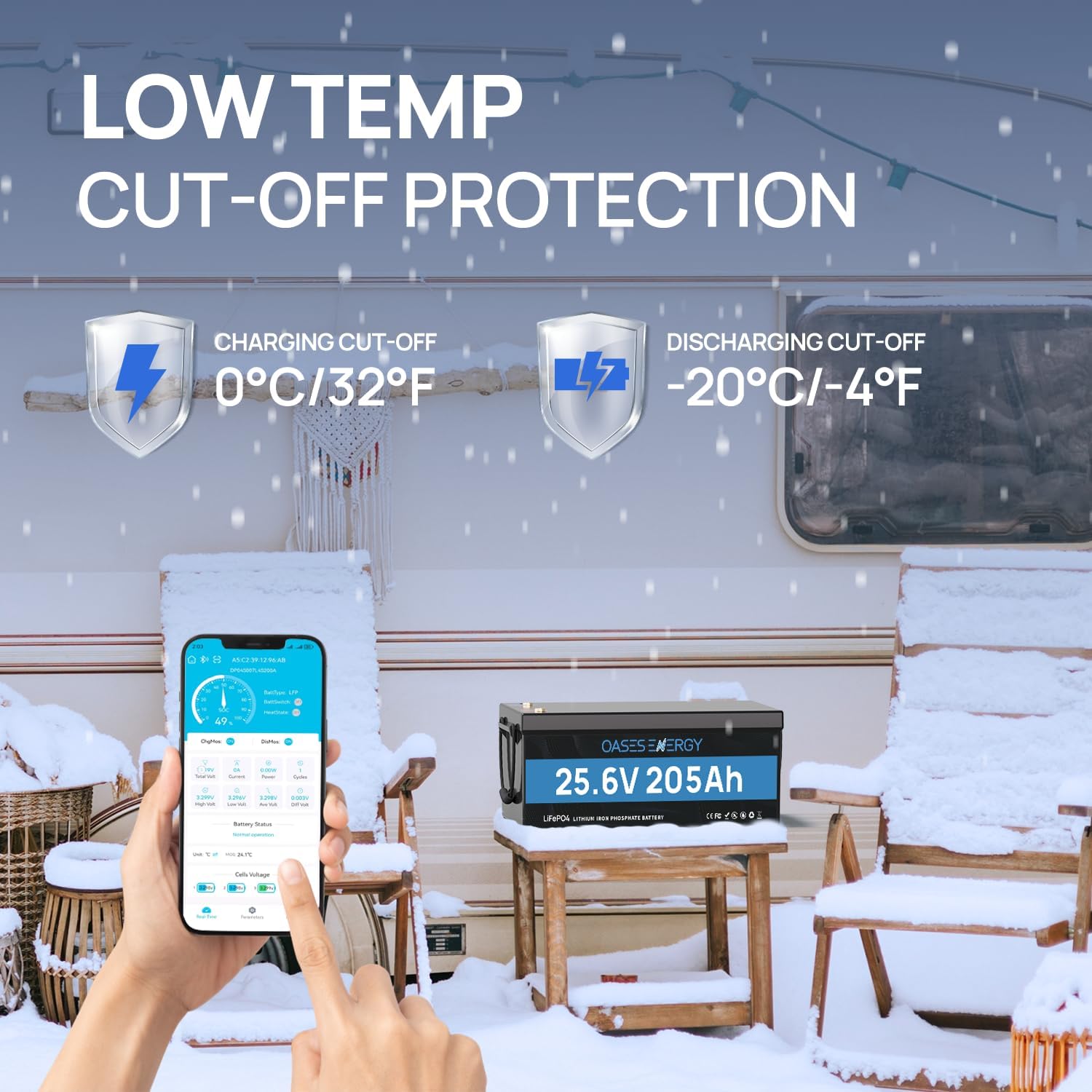
Image: Oasesenergy LiFePO4 battery demonstrating low temperature cut-off protection, with charging cut-off at 0°C/32°F and discharging cut-off at -20°C/-4°F. A smartphone screen shows the Bluetooth app monitoring battery status.
6.4 Typical Applications
The Oasesenergy 24V 200Ah LiFePO4 battery is suitable for a wide range of applications:
- RV & Camping: Powering appliances and electronics in recreational vehicles and during outdoor camping trips.
- Marine: Ideal for trolling motors and other marine electrical needs.
- Solar Systems: Efficient energy storage for off-grid and grid-tied solar installations.
- Home Use: Backup power for essential home appliances like coffee makers, refrigerators, heaters, and air conditioners.

Image: Oasesenergy LiFePO4 battery shown in a home setting, illustrating its capability to power appliances such as a coffee maker (800W for 6.4H), refrigerator (200W for 25.6H), heater (3000W for 1.7H), and air conditioner (1500W for 3.4H), with a max energy output of 5120Wh.
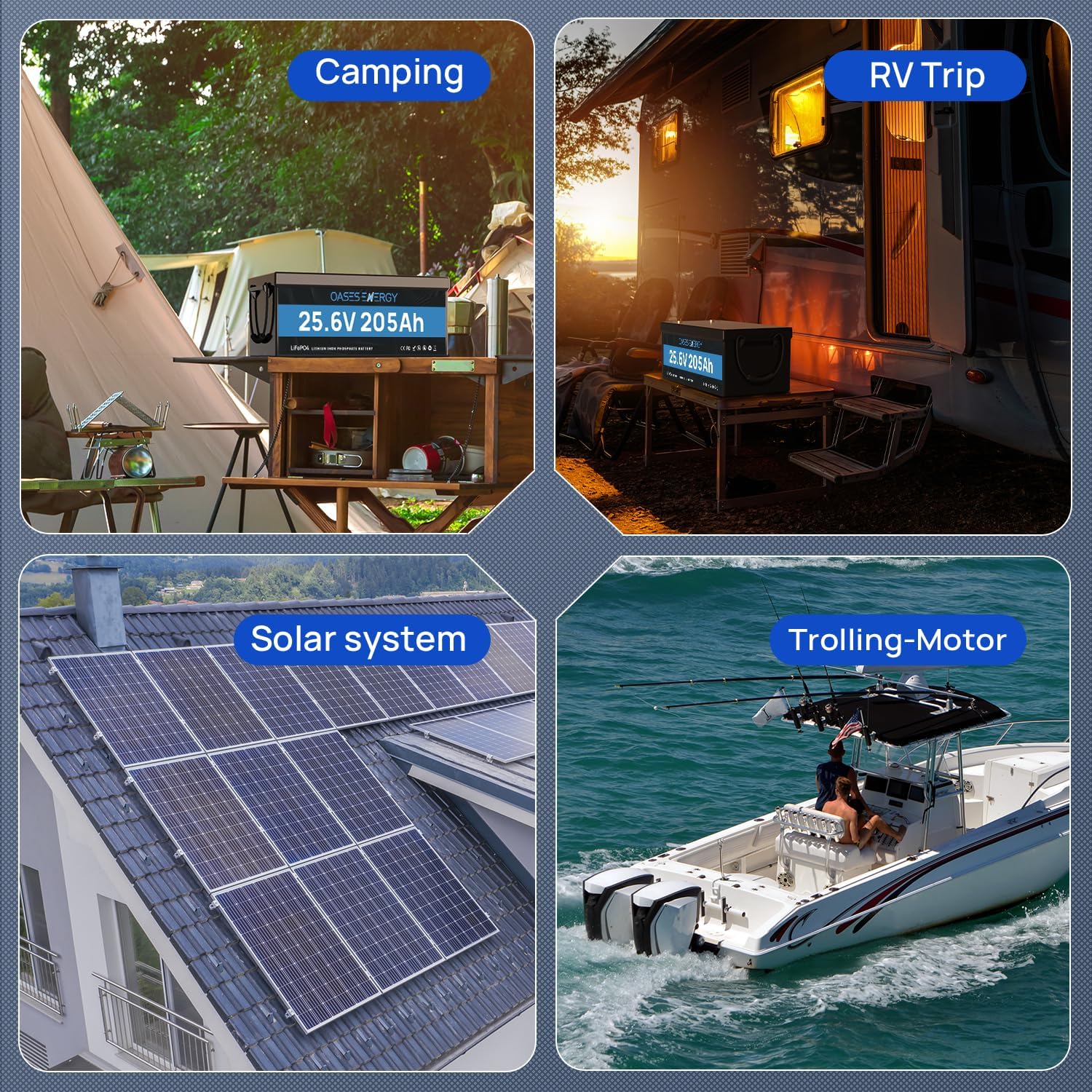
Image: Four panels depicting the Oasesenergy LiFePO4 battery in different applications: Camping, RV Trip, Solar system, and powering a Trolling-Motor on a boat.
7. Maintenance
- Regular Inspection: Periodically check the battery terminals for corrosion or loose connections. Clean terminals with a wire brush if necessary and ensure they are tightened.
- Cleaning: Keep the battery casing clean and free from dust and debris. Use a dry cloth for cleaning. Do not use solvents or abrasive cleaners.
- Storage: If storing the battery for an extended period, ensure it is charged to approximately 50% State of Charge (SOC). Store in a cool, dry place away from direct sunlight and extreme temperatures. Recharge every 3-6 months to prevent deep discharge.
- Temperature Monitoring: Utilize the Bluetooth app to monitor battery temperature, especially during charging and discharging in extreme conditions.
8. Troubleshooting
- Battery Not Charging:
- Check charger connections and ensure it is a LiFePO4 compatible charger.
- Verify charging temperature is within 32°F (0°C) to 113°F (45°C). The BMS will prevent charging outside this range.
- Inspect battery terminals and cables for damage or loose connections.
- Battery Not Discharging/No Power Output:
- Check load connections and ensure they are secure.
- Verify battery SOC using the Bluetooth app. The BMS may have disconnected the battery due to low voltage.
- Check for any BMS fault indicators via the Bluetooth app. The BMS may have activated protection (e.g., overcurrent, short circuit).
- Ensure operating temperature is within -4°F (-20°C) to 140°F (60°C).
- Bluetooth Connection Issues:
- Ensure your device's Bluetooth is enabled and within 5-10 meters of the battery.
- Restart the Bluetooth app and/or your mobile device.
- Check if the battery is powered on.
For persistent issues, please contact Oasesenergy customer support.
9. Warranty and Support
Oasesenergy provides a warranty for this product against defects in materials and workmanship under normal use. Please refer to the product packaging or the official Oasesenergy website for specific warranty terms and conditions. For technical support, troubleshooting assistance, or warranty claims, please contact Oasesenergy customer service through their official channels.