
DAYDOOR Tow Rope Kit
DAYDOOR 7/16'' x 30ft Tow Rope & Soft Shackles User Manual
Model: Tow Rope Kit (TRK112)
Brand: DAYDOOR
1. Introduction
Thank you for choosing the DAYDOOR 7/16'' x 30ft Tow Rope and Soft Shackles Kit. This heavy-duty recovery kit is designed for safe and efficient vehicle recovery in various off-road conditions. Made from advanced UHMWPE fibers, this tow rope offers superior strength while being significantly lighter than traditional ropes. The included soft shackles provide a secure and versatile connection for your recovery needs.
This manual provides essential information for the proper and safe use, maintenance, and storage of your tow rope kit. Please read it thoroughly before use.
Components Included:
- 1 x UHMWPE Tow Rope (7/16'' x 30ft)
- 2 x Synthetic Soft Shackles (7/16'' x 22'')
- 1 x Tie Strap
2. Safety Guidelines
Always prioritize safety during recovery operations. Failure to follow these guidelines can result in serious injury, death, or property damage.
- Inspect Before Use: Always inspect the tow rope and soft shackles for any signs of wear, cuts, fraying, or damage before each use. Do not use damaged equipment.
- Know Your Limits: Understand the Maximum Breaking Strength (MBS) of your rope (31,200 Lbs) and shackles (48,000 Lbs). Never exceed the Working Load Limit (WLL), which is typically 1/3 of the MBS.
- Proper Anchor Points: Only attach the tow rope and shackles to designated recovery points on vehicles (e.g., tow hooks, recovery points). Never attach to bumpers, axles, or suspension components not designed for recovery.
- Clear the Area: Ensure all bystanders are at a safe distance from the recovery area. A snapped rope or shackle can become a dangerous projectile.
- Controlled Pulls: For static towing, apply tension slowly and smoothly. Avoid sudden jerking motions.
- Vehicle Compatibility: This kit is suitable for ATVs, UTVs, SUVs, and other vehicles requiring heavy-duty towing.
3. Setup and Connection
Proper connection is crucial for a safe and effective recovery.
Connecting the Tow Rope:
- Identify the recovery points on both the stuck vehicle and the recovery vehicle. These are typically reinforced loops or hooks.
- Pass one end of the tow rope through the recovery point of the stuck vehicle.
- Secure the rope using a soft shackle. Open the soft shackle by pulling the knot through the loop. Pass the shackle around the tow rope's loop and the vehicle's recovery point. Re-insert the knot through the loop to secure it.
- Repeat the process for the other end of the tow rope and the recovery vehicle's recovery point.

Image: A red Jeep being towed by a black tow rope in a sandy desert environment, demonstrating the rope's strength and lightweight nature. The rope extends from the front of the Jeep to an unseen recovery vehicle.
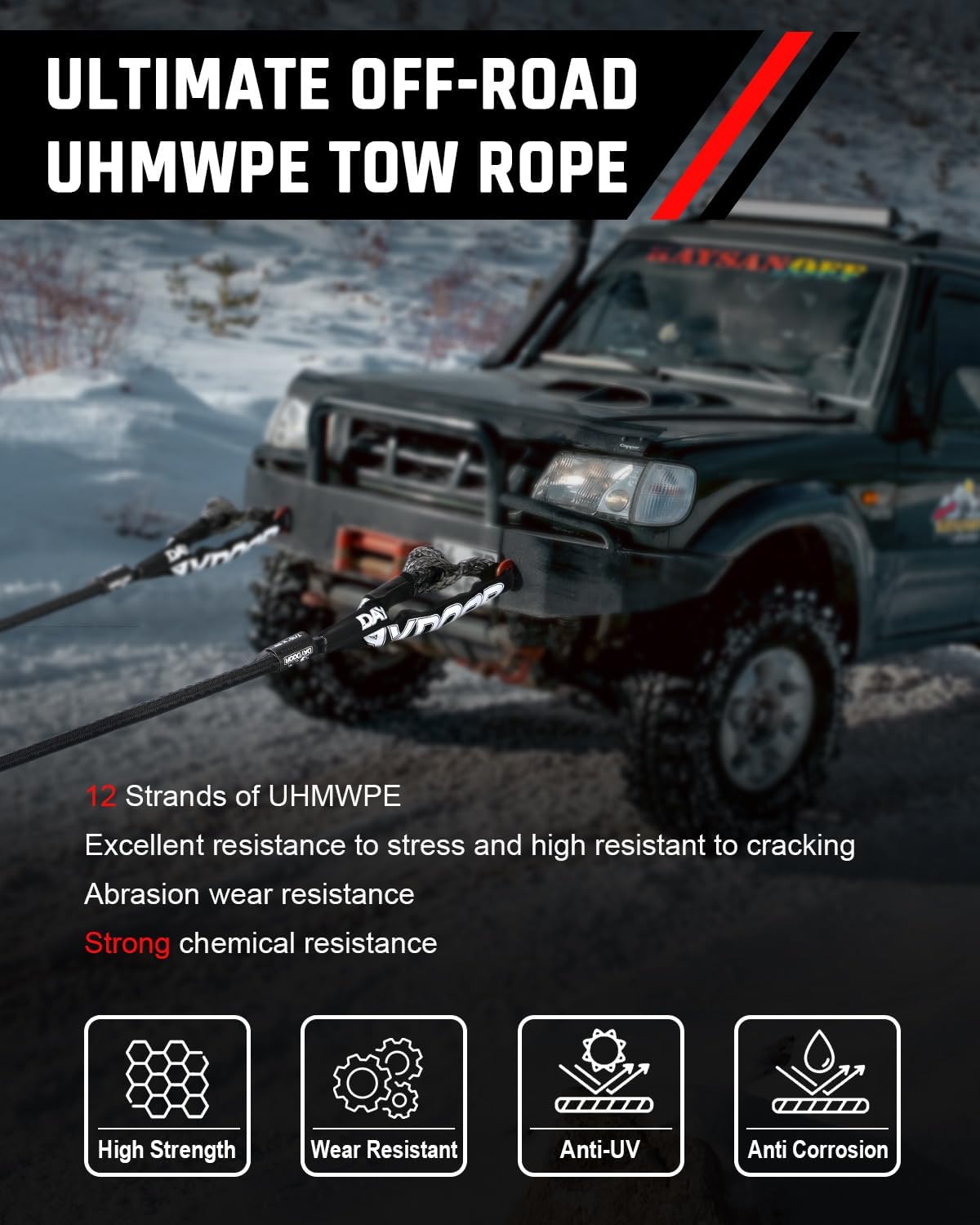
Image: A black SUV being towed by a black tow rope in a snowy, off-road setting. This illustrates the rope's durability and resistance to harsh conditions.
Using Soft Shackles:
Soft shackles are a safe and strong alternative to traditional metal shackles. They are lightweight and float, making them ideal for various recovery scenarios.

Image: Two DAYDOOR soft shackles, gray with black protective sleeves, displayed on a white background. The image highlights their UHMWPE material, protective sleeve, and high-strength diamond knot.
- To open, pull the knotted end through the braided loop.
- Wrap the shackle around the connection points (e.g., tow rope loop, vehicle recovery point).
- Insert the knotted end back through the braided loop to secure the connection. Ensure the knot is fully seated.

Image: A close-up of a soft shackle securely connected to a vehicle's recovery point, demonstrating a proper and safe attachment method for towing.
4. Operating Instructions
Once the tow rope and shackles are securely connected, proceed with the recovery operation carefully.
- Communication: Establish clear communication between the recovery vehicle driver and the stuck vehicle driver.
- Slow and Steady: The recovery vehicle should apply power slowly and smoothly. Avoid sudden acceleration, which can shock load the rope and increase the risk of failure.
- Maintain Tension: Keep a slight tension on the rope to prevent slack, but do not over-tension before the pull.
- Monitor Equipment: Continuously observe the rope and shackles during the pull for any signs of stress or damage.
- Post-Recovery: Once the vehicle is recovered, slowly release tension and disconnect the rope and shackles.

Image: A collage showcasing various vehicles including an ATV, UTV, car, pickup truck, and Jeep, illustrating the versatile applications of the DAYDOOR tow rope kit across different vehicle types and terrains.
5. Care and Maintenance
Proper care extends the life of your tow rope and shackles.
- Cleaning: After use, especially in muddy or sandy conditions, rinse the rope and shackles with fresh water to remove dirt and debris. Do not use harsh chemicals.
- Drying: Allow the rope and shackles to air dry completely before storing. Do not expose to direct sunlight for prolonged drying.
- Inspection: Regularly inspect the entire length of the rope and both shackles for cuts, abrasions, fraying, melted spots, or any other signs of damage. Pay close attention to the eyes/loops of the rope and the knot/loop of the shackles.
- Storage: Store the clean, dry rope and shackles in a cool, dry place away from direct sunlight, extreme temperatures, and sharp objects. The included tie strap can be used to keep the rope neatly coiled.

Image: The complete DAYDOOR Tow Rope and Soft Shackles Kit, showing the coiled black tow rope, two soft shackles, and a black tie strap. This image represents the product in its stored configuration.

Image: A close-up view of the coiled DAYDOOR tow rope, highlighting its braided structure and the protective heat-shrinkable tube, emphasizing its long-lasting durability and wear resistance.
6. Troubleshooting
This section addresses common concerns and issues you might encounter.
Rope or Shackle Damage:
- Issue: Visible cuts, fraying, or melting on the rope or shackles.
- Solution: Immediately discontinue use. Damaged recovery gear can fail unexpectedly and cause severe injury. Replace the damaged component.
Difficulty Securing Soft Shackle:
- Issue: The knot does not easily pass through the loop, or the shackle feels loose.
- Solution: Ensure the shackle is not twisted. The knot should be fully pulled through the loop and seated firmly. If the shackle is wet or dirty, clean and dry it, as this can affect its flexibility.
Ineffective Tow/Recovery:
- Issue: Vehicle is not moving despite tension.
- Solution: Re-evaluate the situation. Is the stuck vehicle too deeply embedded? Are the recovery points correctly chosen? Is the recovery vehicle powerful enough? Ensure the path is clear. Never exceed the WLL of the rope or shackles.
7. Specifications
| Feature | Detail |
|---|---|
| Tow Rope Material | 12 strands braided Ultra-High Molecular Weight Polyethylene (UHMWPE) with Polyester rope cover |
| Tow Rope Dimensions | 7/16'' diameter x 30ft length |
| Tow Rope Max Breaking Strength (MBS) | 31,200 Lbs |
| Soft Shackle Material | Ultra-High Molecular Weight Polyethylene (UHMWPE) |
| Soft Shackle Dimensions | 7/16'' diameter x 22'' length |
| Soft Shackle Max Breaking Strength (MBS) | 48,000 Lbs |
| Color | Gray (Tow Rope and Soft Shackles) |
| UV Resistance | Yes (Polyester coating) |
| Water Absorption | Low (Floats) |
| Abrasion Resistance | High |
| Stretch/Elongation | Very Low (Typically <5%) |
| Item Weight | 2.64 pounds |
| Manufacturer | DAYDOOR |
| Model Number | TRK112 |

Image: A detailed comparison table contrasting UHMWPE Tow Rope with Kinetic Recovery Rope, outlining differences in primary use, material, stretch/elongation, weight, and water absorption properties.

Image: A close-up of the UHMWPE tow rope, accompanied by icons illustrating its high-performance features: low moisture absorption, chemical resistance, low density (floats on sea water), and UV resistance.
8. Warranty and Support
DAYDOOR is committed to providing high-quality products. For any questions, concerns, or support needs regarding your tow rope kit, please refer to the seller's return policy or contact DAYDOOR customer service through the platform where the product was purchased. Please retain your proof of purchase for any warranty claims.
Ask a question about this manual
Ask about setup, troubleshooting, compatibility, parts, safety, or missing instructions. Manuals+ will review the question and use this page’s manual context to help answer it.