
1. Introduction
This manual provides essential information for the safe and efficient use of your DC HOUSE 24V 100Ah LiFePO4 Bluetooth Lithium Battery. This battery features a Smart Battery Management System (BMS) with low-temperature cut-off protection, offering a long cycle life and lightweight design for various applications.

Image 1.1: DC HOUSE 24V 100Ah LiFePO4 Bluetooth Lithium Battery with a smartphone displaying the monitoring app.
2. Safety Information
Always prioritize safety when handling batteries. Failure to follow safety guidelines can result in injury or damage to the battery and connected equipment.
- Do not short-circuit the battery terminals.
- Do not expose the battery to fire or extreme heat.
- Do not immerse the battery in water.
- Use only compatible chargers designed for LiFePO4 batteries.
- Ensure proper ventilation during charging and discharging.
- Avoid dropping or subjecting the battery to severe impacts.
- Keep out of reach of children.
The integrated Smart BMS provides protection against overcharge, over-discharge, over-current, and short-circuiting, enhancing overall safety and battery longevity.

Image 2.1: Visual representation of the Smart BMS protection features including overcharge, over-discharge, short circuit, over current, and high-temperature protection.
3. Setup
3.1 Unpacking and Inspection
Upon receiving your battery, carefully inspect the packaging and the battery for any signs of damage. If any damage is found, contact customer support immediately.
3.2 Connections
The battery is equipped with M8 terminals for secure connections. Ensure all connections are tight and properly insulated to prevent short circuits.
3.3 Parallel and Series Configuration
This 24V 100Ah battery can be expanded up to 2P2S (two in parallel, two in series) to create a 51.2V 200Ah LiFePO4 battery bank, capable of storing up to 10.24kWh of power. Consult a qualified technician for complex configurations.

Image 3.1: Illustration of the battery's expandability for solar panel systems, supporting up to 2P2S configuration.
3.4 Charging Methods
The battery can be charged using various methods:
- Dedicated Li-ion Charger: Connect to a 24V 20A Li-ion battery charger to fully charge the 24V 100Ah battery in approximately 5 hours.
- Solar Recharge: An 800W solar panel with an MPPT controller can fully charge the 24V 100Ah battery in approximately 5 hours.
- Generator: Add a 20A DC to DC charger to fully charge the 24V 100Ah LiFePO4 Battery in approximately 5 hours.

Image 3.2: The DC HOUSE 24V 100Ah battery being charged by a dedicated 24V 20A Li-ion charger.

Image 3.3: A house with solar panels, demonstrating the solar recharge capability for the battery.

Image 3.4: A generator connected to the DC HOUSE 24V 100Ah battery for charging.
4. Operating Instructions
4.1 Bluetooth APP Monitoring
The DC HOUSE 24V 100AH battery includes built-in Bluetooth connectivity. Download the DC HOUSE APP to monitor battery information such as State of Charge (SOC), voltage, current, and temperature. The app provides data accurate to the specific cell and includes a dedicated fault display page for troubleshooting. The Bluetooth signal range is typically 5-10 meters.

Image 4.1: A smartphone screen showing the DC HOUSE app interface, displaying real-time battery monitoring data like battery level, voltage, and current.
4.2 Low Temperature Cut-Off Protection
The battery features an upgraded Low Temperature Cut-Off Protection. The BMS will automatically cut off the charging function if the temperature drops below 19.4℉ (-7℃). Discharge will be cut off if the temperature falls below -4℉ (-20℃). The battery will automatically resume normal operation once the temperature rises to 32℉ (0℃). This feature protects the battery and extends its lifespan.

Image 4.2: An RV in a winter setting, highlighting the battery's low-temperature cut-off protection for charging and recovery.
4.3 Applications
The DC HOUSE 24V 100AH LiFePO4 battery is suitable for a wide range of applications due to its stable performance and robust design:
- Trolling Motors (e.g., 70-80 lb thrust motors)
- Marine and Boat applications
- Recreational Vehicles (RVs) and Campers
- Home Energy Storage systems
- Golf Carts
- Off-grid power solutions

Image 4.3: An inflatable boat equipped with a trolling motor, demonstrating the battery's use in marine applications.
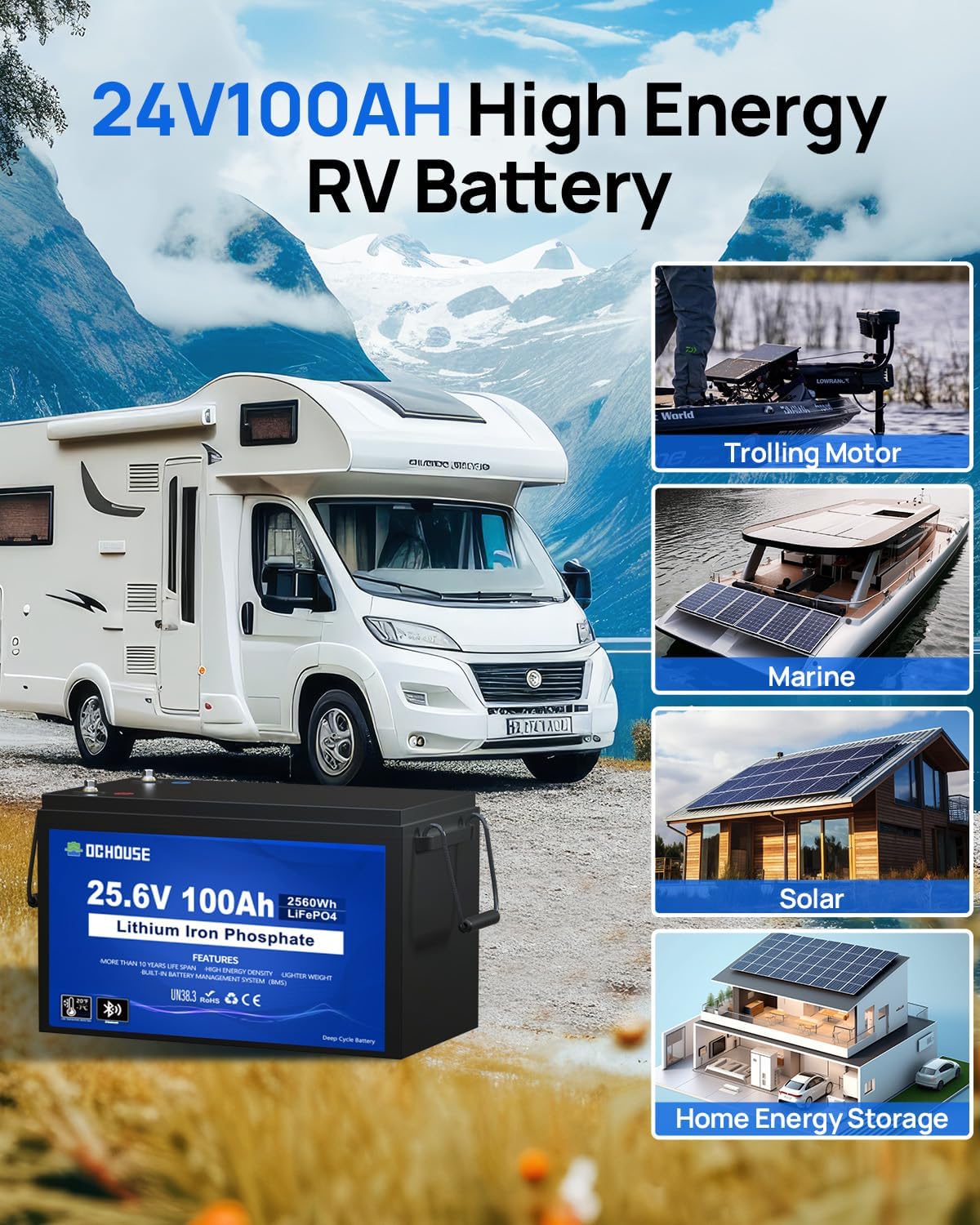
Image 4.4: A collage showing the versatility of the 24V 100Ah battery across different uses like RVs, marine vessels, solar setups, and home energy storage.
5. Maintenance
To ensure optimal performance and longevity of your DC HOUSE LiFePO4 battery, follow these general maintenance guidelines:
- Regularly check battery terminals for cleanliness and tightness.
- Keep the battery in a cool, dry, and well-ventilated area.
- Avoid prolonged storage in a fully discharged state.
- If storing for extended periods, ensure the battery is charged to approximately 50% State of Charge (SOC) and periodically check its voltage.
- The integrated BMS helps manage the battery's health, but visual inspections are still recommended.
6. Troubleshooting
The DC HOUSE APP provides a special fault display page to assist in identifying and resolving potential issues. For common problems, refer to the app's diagnostic information.
If the battery automatically cuts off, check the following:
- Low Temperature: If the ambient temperature is below 19.4℉ (-7℃) for charging or -4℉ (-20℃) for discharging, the BMS will activate the low-temperature cut-off. The battery will resume operation when temperatures rise.
- Over-Discharge: The BMS will cut off discharge if the voltage drops below 1V to protect the battery. Recharge the battery as soon as possible.
- Other Faults: Consult the DC HOUSE APP's fault display page for specific error codes or messages.
For persistent issues or complex problems, contact DC HOUSE customer support.
7. Specifications
Detailed specifications for the DC HOUSE 24V 100Ah LiFePO4 Bluetooth Lithium Battery:

Image 7.1: A visual summary of the battery's key specifications and dimensions.
| Specification | Value |
|---|---|
| Product Name | LiFePO4 Battery |
| Rated Capacity | 100Ah / 2560Wh (25℃, 0.5C) |
| Rated Voltage | 25.6V |
| Voltage Range | 20-29.2V |
| Maximum Continuous Charging Current | 100A |
| Maximum Continuous Discharging Current | 100A |
| Charging Voltage | 29.2V |
| Dimensions (LxWxH) | 367*189*271 mm / 14.4"D x 7.4"W x 10.7"H |
| Weight | 20kg / 44.1 lbs |
| Charging Temperature | 32-131℉ / 0-55℃ |
| Discharging Temperature | -4-131℉ / -20-55℃ |
| Terminal | M8 |
| Model Number | ECO-LFP2410003 |
8. Warranty and Support
DC HOUSE is committed to providing 3 years of service for every battery sold. If you require assistance with battery connection, charging, discharging, or any other product-related inquiries, please contact us through Amazon or the after-sales address provided in the original product packaging.
9. Quality Assurance and Manufacturing
DC HOUSE maintains high standards in manufacturing and product development. Our facilities cover approximately 1,400 acres and employ over 400 people, ensuring meticulous attention to every detail from production to customer service.
Video 9.1: A tour of the DC HOUSE factory, showcasing the production lines, R&D testing center, and customer service operations. This video highlights the scale and processes involved in manufacturing DC HOUSE batteries.
Our batteries incorporate innovative metal fixtures to enhance lifespan and protect cell safety. These fixtures prevent premature wear caused by repeated charge and discharge cycles, and effectively prevent internal expansion and deformation, thereby reducing capacity degradation.
Video 9.2: An explanation of why batteries need fixtures, detailing how metal fixtures contribute to battery stability, safety, and longevity by preventing internal expansion and deformation during charging and discharging cycles.