Introduction
Thank you for choosing ARANA Gas Struts. These high-quality hydraulic gas springs are designed to provide reliable support and controlled movement for various applications, including cabinet doors, toy boxes, benches, RV doors, and other DIY projects. This manual provides essential information for safe installation, operation, and maintenance of your ARANA gas struts.
Safety Information
Please read and understand all safety instructions before installation and use. Failure to follow these instructions may result in injury or damage to the product.
- Do not attempt to disassemble or puncture the gas strut. It contains high-pressure gas.
- Do not heat the gas strut or expose it to open flames.
- Ensure the mounting points are strong enough to support the intended load.
- Wear appropriate personal protective equipment (PPE) during installation, such as safety glasses and gloves.
- Keep children and pets away from the installation area.
- Verify the correct force (N) and length (mm) for your application to prevent improper function or damage.
Product Overview and Components
Your ARANA gas strut package includes the following components:
- 2 x ARANA Gas Struts (500mm 500N)
- 1 x Installation Guide (refer to this manual)

Image: Two ARANA 500mm 500N gas struts, illustrating their design and typical use in lifting applications.
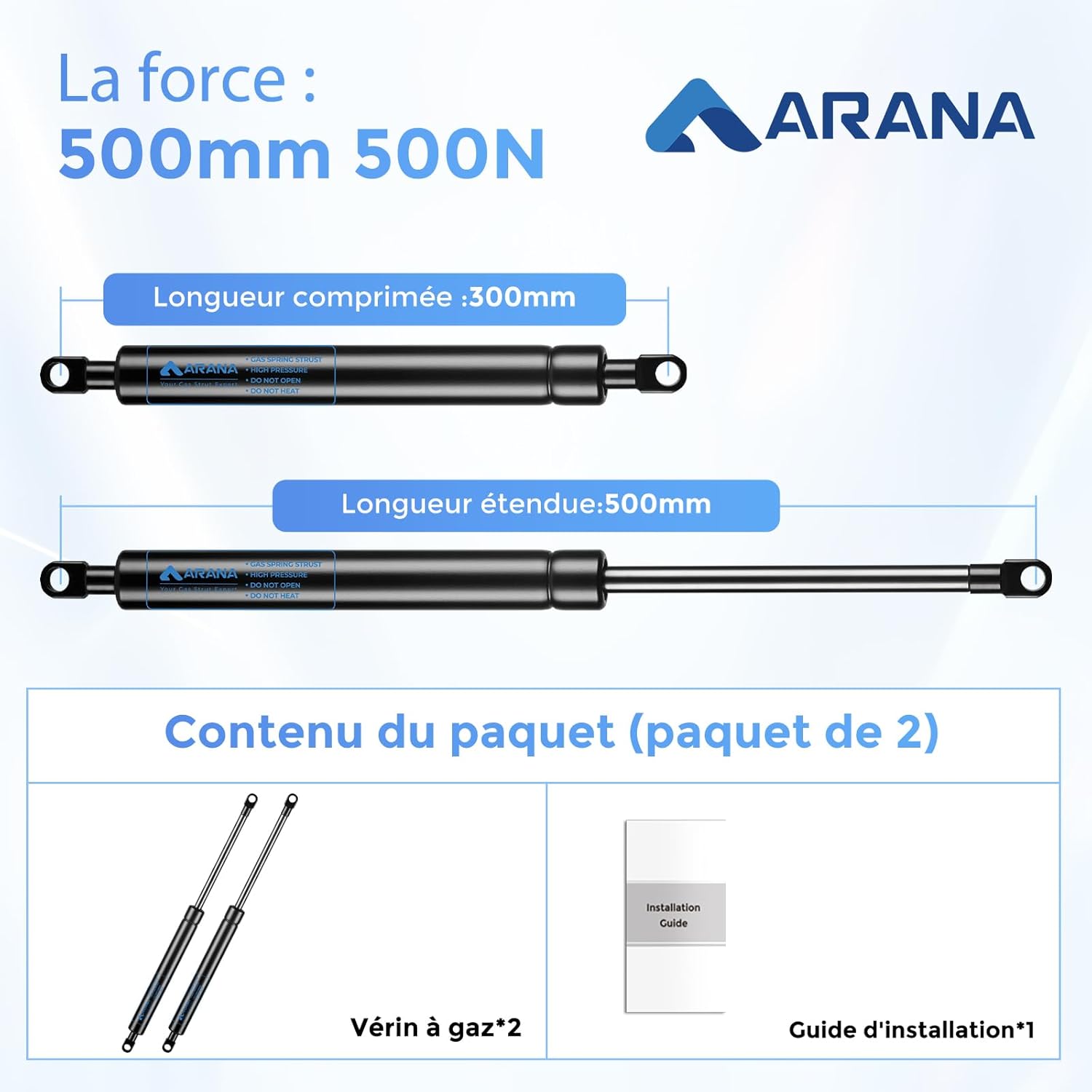
Image: Visual representation of the gas strut's compressed (300mm) and extended (500mm) lengths, along with the package contents (2 gas struts and installation guide).
Specifications
| Feature | Description |
|---|---|
| Model Number | ARANA_1399 |
| Extended Length (Center to Center) | 500 mm |
| Compressed Length (Center to Center) | 300 mm |
| Force | 500 N (supports 41-56 kg lids) |
| Material | Carbon Steel, Stainless Steel |
| Color | Black |
| Weight | 710 g (per pair) |
| Design Feature | Double-seal to prevent oil leakage |
Installation (Setup)
Proper installation is key to the performance and longevity of your gas struts. Follow these steps carefully.
1. Choosing the Correct Force
It is crucial to select the correct gas strut force (N) based on the weight of the lid you intend to support. Refer to the table below to determine the appropriate force for your application. For lids weighing between 41-56kg and with a length of 750-1000mm, the 500N gas strut is suitable.
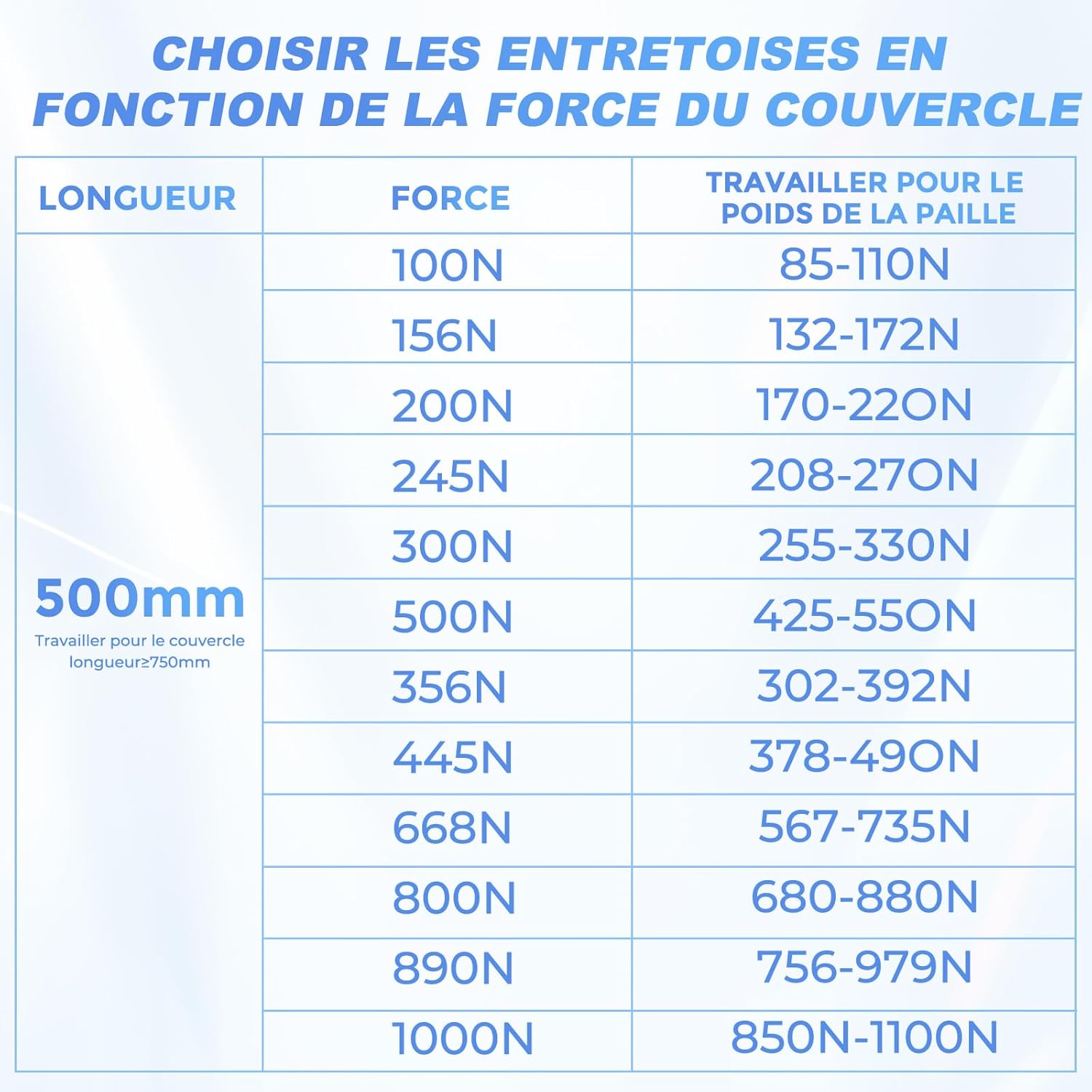
Image: Guide for selecting the appropriate gas strut force based on lid weight and length. For 500mm struts, a 500N force is ideal for lids weighing 425-550N (approx. 41-56kg).
2. Measurement and Placement
Accurate measurement is essential for optimal performance and safe operation. The force arm length should be approximately 1/2 to 2/3 of the lid's length.
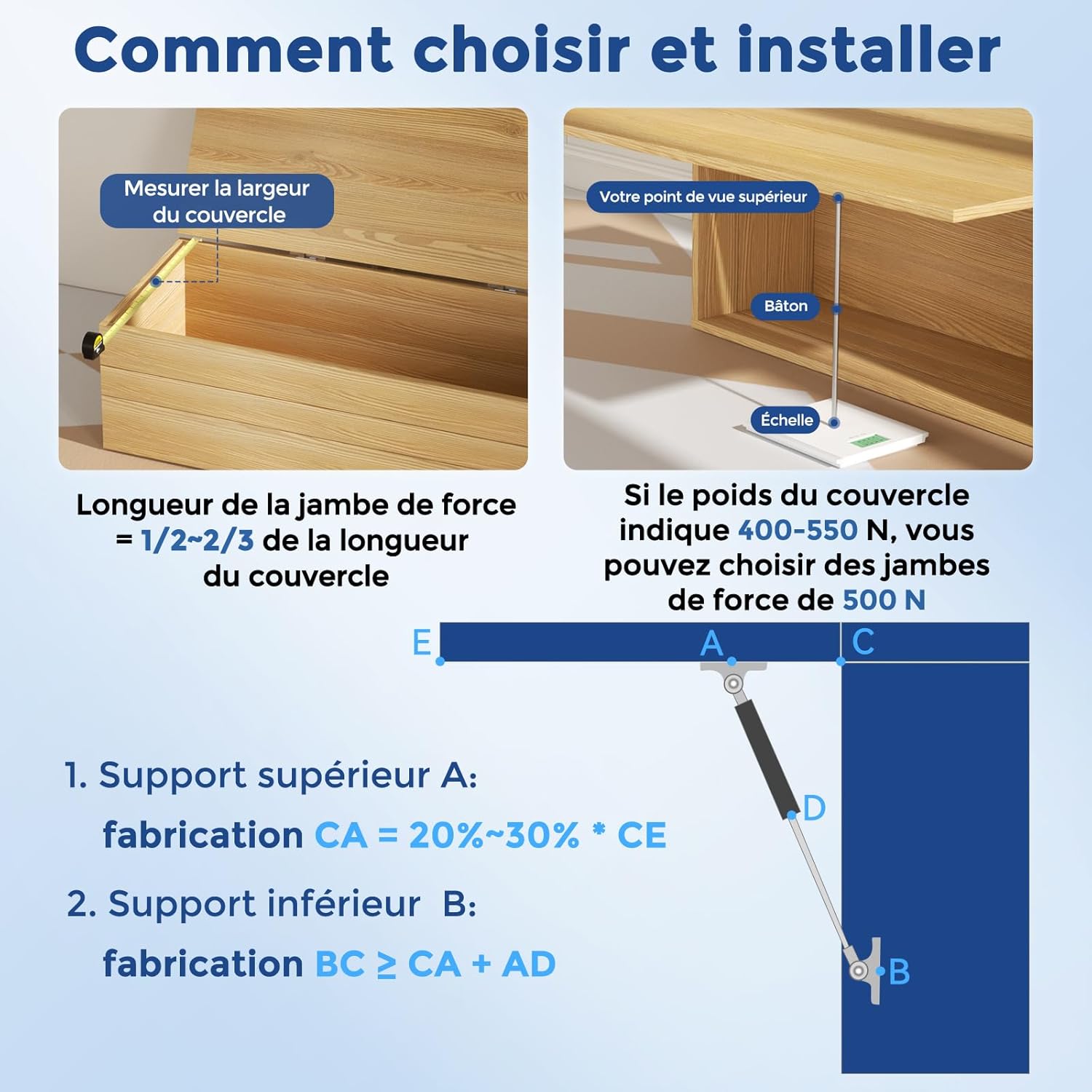
Image: Instructions on measuring the lid width and using a scale to determine the lid's weight. It also shows the ideal placement of the gas strut with upper support A and lower support B, and the calculation for their positions (CA = 20%~30% * CE, BC ≥ CA + AD).
- Measure the lid width: This helps in determining the overall dimensions for strut placement.
- Determine lid weight: Use a scale to accurately weigh the lid. If the lid weighs between 400-550N (approx. 41-56kg), the 500N gas strut is appropriate.
- Upper Support A: Position such that the distance CA is 20% to 30% of the total extended length CE.
- Lower Support B: Position such that the distance BC is greater than or equal to CA + AD. Ensure this condition is met to avoid interference with lid closure.
3. Mounting the Gas Struts
Mounting screws are not included with this product and must be purchased separately. Ensure you use appropriate fasteners for your specific application and material.
- Identify the mounting points on both the lid and the frame/cabinet based on your measurements.
- Securely attach the upper mounting bracket (if applicable) to the lid at point A.
- Securely attach the lower mounting bracket (if applicable) to the frame/cabinet at point B.
- Connect the gas strut to both mounting points. Ensure the strut is oriented correctly (typically, the cylinder body should be at the top when the lid is closed, and the rod extends downwards).
- Test the lid's movement to ensure smooth operation and proper support.
4. Adjustment Methods
If the lid's movement is not ideal after installation, you may need to adjust the mounting points. Always ensure BC ≥ CA + AD to prevent the strut rod from affecting lid closure.

Image: Adjustment method for limited space. If too strong (lid won't close), move A closer to C. If too weak (lid won't stay open), move A closer to E.
- If the lid is too strong (does not close easily): Move the upper support point A closer to point C.
- If the lid is too weak (does not stay open): Move the upper support point A closer to point E.

Image: Recommended adjustment method. Keep upper support A and opening angle unchanged. If too strong, move B inwards along the curve. If too weak, move B outwards along the curve.
- Recommended Adjustment Method: Keep the upper support A and the opening angle unchanged.
- If the lid is too strong (does not close easily): Move the lower support point B inwards along the illustrated curve.
- If the lid is too weak (does not stay open): Move the lower support point B outwards along the illustrated curve.
Operation
Once installed, your ARANA gas struts will assist in lifting and holding open the supported lid, and provide a controlled closing motion.
- Opening: Gently lift the lid. The gas struts will engage and assist in raising the lid to its fully open position, holding it securely.
- Closing: Apply gentle downward pressure to the lid. The gas struts will provide a controlled, slow closing motion, preventing sudden drops.

Image: A man effortlessly lifting a mattress, demonstrating how the gas struts support easy lifting.

Image: A woman safely controlling the descent of an ottoman bed, highlighting the controlled closing feature of the gas struts.
Maintenance
ARANA gas struts are designed for durability and require minimal maintenance. However, following these guidelines can extend their lifespan:
- Cleaning: Wipe the strut rod clean periodically with a soft, damp cloth to remove dust and debris. Avoid abrasive cleaners.
- Inspection: Regularly inspect the gas struts and mounting points for any signs of wear, damage, or corrosion. Ensure all fasteners are tight.
- Lubrication: The gas struts are self-lubricating and do not require external lubrication. Do not apply grease or oil to the rod.
- Storage: If storing the struts before installation, keep them in a clean, dry place away from extreme temperatures.
Troubleshooting
If you encounter issues with your gas struts, consider the following common problems and solutions:
| Problem | Possible Cause | Solution |
|---|---|---|
| Lid does not stay open / Strut is too weak. | Incorrect force selected (too low); Lid is heavier than expected; Improper mounting position. | Verify lid weight and strut force. Adjust mounting points (move lower support B outwards) or consider a higher force strut. |
| Lid is difficult to close / Strut is too strong. | Incorrect force selected (too high); Lid is lighter than expected; Improper mounting position. | Verify lid weight and strut force. Adjust mounting points (move lower support B inwards) or consider a lower force strut. |
| Lid closes too quickly / No damping. | Damaged strut; Incorrect installation angle. | Inspect strut for damage. Re-check installation angles and ensure smooth movement. Replace if damaged. |
| Squeaking or grinding noise. | Misaligned mounting; Debris on rod; Worn out strut. | Check mounting alignment. Clean the rod. If noise persists, the strut may need replacement. |
Warranty and Support
ARANA offers 18 months of replacement assistance for defective products, compatibility issues, or missing parts. If you encounter any problems, please contact ARANA customer support with your purchase details.
For further assistance, please visit the ARANA store on Amazon: ARANA Store


