
1. Introduction
Thank you for choosing the avigator PM6202C 20 Bar Espresso Machine. This manual provides essential information for the safe and efficient operation, maintenance, and troubleshooting of your new espresso machine. Please read it thoroughly before first use and keep it for future reference.
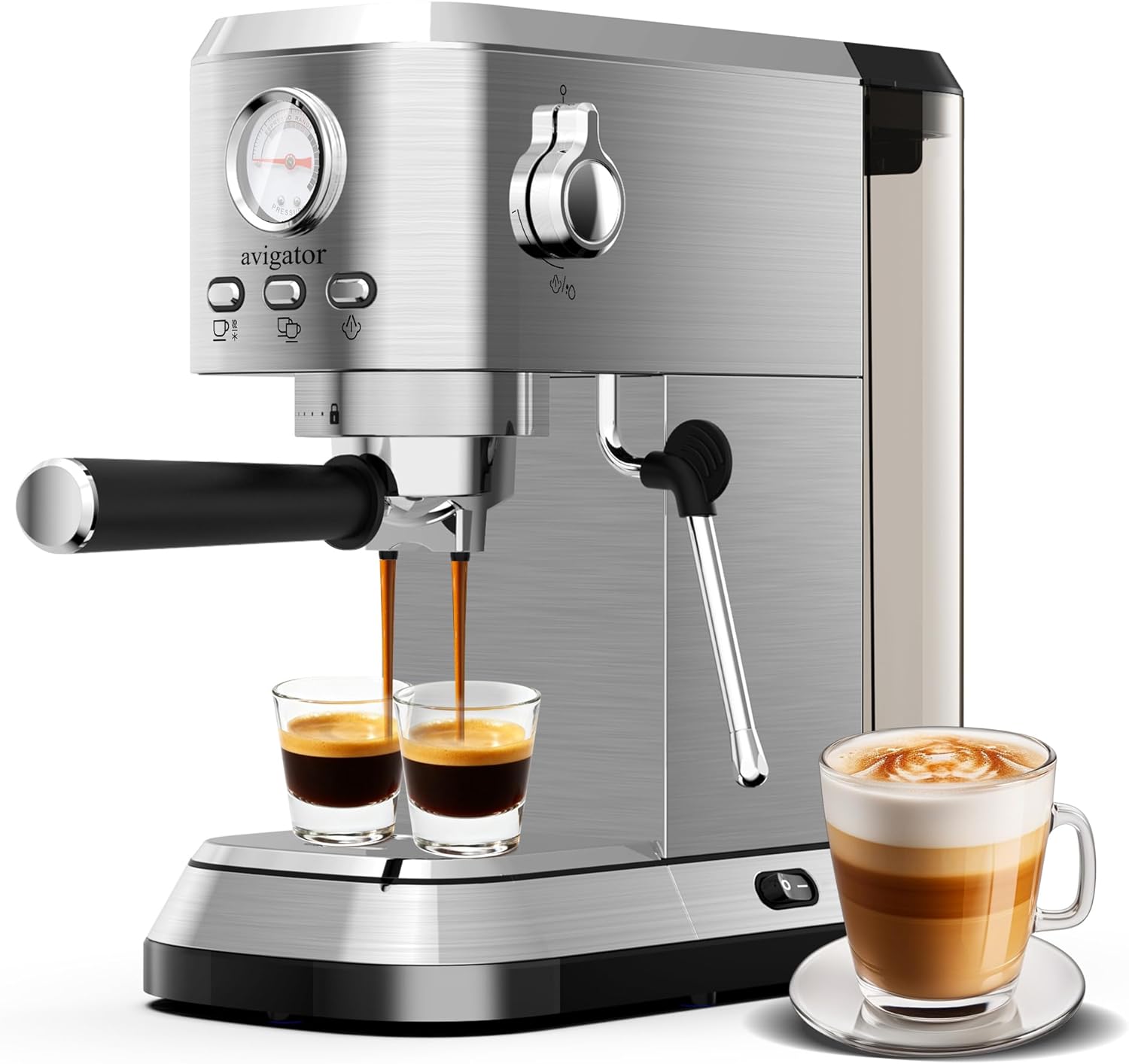
Image: The avigator PM6202C Espresso Machine in silver, actively brewing two espresso shots into small glasses, with a prepared latte in a glass mug to the right.
2. Important Safety Instructions
Always follow basic safety precautions when using electrical appliances to reduce the risk of fire, electric shock, and injury to persons.
- Read all instructions before operating the appliance.
- Do not touch hot surfaces. Use handles or knobs.
- To protect against fire, electric shock, and injury, do not immerse cord, plugs, or the appliance in water or other liquid.
- Close supervision is necessary when any appliance is used by or near children.
- Unplug from outlet when not in use and before cleaning. Allow to cool before putting on or taking off parts, and before cleaning the appliance.
- Do not operate any appliance with a damaged cord or plug, or after the appliance malfunctions or has been damaged in any manner.
- The use of accessory attachments not recommended by the appliance manufacturer may result in fire, electric shock, or injury to persons.
- Do not use outdoors.
- Do not let cord hang over edge of table or counter, or touch hot surfaces.
- Do not place on or near a hot gas or electric burner, or in a heated oven.
- Always attach plug to appliance first, then plug cord into the wall outlet. To disconnect, turn any control to 'off', then remove plug from wall outlet.
- Do not use appliance for other than intended use.
- Use extreme caution when disposing of hot steam.
3. Product Overview and Components
Familiarize yourself with the parts of your avigator espresso machine for optimal use.

Image: An exploded view diagram of the avigator espresso machine, highlighting its key components: 1.5L water tank, 7g/14g filters, 58mm portafilter, spoon with tamper, drip tray with float indicator, and drip plate.
Key Features:
- 20-Bar Professional Pump: Ensures optimal pressure for rich espresso extraction.
- Fast Heating System: Ready to brew in approximately 25 seconds.
- Built-in Steam Wand: For frothing milk and dispensing hot water.
- Removable 1.5L Water Tank: Easy to fill and clean.
- Compact Design: Slim profile to save counter space.
- Cup Warmer: Located on top to preheat cups.
- One-Touch Controls: Simple operation for espresso and steam functions.
- Built-in Pressure Gauge: Monitors brewing pressure for consistent results.
4. Setup and First Use
4.1 Unpacking
- Carefully remove all packaging materials and the espresso machine from the box.
- Check that all accessories are present: portafilter, single shot filter, double shot filter, measuring spoon with tamper.
- Place the machine on a stable, flat, heat-resistant surface.
4.2 Initial Cleaning
Before first use, clean all removable parts with warm water and mild detergent. Rinse thoroughly and dry. Wipe the exterior of the machine with a damp cloth.
4.3 Filling the Water Tank
- Remove the water tank from the back of the machine.
- Fill the tank with fresh, cold water up to the MAX line. Do not exceed the MAX line.
- Place the water tank back into its position, ensuring it is securely seated.
4.4 Priming the Machine (First Use)
This step removes air from the system and prepares the machine for brewing.
- Ensure the water tank is filled.
- Plug the machine into a grounded electrical outlet.
- Press the power button to turn on the machine. The indicator lights will flash as it heats up.
- Once the lights stop flashing and remain solid, the machine is preheated.
- Place a cup under the portafilter spout (without coffee).
- Press the single shot button to run water through the system for about 30 seconds. Repeat this process for the steam wand by turning the steam knob to release hot water/steam.
- Discard the water. Your machine is now primed and ready for use.
5. Operating Instructions
5.1 Preheating Cups
For best results, preheat your espresso cups using the cup warmer on top of the machine or by running hot water into them.

Image: A diagram illustrating the cup warming function, with two cups placed on the top surface of the espresso machine, being heated.
5.2 Making Espresso

Image: A four-step visual guide to making espresso: Step 1 shows adding water and preheating the machine. Step 2 shows filling the portafilter with ground coffee and tamping it. Step 3 shows the coffee grounds level near the max line. Step 4 shows locking the portafilter into the machine and starting extraction.
- Ensure the machine is preheated (solid indicator lights).
- Insert the desired filter (single or double shot) into the portafilter.
- Add finely ground espresso coffee to the filter. For a single shot, use about 7g; for a double, about 14g.
- Use the tamper to press the coffee grounds firmly and evenly. The coffee level should be close to the MAX line in the filter.
- Attach the portafilter to the group head by aligning it and twisting firmly to the right until it is secure.
- Place your preheated cup(s) under the portafilter spouts.
- Press the single shot button (for 40ml) or double shot button (for 80ml) to start brewing. The machine will automatically stop when the programmed volume is reached.
- Monitor the pressure gauge during extraction; it should ideally be in the optimal espresso range.

Image: The avigator espresso machine highlighting its one-touch controls for fast extraction, with visual indicators for 40ml (single shot) and 80ml (double shot) espresso volumes.
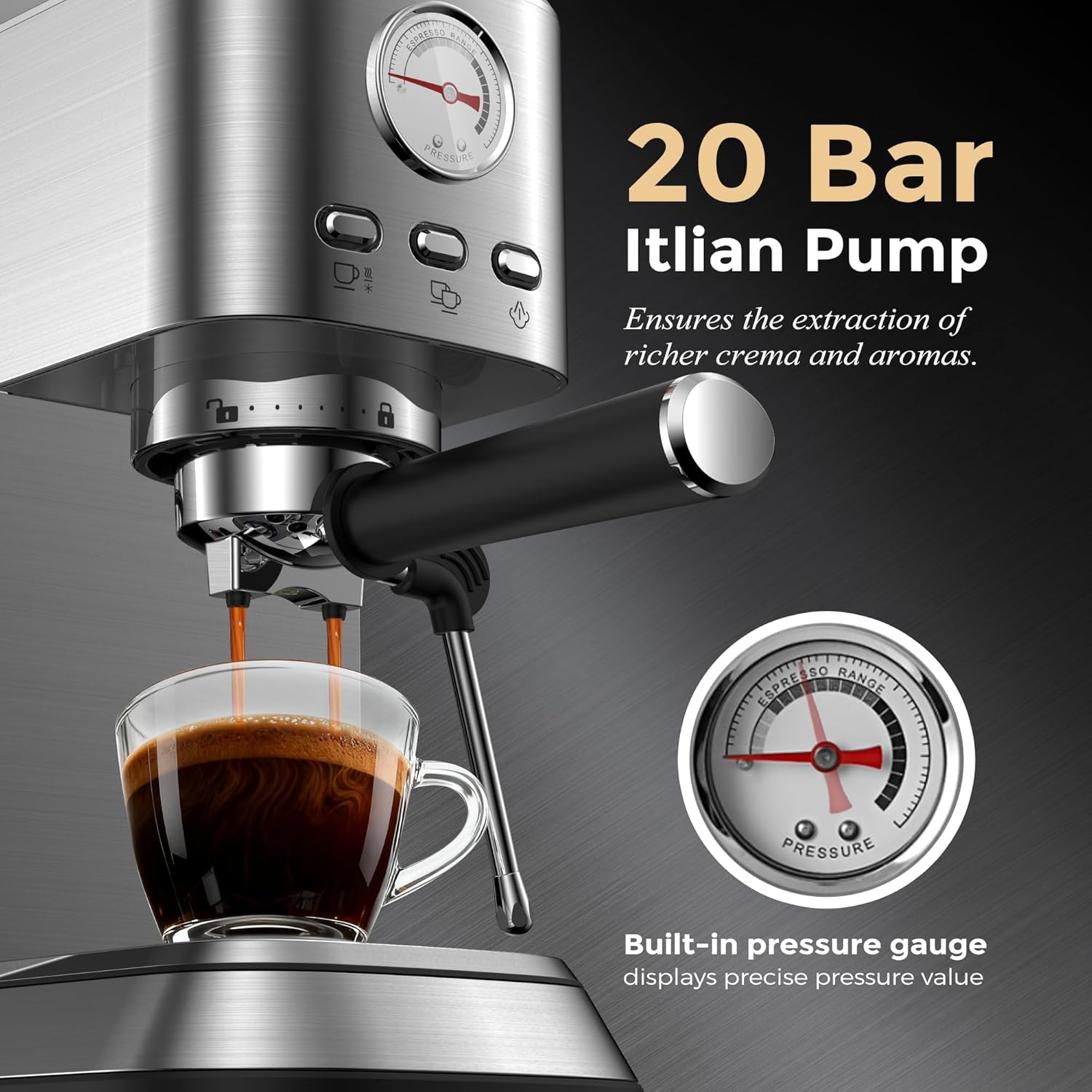
Image: A close-up view of the avigator espresso machine emphasizing its 20 Bar Italian Pump and the built-in pressure gauge, which displays precise pressure values during brewing.
5.3 Using the Milk Frother (Steam Wand)

Image: A diagram illustrating the process of releasing hot steam from the steam wand for frothing milk, by clicking the steam mode button and turning the knob.
- Fill a stainless steel frothing pitcher with cold milk (dairy or non-dairy) to just below the spout.
- Press the steam button. The indicator light will flash as the machine heats up to steam temperature. Once solid, it's ready.
- Position the steam wand just below the surface of the milk.
- Turn the steam knob to release steam. Move the pitcher up and down to create foam.
- Once desired foam and temperature are reached, turn the steam knob off and press the steam button to exit steam mode.
- Immediately wipe the steam wand with a damp cloth to prevent milk residue from drying.
5.4 Dispensing Hot Water

Image: A diagram demonstrating how to dispense hot water from the steam wand by simply turning the knob, without needing to activate steam mode.
- Ensure the machine is preheated (solid indicator lights).
- Place a cup under the steam wand.
- Turn the steam knob to release hot water. No need to press the steam button for this function.
- Turn the knob back to the off position when done.
6. Maintenance and Cleaning
Regular cleaning ensures optimal performance and extends the life of your espresso machine. The machine features cleaning reminders for convenience.

Image: A diagram illustrating the ease of assembly, disassembly, and cleaning of the avigator espresso machine, highlighting its main removable parts.
6.1 Daily Cleaning
- Portafilter and Filters: After each use, remove the portafilter, discard coffee grounds, and rinse the portafilter and filter under running water.
- Steam Wand: Immediately after frothing milk, wipe the steam wand with a damp cloth. Purge a small amount of steam to clear any internal milk residue.
- Drip Tray: Empty and rinse the drip tray daily or when the float indicator rises.
- Water Tank: Empty any remaining water and rinse the water tank daily. Refill with fresh water for each use.
6.2 Descaling
Over time, mineral deposits can build up in the machine, affecting performance. Descale your machine every 2-3 months, or more frequently if you have hard water.
- Prepare a descaling solution according to the descaler manufacturer's instructions (or use a mixture of white vinegar and water).
- Fill the water tank with the descaling solution.
- Place a large container under the group head and steam wand.
- Run half of the solution through the group head by pressing the double shot button.
- Run the other half through the steam wand by activating steam mode and turning the knob.
- Turn off the machine and let it sit for 15-20 minutes.
- Empty the water tank, rinse it thoroughly, and refill with fresh water.
- Run several full tanks of fresh water through both the group head and steam wand to rinse out any descaling solution.
7. Troubleshooting
Refer to this section for common issues and their solutions.
| Problem | Possible Cause | Solution |
|---|---|---|
| No coffee dispenses | Water tank empty; Clogged filter; Machine not primed; Pump issue. | Fill water tank; Clean filter; Prime the machine; Contact customer service. |
| Weak or watery espresso | Coffee too coarse; Not enough coffee; Insufficient tamping; Machine needs descaling. | Use finer grind; Increase coffee amount; Tamp more firmly; Descale machine. |
| No steam from wand | Steam button not pressed; Wand clogged; Machine not hot enough. | Press steam button and wait for preheat; Clean wand; Allow machine to fully heat. |
| Machine leaks water | Water tank not seated correctly; Drip tray full; Seal issue. | Reseat water tank; Empty drip tray; Contact customer service. |
| Espresso extracts too slowly | Coffee too fine; Too much coffee; Over-tamping; Clogged filter. | Use coarser grind; Reduce coffee amount; Tamp less firmly; Clean filter. |
8. Specifications
| Feature | Detail |
|---|---|
| Brand | avigator |
| Model Name | PM6202C |
| Pressure | 20 Bar |
| Water Tank Capacity | 1.5 Liters |
| Dimensions (D x W x H) | 14"D x 8"W x 14"H |
| Item Weight | 10.18 pounds |
| Coffee Input Type | Ground Coffee |
| Operation Mode | Semi-Automatic |
| Special Features | Cup Warmer, Milk Frother, Removable Tank, Pressure Gauge |
| UPC | 702262406346 |
9. Warranty and Customer Support
avigator is committed to providing high-quality products and excellent customer service. For any questions, concerns, or assistance with your espresso machine, please contact our dedicated support team. We aim to provide fast, professional guidance via email within 24 hours.
Please refer to your purchase documentation for specific warranty details. Keep your proof of purchase for any warranty claims.