
1. Introduction
This manual provides essential information for the safe and effective operation of your Mastech MS8301A Digital Multimeter. Please read this manual thoroughly before using the device to ensure proper functionality and to prevent potential hazards. Keep this manual for future reference.
2. Safety Information
Always adhere to the following safety precautions to avoid electric shock or personal injury, and to prevent damage to the multimeter or the equipment under test.
- Read Instructions: Understand all instructions and safety information before use.
- Rated Voltage: Do not apply more than the rated voltage, as marked on the multimeter, between the terminals or between any terminal and ground.
- Test Leads: Inspect test leads for damaged insulation or exposed metal. Replace if damaged.
- Circuit Disconnection: Disconnect the circuit power and discharge all high-voltage capacitors before testing resistance, continuity, diodes, or capacitance.
- Function Selection: Ensure the function switch is in the correct position for the measurement being performed.
- Live Circuits: Do not measure current on a live circuit with the test leads connected in parallel.
- Operating Environment: Do not operate the multimeter in explosive gas, vapor, or damp environments.
- Personal Protective Equipment: Always wear appropriate personal protective equipment, such as safety glasses, when working with electrical circuits.
- Safety Rating: This device is rated for CAT III 600V. Do not exceed this rating.
3. Product Overview
3.1 Features
The Mastech MS8301A Digital Multimeter offers a range of features for various electrical measurements:
- Display: 2000 Counts
- Data Hold: Freezes the displayed reading for convenient recording.
- Battery Tester: For 1.5V and 9V batteries.
- Compact Design: Product Size: 150mm x 74mm x 48mm (5.9" x 2.9" x 1.7")
- Lightweight: Product Weight: 220g (0.48lb)

Image: Detailed features and specifications of the Mastech MS8301A multimeter, including display count, data hold, battery test function, and physical dimensions.
3.2 Components
The Mastech MS8301A package typically includes the following components:
- Mastech MS8301A Digital Multimeter Unit
- Test Leads (Red and Black)
- AAA Batteries (2x1.5V)
- Calibration Certificate (if applicable)
- Quick Start Guide
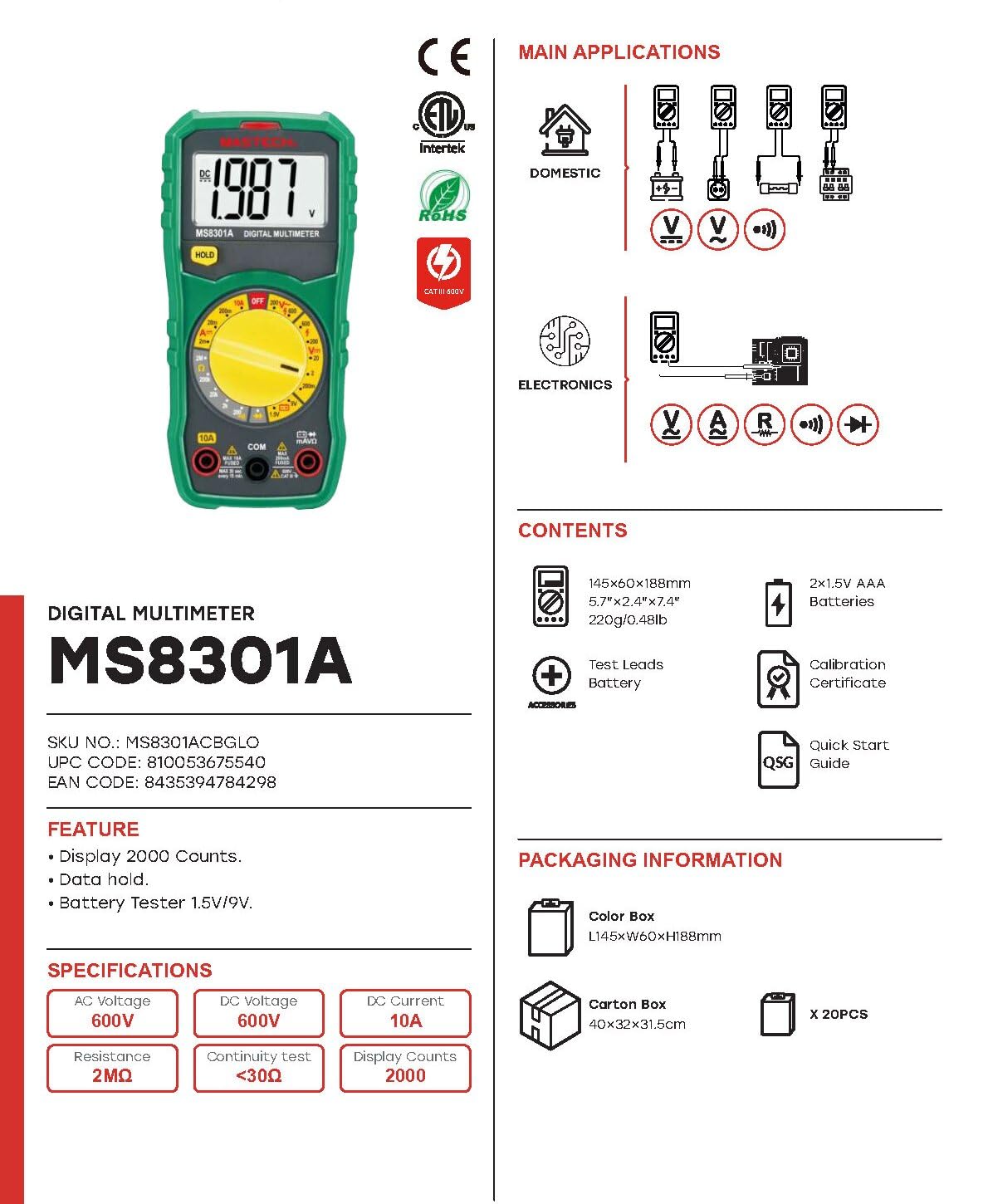
Image: The Mastech MS8301A Digital Multimeter showing its front panel, rotary switch, display, input jacks, and a list of included accessories such as test leads and batteries.
4. Setup
4.1 Battery Installation
- Ensure the multimeter is turned off and disconnect any test leads.
- Locate the battery compartment cover on the back of the multimeter.
- Unscrew the retaining screw(s) and remove the cover.
- Insert two 1.5V AAA batteries, observing the correct polarity (+ and -) as indicated inside the compartment.
- Replace the battery compartment cover and secure it with the screw(s).
4.2 Connecting Test Leads
Connect the test leads to the appropriate input jacks on the multimeter:
- Insert the black test lead into the COM (common) jack.
- For most measurements (Voltage, Resistance, Diode, Continuity, Temperature, Battery Test), insert the red test lead into the VΩmA jack.
- For high current measurements (up to 10A), insert the red test lead into the 10A jack.
5. Operating Instructions
Before taking any measurement, ensure the test leads are correctly connected and the rotary switch is set to the desired function.
5.1 Measuring DC Voltage (V=)
- Set the rotary switch to the desired V= range (e.g., 20V for measuring up to 20V DC).
- Connect the red test lead to the positive (+) side of the circuit and the black test lead to the negative (-) side.
- Read the voltage value on the display.
5.2 Measuring AC Voltage (V~)
- Set the rotary switch to the desired V~ range (e.g., 200V for measuring up to 200V AC).
- Connect the test leads across the AC voltage source.
- Read the voltage value on the display.
5.3 Measuring DC Current (A=)
- Important: Disconnect power to the circuit before connecting the multimeter in series.
- Set the rotary switch to the desired A= range (e.g., 200mA or 10A). Remember to move the red lead to the 10A jack for high current.
- Open the circuit where current is to be measured.
- Connect the multimeter in series with the circuit, ensuring the current flows through the multimeter.
- Apply power to the circuit and read the current value on the display.
5.4 Measuring Resistance (Ω)
- Important: Ensure the circuit is de-energized and all capacitors are discharged before measuring resistance.
- Set the rotary switch to the desired Ω range.
- Connect the test leads across the component to be measured.
- Read the resistance value on the display.
5.5 Diode Test (→|)
- Important: Ensure the diode is disconnected from the circuit.
- Set the rotary switch to the Diode Test position.
- Connect the red test lead to the anode and the black test lead to the cathode of the diode. The display will show the forward voltage drop.
- Reverse the leads. The display should show "OL" (Open Loop) for a good diode.
5.6 Continuity Test ())))
- Important: Ensure the circuit is de-energized.
- Set the rotary switch to the Continuity Test position.
- Connect the test leads across the component or wire to be tested.
- If the resistance is below approximately 30Ω, the buzzer will sound, indicating continuity. The display will also show the resistance value.
5.7 Battery Test (1.5V/9V)
- Set the rotary switch to the 1.5V or 9V battery test position, corresponding to the battery type.
- Connect the red test lead to the positive (+) terminal of the battery and the black test lead to the negative (-) terminal.
- Read the battery voltage on the display.
5.8 Data Hold
Press the "HOLD" button to freeze the current reading on the display. Press it again to release the hold function and resume live readings.
6. Specifications
| Measurement | Range | Resolution |
|---|---|---|
| DC Voltage | 200mV / 2V / 20V / 200V / 600V | 100µV / 1mV / 10mV / 100mV / 1V |
| AC Voltage | 200V / 600V | 100mV / 1V |
| DC Current | 2mA / 20mA / 200mA / 10A | 1µA / 10µA / 100µA / 10mA |
| Resistance | 200Ω / 2kΩ / 20kΩ / 200kΩ / 2MΩ | 0.1Ω / 1Ω / 10Ω / 100Ω / 1kΩ |
| Continuity Test | Buzzer sounds at <30Ω | — |
| Diode Test | Forward voltage drop | — |
| Battery Test | 1.5V / 9V | — |
General Specifications
- Display: 2000 Counts
- Power Supply: 2 x 1.5V AAA Batteries
- Dimensions: 150mm x 74mm x 48mm (5.9" x 2.9" x 1.7")
- Weight: 220g (0.48lb)
- Safety Rating: CAT III 600V
- Material: Acrylonitrile Butadiene Styrene (ABS)
- Color: Blue

Image: A table detailing manual ranging specifications for various Mastech digital multimeters, including the MS8301A, showing display counts, safety ratings, and measurement capabilities.
7. Maintenance
7.1 Battery Replacement
When the battery low indicator appears on the display, replace the batteries immediately to ensure accurate readings. Follow the steps outlined in Section 4.1 for battery installation.
7.2 Cleaning
Wipe the case with a damp cloth and mild detergent. Do not use abrasives or solvents. Ensure the multimeter is completely dry before use.
7.3 Storage
If the multimeter is not used for an extended period, remove the batteries to prevent leakage and damage to the device. Store in a cool, dry place away from direct sunlight.
8. Troubleshooting
| Problem | Possible Cause | Solution |
|---|---|---|
| No display or dim display | Dead or low batteries; incorrect battery polarity. | Replace batteries; check battery orientation. |
| "OL" (Overload) displayed | Measurement exceeds selected range; open circuit. | Select a higher range; check for open circuit in the component or leads. |
| Incorrect readings | Incorrect function selected; poor test lead connection; damaged test leads. | Verify function switch position; ensure secure lead connection; inspect and replace damaged leads. |
| No continuity beep | Open circuit; resistance too high. | Check for breaks in the circuit; ensure resistance is below 30Ω. |
9. Warranty and Support
Mastech products are designed for reliability and performance. For specific warranty information, please refer to the warranty card included with your product or contact Mastech customer support. Keep your purchase receipt as proof of purchase.
For technical support or service inquiries, please visit the official Mastech website or contact their authorized service centers.


