
Introduction
This manual provides detailed instructions for the installation, operation, and maintenance of your Pomya H81 Micro ATX Motherboard. Designed for 4th generation Intel Core processors (LGA 1150 socket), this motherboard supports DDR3 memory, high-speed M.2 NVMe/NGFF storage, and various I/O interfaces, making it suitable for desktop computer builds.
What's Included
Upon unboxing, please verify that all components listed below are present and in good condition. If any items are missing or damaged, contact your retailer.
Video: Unboxing the Pomya H81 Motherboard. This video demonstrates the contents of the package, including the motherboard, I/O shield, SATA cable, and driver CD.

Image: The Pomya H81 Motherboard with included accessories: I/O shield, SATA data cable, and driver CD.
- Pomya H81 Micro ATX Motherboard
- I/O Shield
- SATA Data Cable
- Driver CD (for system drivers)
Features
The Pomya H81 Motherboard offers a robust set of features for building a reliable desktop system:
- LGA 1150 Socket: Supports 4th generation Intel Core i3, i5, i7, Xeon E3 V3 series, and G series processors.
- Dual Channel DDR3 Memory: Two 240-pin DDR3 SDRAM slots supporting unbuffered memory with effective frequencies of 1066, 1333, and 1600MHz, up to a maximum capacity of 16GB.
- High-Speed M.2 Interface: Features an M.2 hard disk interface with a jumper cable, supporting both NVMe and NGFF modes for flexible high-speed storage options.
- Comprehensive I/O Interfaces: Includes 4 USB 2.0 ports, 2 USB 3.0 ports, 1 VGA port, 1 HD Multimedia Interface compatible port, 1 RJ45 LAN port, and a 3-in-1 audio interface (line in, line out, microphone).
- Storage and Expansion Slots: Equipped with 2 SATA 2.0 (3GB/s) ports and 1 SATA 3.0 (6GB/s) port for multiple storage devices. Expansion slots include 1 PCI Express x16 slot, 1 PCI Express x1 slot, and 1 M.2 slot.
- Durable Design: Constructed with an 8-layer PCB for enhanced stability and longevity.

Image: Close-up view of the LGA 1150 CPU socket, highlighting compatibility with Intel 4th generation processors.

Image: Overview of the motherboard showing the dual DDR3 memory slots and the M.2 NVMe/NGFF connector.
Setup
Follow these steps for proper installation of your motherboard into a computer chassis:
- Prepare the Chassis: Ensure your computer case is compatible with Micro ATX motherboards. Install the I/O shield into the rear panel opening of the chassis.
- Install the CPU: Open the CPU socket retention lever. Carefully align your LGA 1150 processor with the socket, ensuring the triangular markers match. Gently place the CPU into the socket without forcing it. Close the retention lever to secure the CPU.
- Install the CPU Cooler: Apply thermal paste to the CPU (if not pre-applied on the cooler). Mount the CPU cooler according to its manufacturer's instructions, ensuring it is securely fastened and makes good contact with the CPU.
- Install RAM: Open the clips on the DDR3 memory slots. Align the memory modules with the slots, ensuring the notch on the module matches the key in the slot. Press down firmly on both ends of the module until the clips snap into place.
- Mount the Motherboard: Carefully place the motherboard into the chassis, aligning the screw holes with the standoffs in the case. Secure the motherboard with screws.
- Connect Power: Connect the 24-pin ATX power connector and the 4-pin CPU power connector from your power supply to the motherboard.
- Install Storage Devices: Connect your SATA hard drives or SSDs to the SATA 2.0 or SATA 3.0 ports using the provided SATA cables. If using an M.2 drive, install it into the M.2 slot and secure it with the provided screw. Important: You need to turn on the toggle switch on the mainboard and flip it to the NVMe side to enable normal operation for NVMe M.2 drives.
- Connect Expansion Cards: Install any PCI Express x16 or x1 expansion cards (e.g., graphics card) into their respective slots and secure them.
- Connect Front Panel Cables: Connect the front panel USB, audio, power switch, reset switch, and LED cables to the corresponding headers on the motherboard. Refer to your chassis manual for specific pin assignments.
- Connect Peripherals: Connect your monitor, keyboard, mouse, and other peripherals to the rear I/O ports.

Image: Detailed view of the rear I/O panel, showing USB 2.0, USB 3.0, VGA, HD Multimedia Interface, RJ45, and audio ports.
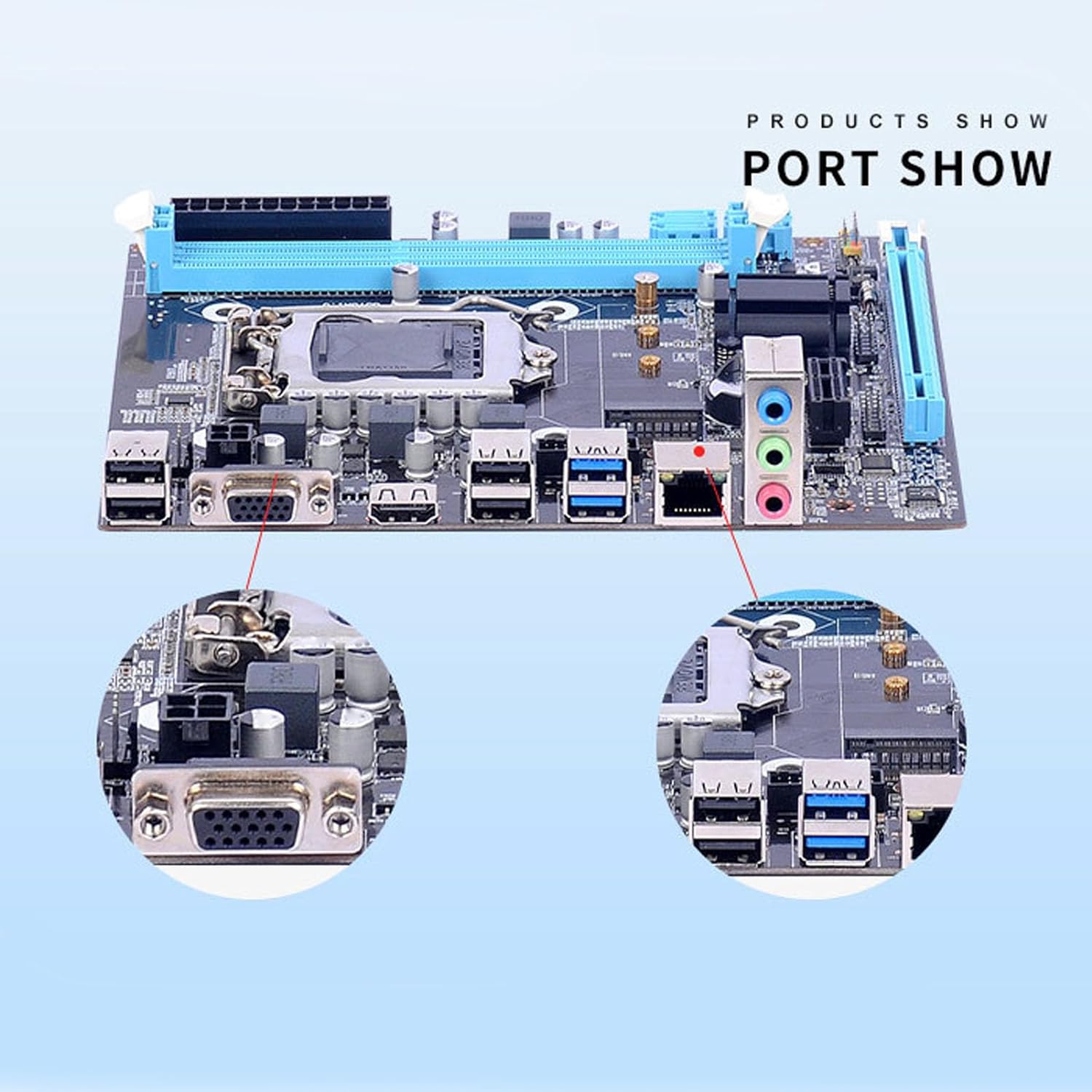
Image: Close-up of the M.2 slot and SATA 2.0/3.0 ports for connecting storage devices, including the M.2 jumper.
Operating
Once all components are installed and connected, you can power on your system:
- Initial Power On: Press the power button on your computer case. The system should boot up and display the BIOS/UEFI screen or begin the operating system installation process.
- BIOS/UEFI Configuration: Access the BIOS/UEFI setup by pressing the designated key (usually Del, F2, or F10) during startup. Configure boot order, system time, and other settings as needed.
- Operating System Installation: Install your preferred operating system (e.g., Windows 10) from a bootable USB drive or DVD.
- Driver Installation: After installing the operating system, install all necessary drivers from the provided driver CD or download the latest versions from the manufacturer's website. This includes chipset drivers, audio drivers, LAN drivers, and any other peripheral drivers.
- System Optimization: For optimal performance, ensure your BIOS/UEFI is updated and all drivers are current.
Video: Overview of the H81 Motherboard's features and interfaces. This video provides a visual guide to the various ports and slots on the motherboard, useful for understanding connectivity.
Maintenance
Regular maintenance helps ensure the longevity and stable performance of your motherboard:
- Keep it Clean: Periodically clean dust from inside your computer case, especially around the motherboard, CPU cooler, and fan vents. Use compressed air and anti-static brushes.
- Check Connections: Ensure all cables (power, SATA, front panel) are securely connected. Loose connections can cause system instability.
- Monitor Temperatures: Use monitoring software to keep an eye on CPU and chipset temperatures. Excessive heat can degrade components over time.
- Update Drivers and BIOS/UEFI: Regularly check for updated drivers and BIOS/UEFI versions from the manufacturer's website to improve compatibility, performance, and security.
- Avoid Static Discharge: Always ground yourself before handling internal components to prevent electrostatic discharge (ESD) damage.
Troubleshooting
If you encounter issues with your motherboard, consider the following common troubleshooting steps:
- No Power/No Boot:
- Check all power connections (24-pin ATX, 4-pin CPU).
- Ensure the power supply is switched on and functioning.
- Verify the front panel power switch cable is correctly connected to the motherboard header.
- No Display:
- Ensure the monitor is connected to the correct video output (motherboard or graphics card).
- Reseat the graphics card and RAM modules.
- Test with a different monitor or video cable.
- System Instability/Crashes:
- Check CPU and RAM for proper installation.
- Run memory diagnostic tools to check for faulty RAM.
- Ensure CPU cooler is properly installed and thermal paste is applied.
- Update all drivers and BIOS/UEFI.
- Storage Device Not Detected:
- Verify SATA data and power cables are securely connected.
- Check BIOS/UEFI settings to ensure SATA ports are enabled and M.2 mode is correctly configured (NVMe/NGFF).
- Ensure the M.2 jumper is set to the correct mode as per the product description.
- Peripheral Issues:
- Try connecting the peripheral to a different USB port.
- Install or update USB drivers.
- Check for conflicts in Device Manager (Windows).
If these steps do not resolve the issue, consult the manufacturer's support resources or a qualified technician.
Specifications
| Feature | Detail |
|---|---|
| Model | Pomyawvczfu6179 |
| CPU Socket | LGA 1150 |
| Compatible Processors | 4th Gen Intel Core i3/i5/i7, Xeon E3 V3 series, G series (e.g., i7 4790K, i5 4690K, i3 4160T, E3 1280 v3, G3260T, G1830) |
| Chipset Type | Intel H81 |
| Memory Slots | 2 x 240-pin DDR3 SDRAM |
| Memory Technology | DDR3 (Unbuffered) |
| Memory Frequency | 1066MHz, 1333MHz, 1600MHz |
| Max Memory Capacity | 16GB |
| Storage Ports | 2 x SATA 2.0 (3GB/s), 1 x SATA 3.0 (6GB/s) |
| M.2 Slot | 1 x M.2 slot (supports NVMe and NGFF modes with jumper) |
| Expansion Slots | 1 x PCI Express x16, 1 x PCI Express x1 |
| LAN | 10/100 Mbps (1000Mbps Optional) |
| USB Ports (Rear) | 4 x USB 2.0, 2 x USB 3.0 |
| Video Output | 1 x VGA, 1 x HD Multimedia Interface compatible |
| Audio | 3-in-1 audio interface (Line In, Line Out, Microphone) |
| Form Factor | Micro ATX (17cm x 19cm / 6.69in x 7.48in) |
| PCB Layers | 8 layers |
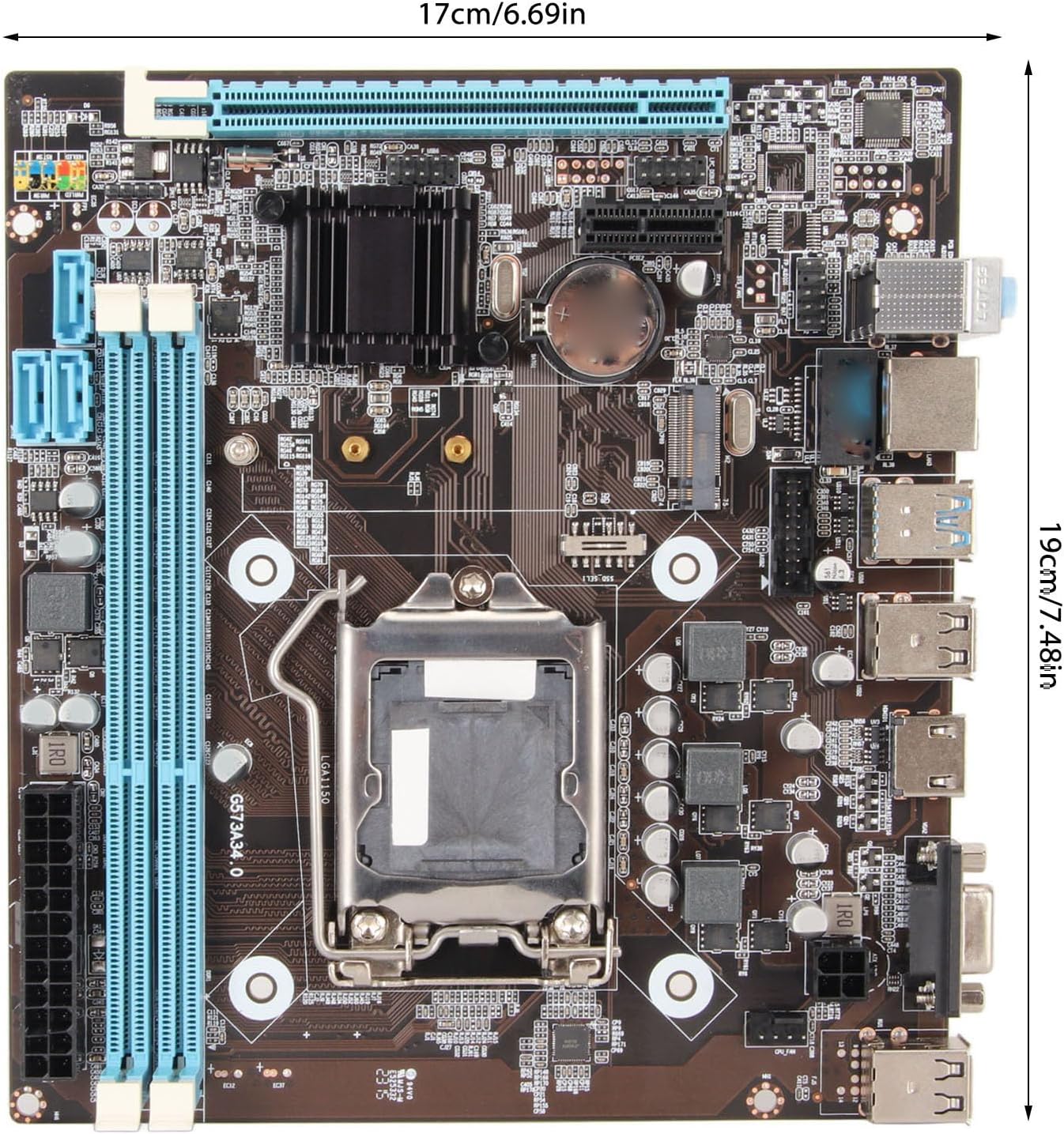
Image: Diagram showing the dimensions of the Micro ATX motherboard (17cm x 19cm).

Image: Infographic highlighting key components: NVMe connector, CPU socket, audio chipset, and DDR3 memory slots.
Warranty and Support
For warranty information and technical support, please refer to the documentation included with your purchase or visit the official Pomya website. Standard warranty terms typically cover manufacturing defects for a specified period from the date of purchase. Keep your proof of purchase for warranty claims.
Contact Information:
- Manufacturer: Pomya
- For support, visit the Pomya Store on Amazon or their official website.