Hantek TO1000 Series Full Touch Screen Oscilloscope Instruction Manual
Model: TO1112
1. Product Overview
The Hantek TO1000 Series is a versatile full touch screen smart oscilloscope designed for various measurement tasks. It integrates multiple functions including a digital storage oscilloscope, a high-precision multimeter, and a signal generator. The device features a multi-touch large screen with a resolution of up to 800x480, offering a user-friendly interface and an intuitive interaction experience.
Key features include:
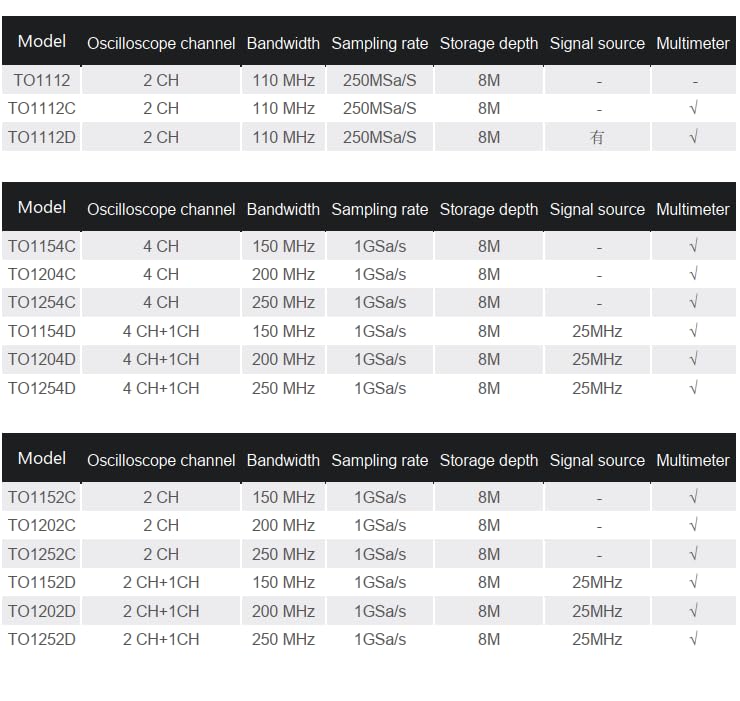
Standard configuration of 2-channel oscilloscope with a maximum bandwidth of 110MHz and a maximum sampling rate of 1GSa/s, featuring 8M large storage.
High-precision multimeter with data recording, storage, trend chart, and statistical analysis functions.
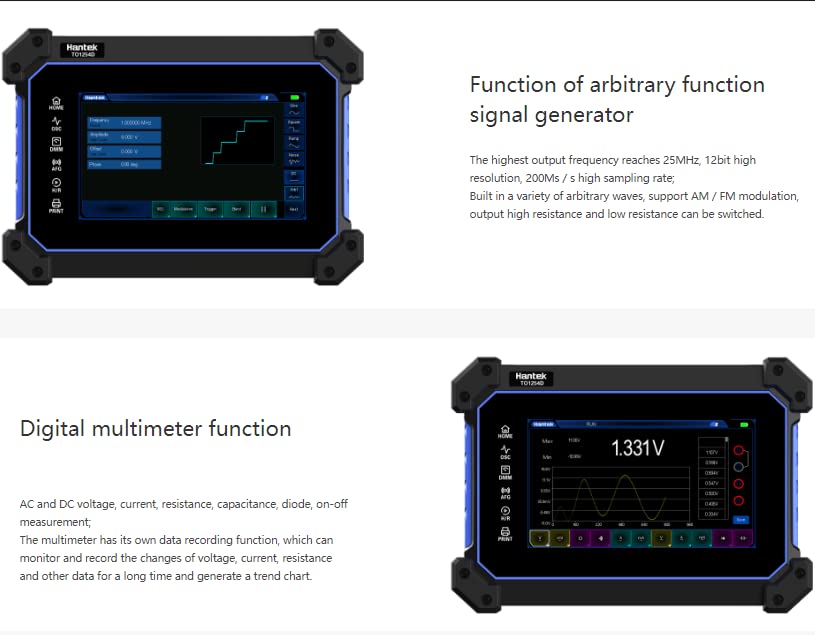
Built-in arbitrary waveform signal generator with a highest output frequency of 25MHz.
One-key waveform storage for convenient and fast data saving.
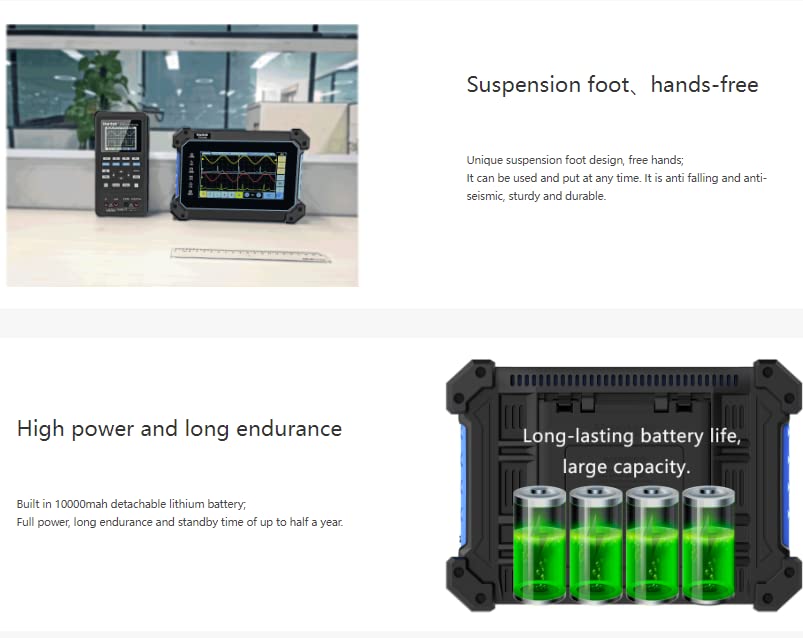
Suspension foot design for multi-angle adjustment, anti-falling, and anti-seismic protection.
Built-in super large capacity lithium battery for long endurance, with standby time up to half a year.
Standard 18W charger supporting Type-C fast charging.
Figure 1.1: Main view of the Hantek TO1000 Series Oscilloscope.
Figure 1.2: The Hantek TO1000 Series integrates multiple functions, including oscilloscope, multimeter, signal generator, and more, accessible via its touch screen interface.
Video 1.1: Overview of Hantek TO1000 Series features and design, demonstrating its multi-functionality and portability.
2. Setup
2.1 Initial Charging
Before first use, fully charge the device using the provided 18W Type-C charger. Connect the charger to the Type-C port on the side of the oscilloscope and plug it into a power outlet. The charging indicator will show the charging status. A full charge ensures optimal battery life and performance.
2.2 Powering On/Off
To Power On: Press and hold the power button located on the side of the device until the Hantek logo appears on the screen.
To Power Off: Press and hold the power button until a power-off prompt appears on the screen. Follow the on-screen instructions to shut down the device.
2.3 Connecting Probes
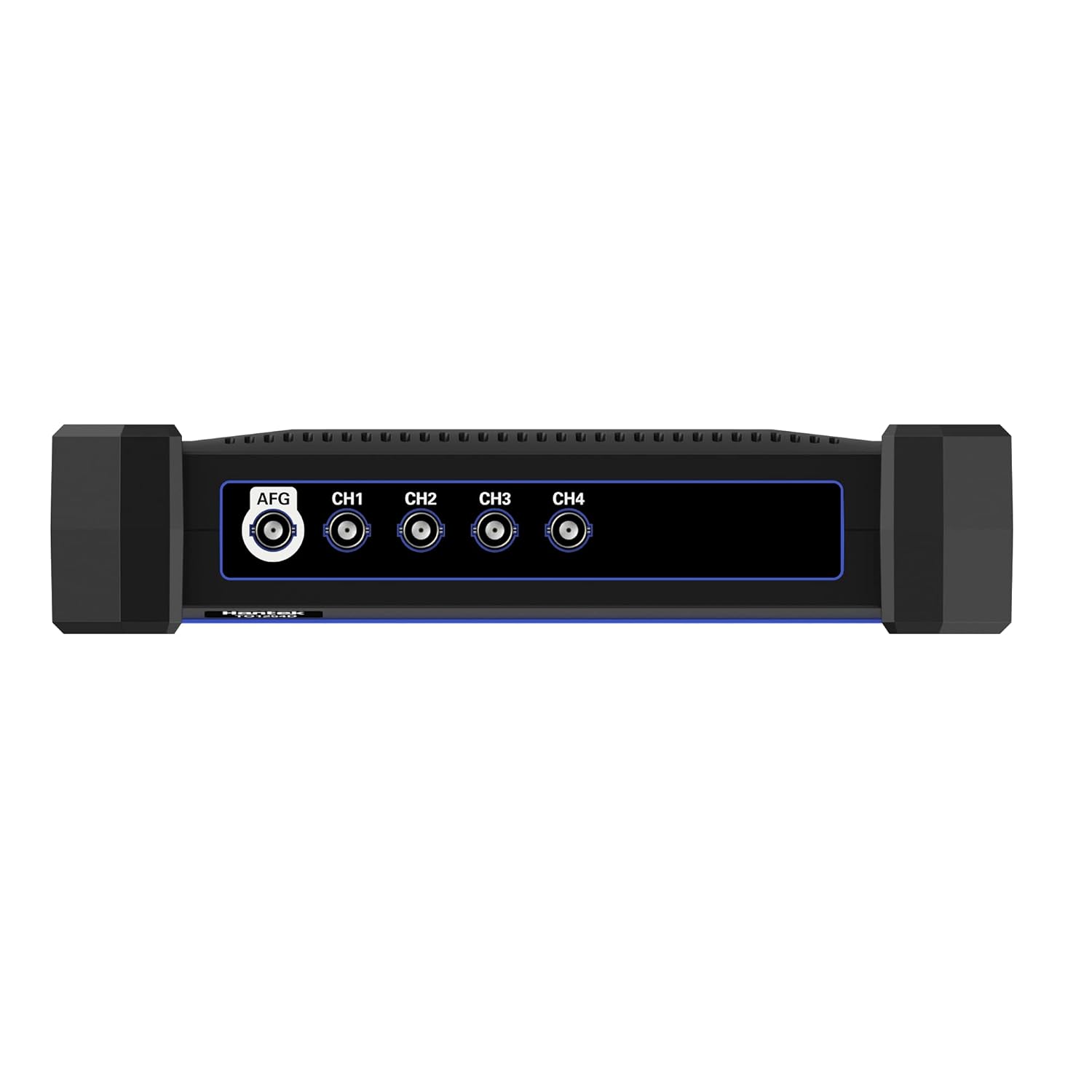
Connect the oscilloscope probes to the BNC connectors (CH1, CH2) on the top of the device. Ensure a secure connection. For multimeter functions, use the dedicated multimeter probes and connect them to the appropriate ports (V/Ω/C, COM, mA, A) on the side of the device.
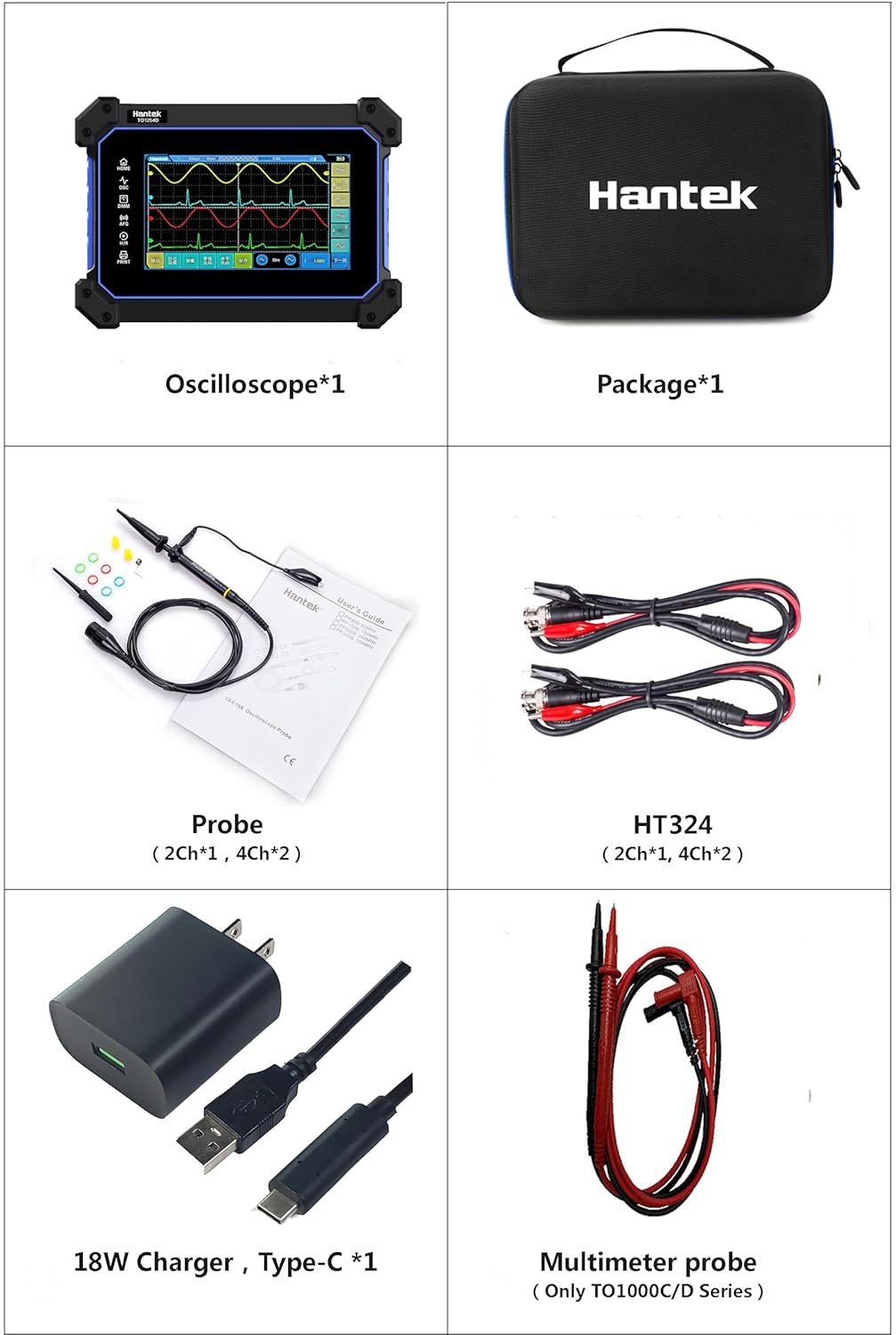
Figure 2.1: Included accessories, showing oscilloscope, probes, HT324 cables, 18W Type-C charger, and multimeter probes.
3. Operating Instructions
3.1 Navigating the Touch Screen Interface
The TO1000 Series features a multi-touch screen. Use gestures such as tap, swipe, and pinch-to-zoom for navigation and control. The main screen displays icons for different functions: Oscilloscope (OSC), Digital Multimeter (DMM), Arbitrary Function Generator (AFG), File Browser, Settings, and Pictures.
3.2 Oscilloscope Function (OSC)
Tap the 'OSC' icon to enter the oscilloscope interface. Here you can view and analyze waveforms. The TO1112 model offers 2 channels with 110MHz bandwidth and 1GSa/s sampling rate.
Channel Selection: Select active channels (CH1, CH2) from the on-screen menu.
Vertical Scale (Volts/Div): Adjust the vertical scale using touch controls to change the voltage per division.
Horizontal Scale (Time/Div): Adjust the horizontal scale to change the time per division.
Trigger Settings: Configure trigger type (Edge, Slope, Pulse Width, Video, Timeout), source, and level to stabilize waveforms.
Measurements: Access automatic measurement functions for parameters like frequency, period, Vpp, Vmax, Vmin, etc.
Waveform Storage: Use the one-key waveform storage feature to save current waveforms.
Figure 3.1: The oscilloscope interface showing multiple waveforms and measurement parameters on the touch screen.
3.3 Digital Multimeter Function (DMM)
Tap the 'DMM' icon to access the digital multimeter. This function provides high-precision measurements for various electrical parameters.
Measurement Modes: Select between AC/DC voltage, current, resistance, capacitance, diode test, and on-off measurement.
Data Recording: The multimeter has a data recording function to monitor and record changes in voltage, current, and resistance over time, generating trend charts.
Figure 3.2: The digital multimeter interface displaying voltage readings and a trend graph.
3.4 Arbitrary Function Generator (AFG)
Tap the 'AFG' icon to enter the arbitrary function generator interface. This allows you to generate various waveforms for testing purposes.
Waveform Selection: Choose from a variety of built-in arbitrary waveforms.
Frequency and Amplitude: Adjust the output frequency (up to 25MHz) and amplitude of the generated signal.
Modulation: Support for AM/FM modulation.
Output Impedance: Switch between high resistance and low resistance output.
Figure 3.3: The arbitrary function generator interface, showing waveform selection and parameter adjustments.
4. Maintenance
4.1 Cleaning the Device
Use a soft, dry cloth to clean the exterior of the oscilloscope. For the touch screen, use a screen-specific cleaning solution and a microfiber cloth. Avoid using abrasive cleaners or solvents that could damage the screen or casing.
4.2 Battery Care
The device is equipped with a high-capacity lithium battery. To prolong battery life:
Avoid fully discharging the battery frequently.
Store the device in a cool, dry place when not in use for extended periods, with the battery charged to approximately 50-70%.
Use only the provided 18W Type-C charger or a compatible charger to prevent damage.
4.3 Storage
When storing the device, especially for long periods, ensure it is powered off and placed in a protective case to prevent physical damage. The suspension foot design allows for stable placement on various surfaces.
Figure 4.1: The suspension foot design allows for hands-free operation and stable positioning.
5. Troubleshooting
5.1 Device Not Powering On
Check Battery: Ensure the battery is sufficiently charged. Connect the device to the charger and wait a few minutes before attempting to power on again.
Charger Connection: Verify that the Type-C charger is properly connected to both the device and a working power outlet.
Power Button: Ensure the power button is pressed and held for the required duration (typically a few seconds) to initiate power-on.
5.2 Incorrect or Unstable Readings
Probe Connection: Ensure all probes (oscilloscope or multimeter) are securely connected to the device and the circuit under test. Loose connections can cause erratic readings.
Probe Compensation: For oscilloscope probes, perform probe compensation if waveforms appear distorted (e.g., overshoots or undershoots). Refer to the detailed user manual for compensation procedures.
Measurement Range: Ensure the correct voltage/current/resistance range is selected for the multimeter function.
Environmental Factors: Strong electromagnetic interference can affect measurements. Operate the device in a stable environment.
5.3 Touch Screen Unresponsive
Restart Device: If the touch screen becomes unresponsive, try restarting the device by holding down the power button.
Clean Screen: Ensure the screen is clean and free of debris or moisture that might interfere with touch input.
6. Specifications
Feature
Specification
Manufacturer
Hantek Qingdao
Model Number
YQH-TO1112
Item Weight
1.5 kg
Product Dimensions
21 x 11 x 16 cm
Batteries
1 Lithium Metal battery required (included)
Oscilloscope Channels
2 Channels
Bandwidth
110 MHz
Sampling Rate
250MSa/s (for TO1112)
Storage Depth
8M
Signal Source
Not included in TO1112 (available in 'D' models)
Multimeter Function
Yes
Wattage
10 watts
Measurement Accuracy
0.5%
Certifications
CE, ISO 9001, RoHS
Material
Acrylonitrile Butadiene Styrene
Color
Multicolored
7. Warranty and Support
7.1 Warranty Information
Please refer to the warranty card included with your product for specific warranty terms and conditions. Generally, Hantek products come with a limited warranty covering manufacturing defects from the date of purchase. Keep your proof of purchase for warranty claims.
7.2 Technical Support
For technical assistance, troubleshooting, or service inquiries, please contact Hantek customer support. You can typically find contact information on the official Hantek website or through the retailer where you purchased the product. When contacting support, please have your product model number (TO1112) and serial number ready.
Related Documents - TO1112
Hantek2000 Series Handheld Oscilloscope User Manual Comprehensive user manual for the Hantek2000 Series handheld oscilloscopes, detailing features, operation, DMM functions, signal generation, troubleshooting, and technical specifications for models like Hantek2C72, Hantek2C42, Hantek2D72, and Hantek2D42.
Hantek2000 Series Handheld Scopemeter User Manual V1.1 This user manual provides comprehensive instructions and specifications for the Hantek2000 Series Handheld Scopemeter, covering its features, operation, safety guidelines, troubleshooting, and technical details.
Hantek2D82 Automotive Diagnostic Oscilloscope User Manual | Comprehensive Guide Explore the Hantek2D82 Automotive Diagnostic Oscilloscope. This user manual provides detailed information on its features, operation, safety, technical specifications, and troubleshooting for automotive diagnostics, DMM, and waveform generation.
Hantek DSO2D20 Series Digital Oscilloscope User Manual Comprehensive user manual for the Hantek DSO2D20 series digital oscilloscopes, detailing features, operation, troubleshooting, and specifications for accurate signal analysis.