
1. Introduction
The ANCEL L3000 Digital Automotive Smoke Leak Detector is a professional tool designed for diagnosing leaks in various vehicle systems. It provides precise measurement of pressure drop rates and visually identifies leaks using smoke output. This manual provides detailed instructions for the safe and effective use of the device.
The L3000 is equipped with an integrated LED display and a precision pressure gauge to quantify leaks, moving beyond simple leak location to measure severity. It includes four essential adapters for secure sealing on most gasoline and diesel engines, enabling testing of EVAP systems, intake manifolds, turbo piping, and vacuum lines.

Image 1.1: Diagram illustrating various vehicle systems where leaks can occur, including exhaust, EGR, crankcase, turbo, fuel tank, EVAP, intake, and cooling systems. Below are descriptions of Major, Minor, and Undetectable leaks.
2. Safety Information
Always observe the following safety precautions when operating the ANCEL L3000 to prevent injury or damage to the device or vehicle:
- Wear appropriate personal protective equipment, including safety glasses and gloves.
- Ensure adequate ventilation in the work area to disperse smoke.
- Do not operate the device near open flames or sources of ignition.
- Use only the recommended test oil (baby oil is suitable) in the device.
- Connect the power clamps correctly: red to positive (+), black to negative (-). Incorrect connection can damage the device.
- Avoid using the device in windy environments, as this can affect smoke visibility.
- The device features anti-frost protection down to -20°C and over-heat protection up to 75°C. Do not operate outside these temperature ranges.
- Keep the device away from water and moisture.

Image 2.1: This image highlights the ANCEL L3000's safety features, including anti-frost protection down to -20°C and over-heat protection up to 75°C. It also shows the wide range of vehicles it can be used on, such as cars, ATVs, boats, motorcycles, snowmobiles, and light trucks.
3. Package Contents
The ANCEL L3000 package typically includes the following items:
- ANCEL L3000 Digital Automotive Smoke Leak Detector Unit
- Power Cable with Battery Clamps
- Smoke Output Hose
- Various Universal Automotive Adapters (e.g., for engine, fuel, intake systems, and a cone set)
- Oil Fill Bottle/Funnel
- User Manual

Image 3.1: A collection of universal automotive adapters designed for use with the ANCEL L3000, including specific adapters for engine systems, fuel systems, intake systems, and a general adapter cone set.
4. Product Overview
The ANCEL L3000 is a compact and robust diagnostic tool. Key components include:
- Digital Display: Shows real-time pressure readings in various units (Psi, Bar, Kpa, kg/cm²).
- Pressure Gauge: Provides a visual indication of system pressure.
- Flow Meter: Indicates the rate of smoke output and helps assess leak size.
- Oil Fill Port: For adding test oil to the smoke generator.
- Smoke Output Port: Connects to the smoke hose.
- Power Input: Connects to a 12V vehicle battery.
- Built-in Air Pump: Generates smoke without needing an external air compressor.

Image 4.1: A red ANCEL L3000 diagnostic leak detector unit, featuring a digital display, pressure gauge, and various connection hoses and adapters.

Image 4.2: A detailed view of the digital display gauge, emphasizing its high accuracy, customizable unit preferences (Psi, Bar, Kpa, kg/cm²), and memory functionality for precise leak insights.

Image 4.3: An internal view of the ANCEL L3000's built-in air pump, which ensures hands-free smoke generation, precise and adjustable smoke output, quick smoke generation, and reduces the need for external air compressors, improving testing ease and efficiency.
5. Setup
Follow these steps to prepare the ANCEL L3000 for operation:
- Add Test Oil: Open the oil fill port and carefully pour the recommended test oil (e.g., baby oil) into the reservoir using the provided funnel. Do not overfill; ensure the oil level is within the indicated range.
- Connect the Machine: Attach the smoke output hose to the smoke output port on the device.
- Prepare Vehicle Connection: Disconnect the pipe or system component on the vehicle that needs to be tested. Select the appropriate adapter from the kit to seal the opening securely.
- Connect Power: Connect the red power clamp to the vehicle's positive (+) battery terminal and the black power clamp to the negative (-) battery terminal. Ensure a secure connection.

Image 5.1: A simplified visual guide showing the four steps for quick setup: 1) Fill test oil (baby oil recommended), 2) Disconnect the pipe to be tested, 3) Connect the detector to a DC 12V battery and choose work mode, and 4) Inspect for smoke to identify leak points.
6. Operation
The ANCEL L3000 offers two primary modes for leak detection:
6.1. Air Mode (Pressure Decay Test)
Air Mode is used to quickly diagnose if a leak exists and to quantify its severity by monitoring pressure drops. This mode is particularly useful for small leaks that may not produce visible smoke immediately.
- After setup, select Air Mode on the device.
- The device will pressurize the system with air.
- Observe the digital display and pressure gauge. A drop in pressure indicates a leak. The rate of pressure drop helps determine the leak's size.
- For very small leaks (e.g., less than 0.2mm), the smoke may not be immediately obvious. In such cases, rely on the pressure decay reading.
6.2. Smoke Mode
Smoke Mode is used to visually locate the exact point of a leak once its presence has been confirmed.
- After setup, select Smoke Mode on the device.
- The device will begin generating and outputting smoke through the hose.
- Direct the smoke output into the sealed system.
- Visually inspect all connections, hoses, and components for escaping smoke, which indicates the leak location.
- Adjust the smoke output volume as needed using the control knob for optimal visibility.
6.3. EVAP System Testing
For EVAP systems, which often require lower pressure, an optional external pressure regulator may be beneficial to optimize testing.
- Connect an external pressure regulator (7-12 PSI recommended) between the smoke output hose and the EVAP system.
- Proceed with Air Mode or Smoke Mode as described above, ensuring the pressure is appropriate for the EVAP system.
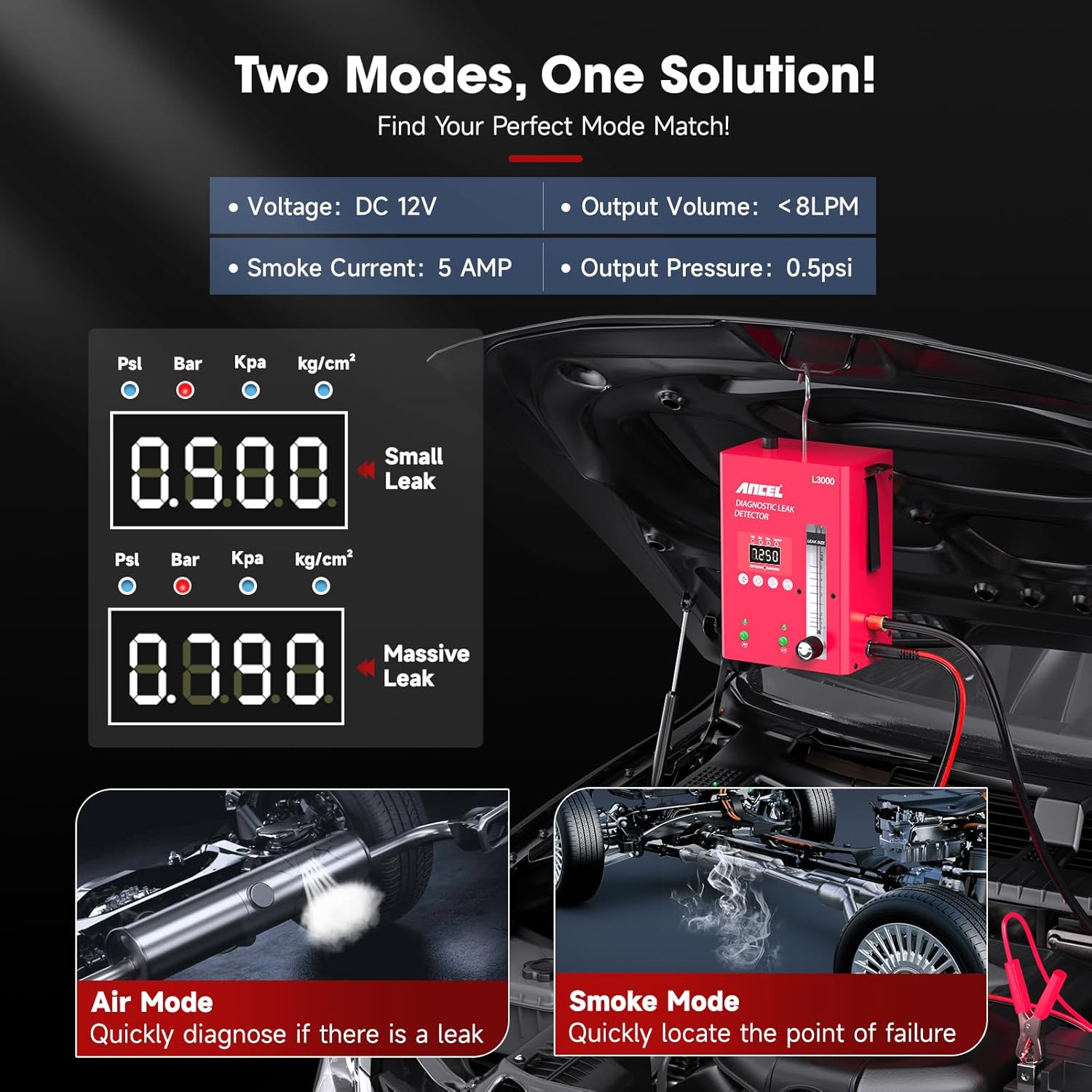
Image 6.1: This image explains the two operational modes: Air Mode, which quickly diagnoses the presence of a leak by showing pressure drops for small or massive leaks on the digital display, and Smoke Mode, which helps quickly locate the exact point of failure using visible smoke.

Image 6.2: This image demonstrates how to optimize the ANCEL L3000 for EVAP systems by adding an external pressure regulator (7-12 PSI) for low-pressure testing, ensuring accurate diagnosis for sensitive systems.
7. Maintenance
Proper maintenance ensures the longevity and reliable performance of your ANCEL L3000.
- Oil Level: Regularly check the oil level before each use. Refill if it is below the minimum mark.
- Smoke Oil: Use only clean, recommended test oil. Incompatible oils can lead to weak smoke or oil drips.
- Smoke Hose: Periodically remove the smoke hose and dry it to prevent normal smoke condensation from affecting performance.
- Cleaning: Wipe the exterior of the device with a soft, damp cloth. Do not use abrasive cleaners or solvents.
- Storage: Store the device in a cool, dry place away from direct sunlight and extreme temperatures.
8. Troubleshooting
Refer to the table below for common issues and their solutions:
| Error | Possible Reason | Solution |
|---|---|---|
| LED is not ON | Mistaken positive to negative connection | Connect to power source correctly (red to +, black to -) |
| LED is not ON | Poor connection of power line | Check with meter if the powerline is broken, confirm and replace the power line |
| Pump is on but no air output | Flow Dial not open | Open the flow dial anti-clockwise |
| Pump is on but no air output | Pump failure | Replace a new pump |
| No smoke output | No air output | Open the flow dial anti-clockwise |
| No smoke output | Smoke oil at min. limit or overfilled | Check oil level; turn unit upside down while the oil filter port is open and refill to the correct level |
| No smoke output | Voltage low | Check battery voltage if it's over 12V |
| No smoke output | Heater damaged | Run Air Mode, plug up the smoke outlet, observe if there's pressure change in the pressure gauge |
| Weak smoke, obvious oil drops from the output | Smoke oil not compatible | Change proper smoke oil |
| Slow oil drops from the output | Normal smoke condensation | Periodically take off the smoke hose and dry it |
| Sudden stop of smoke output | Overheat protection activated | Cool down the unit before using again |

Image 8.1: A table outlining common operational errors, their potential causes, and corresponding solutions.
9. Specifications
| Feature | Detail |
|---|---|
| Model Number | ANCEL L3000 |
| Manufacturer Part Number | L3000-UK |
| Power Input | DC 12V |
| Smoke Current | 5 AMP |
| Output Volume | < 8LPM |
| Output Pressure | 0.5psi |
| Item Weight | 5.06 pounds (approx. 2.3 kg) |
| Product Dimensions | 5 x 3.35 x 18.5 inches (approx. 12.7 x 8.5 x 47 cm) |
| Operating Temperature | -20°C to 75°C (Anti-frost and Over-heat Protection) |
| Display Units | Psi, Bar, Kpa, kg/cm² |
10. Warranty and Support
For warranty information, technical support, or service inquiries, please refer to the official ANCEL website or contact their customer service directly. Details regarding product registration and warranty claims can typically be found on the manufacturer's support pages.
Please retain your purchase receipt as proof of purchase for any warranty-related services.