
ZHDBD 8898
ZHDBD 8898 2-in-1 Soldering and Rework Station User Manual
Model: 8898
Introduction
This manual provides essential instructions for the safe and effective operation, setup, and maintenance of your ZHDBD 8898 2-in-1 Soldering and Rework Station. This device integrates a hot air gun and a soldering iron, designed for precision electronic repair and soldering tasks.
Please read this manual thoroughly before using the product and retain it for future reference.
Safety Precautions
- Always operate the station in a well-ventilated area to avoid inhaling fumes.
- Wear appropriate personal protective equipment, including safety glasses and heat-resistant gloves.
- The soldering iron tip and hot air nozzle reach very high temperatures. Avoid direct contact.
- Ensure the power cord is undamaged and properly grounded.
- Do not use the station near flammable materials or gases.
- Unplug the unit from the power outlet when not in use or before cleaning/maintenance.
- Keep out of reach of children.
Product Components
The ZHDBD 8898 Soldering and Rework Station typically includes the following components:
- Main Control Unit with Digital Displays
- Hot Air Gun
- Soldering Iron
- Soldering Iron Stand
- Hot Air Nozzles (various sizes)
- Power Cord
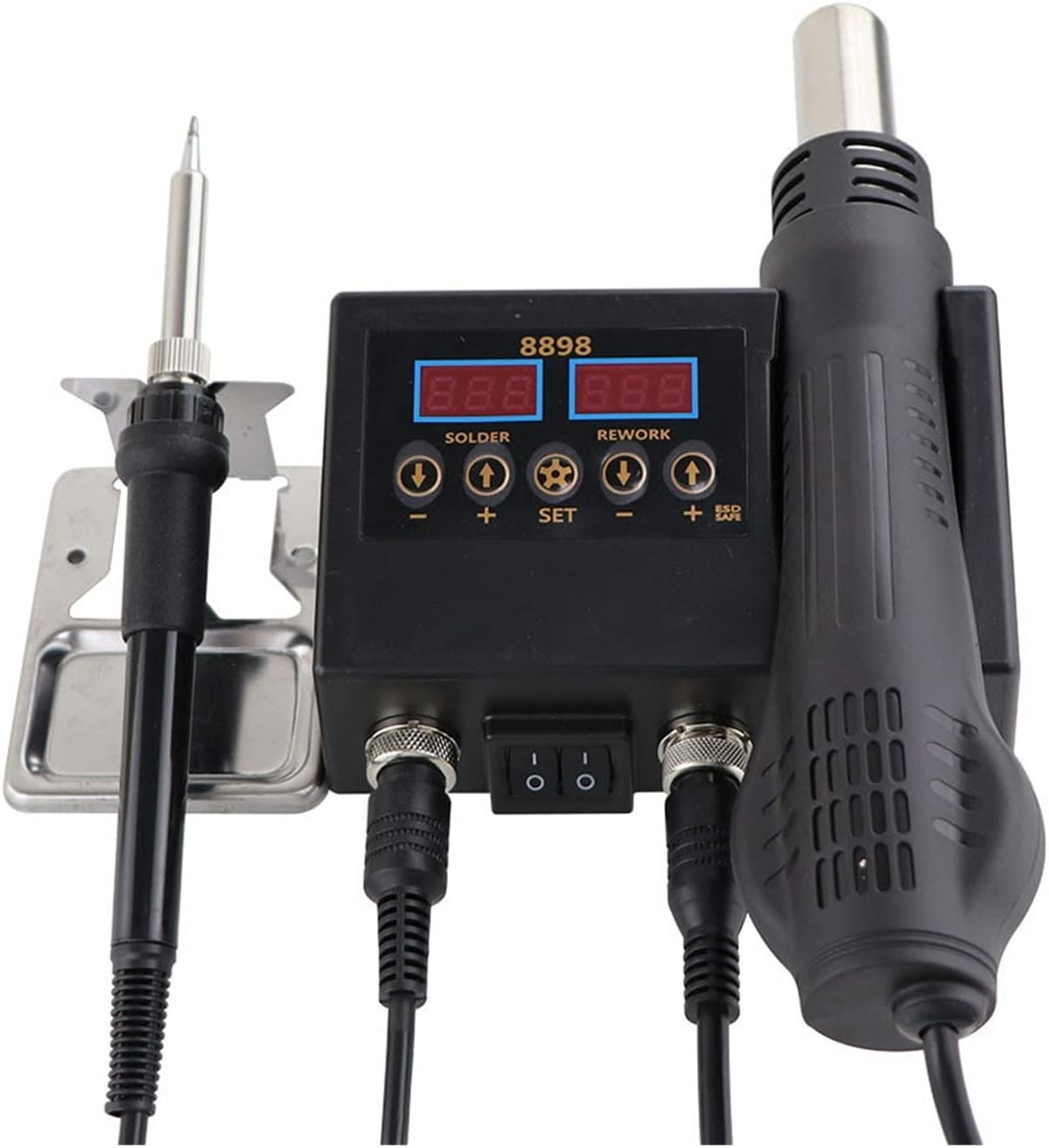
Image: The ZHDBD 8898 Soldering and Rework Station, showing the main control unit, soldering iron, and hot air gun connected. The digital displays for solder and rework temperatures are visible.

Image: The ZHDBD 8898 Soldering and Rework Station, including the main unit, soldering iron, hot air gun, and a set of three different sized hot air nozzles.
Setup Instructions
- Unpacking: Carefully remove all components from the packaging. Inspect for any damage.
- Placement: Place the main control unit on a stable, heat-resistant, and non-flammable surface. Ensure adequate clearance for ventilation.
- Connect Soldering Iron: Plug the soldering iron cable into the designated "SOLDER" port on the main unit. Place the soldering iron securely in its stand.
- Connect Hot Air Gun: Plug the hot air gun cable into the designated "REWORK" port on the main unit. Ensure the hot air gun is placed in its holder on the side of the unit.
- Attach Nozzle (Hot Air Gun): Select the appropriate hot air nozzle for your task and securely attach it to the hot air gun.
- Power Connection: Connect the power cord to the main unit and then plug it into a grounded electrical outlet.
Operating Instructions
General Operation
- Power On: Flip the main power switch on the front of the unit to the "ON" position. The digital displays will illuminate.
- Temperature Adjustment:
- For the Soldering Iron: Use the "SOLDER" temperature adjustment buttons (+ and -) to set the desired temperature. The recommended temperature range is 180°C-500°C.
- For the Hot Air Gun: Use the "REWORK" temperature adjustment buttons (+ and -) to set the desired temperature. The recommended temperature range is 100°C-480°C.
- Air Flow Adjustment (Hot Air Gun): Use the "REWORK" air flow adjustment button (often labeled with a fan icon or "AIR") to control the air volume.
- Automatic Standby (Hot Air Gun): The hot air gun features a sensor switch in its handle. When the handle is placed in its holder, the system will automatically enter standby mode, cooling down the element and prolonging its life. When the handle is picked up, it will quickly return to the set operating temperature.
- Power Off: When finished, flip the main power switch to the "OFF" position. Allow the hot air gun to cool down completely in its holder before unplugging.
Soldering Iron Usage
- Preparation: Ensure the electronic components to be soldered are clean.
- Pre-tinning: Once the iron reaches the desired temperature (recommended 300-400°C), apply a small amount of solder to the heated iron tip. This prevents oxidation and helps transfer heat efficiently. Rub the tip to evenly spread the solder.
- Soldering: Bring the heated, tinned iron tip into contact with both the component lead and the PCB pad simultaneously. Apply solder to the joint, not directly to the iron tip. Allow the solder to flow smoothly and form a shiny, conical joint. Remove the iron and allow the joint to cool without disturbance.
Hot Air Gun Usage (Rework)
- Component Removal: Select an appropriate nozzle. Set the desired temperature and airflow. Direct the hot air stream evenly over the component to be removed. Once the solder melts, carefully lift the component using tweezers.
- Component Installation: Apply solder paste to the pads on the PCB. Carefully place the SMD component onto the solder paste. Direct the hot air stream evenly over the component and pads until the solder paste melts and reflows, forming solid connections.
- Cool Down: After use, place the hot air gun back into its holder. The unit will automatically initiate a cooling cycle to protect the heating element.
Maintenance
- Soldering Iron Tip Cleaning: Regularly clean the soldering iron tip using a damp sponge or brass wool to remove excess solder and oxidation. Re-tin the tip after cleaning.
- Tip Replacement: Replace worn or damaged soldering iron tips to ensure optimal heat transfer and soldering performance.
- Hot Air Nozzle Cleaning: Ensure hot air nozzles are free from debris or blockages. Clean gently if necessary.
- Unit Cleaning: Disconnect power before cleaning. Wipe the main unit with a soft, dry cloth. Do not use abrasive cleaners or solvents.
- Storage: Store the unit in a dry, dust-free environment when not in use.
Troubleshooting
| Problem | Possible Cause | Solution |
|---|---|---|
| Soldering iron not heating up. | Power switch off, loose connection, faulty heating element. | Check power switch. Ensure iron is securely plugged in. If problem persists, contact support. |
| Hot air gun not producing hot air. | Hot air gun not picked up from holder, loose connection, faulty heating element/fan. | Ensure hot air gun is picked up from its holder. Check connection. If problem persists, contact support. |
| Solder not melting properly. | Insufficient temperature, oxidized iron tip, incorrect solder. | Increase temperature. Clean and re-tin the iron tip. Use appropriate solder for electronics. |
| Unit displays an error code. | Internal fault. | Refer to specific error code documentation (if available) or contact customer support. |
Technical Specifications
| Feature | Specification |
|---|---|
| Model | 8898 |
| Input Voltage | Not specified (typically 110V/220V AC, 50/60Hz) |
| Total Output Power | 750W |
| Hot Air Gun | |
| Output Power | 500W |
| Frequency | 50Hz/60Hz |
| Temperature Range | 100°C - 480°C |
| Temperature Stability | ±2°C |
| Air Flow | 120 L/min (max) |
| Soldering Iron | |
| Output Power | 60W |
| Frequency | 50Hz/60Hz |
| Temperature Range | 180°C - 500°C |
| Temperature Stability | ±1°C |
| Heater Material | Ceramics |
| Design | ESD Safe |
Warranty and Support
For warranty information or technical support, please refer to the documentation provided with your purchase or contact the manufacturer directly. Keep your purchase receipt as proof of purchase.
Manufacturer: ZHDBD
Related Documents - 8898
 |
YIHUA 882D Soldering Station Overview An overview of the YIHUA 882D 2-in-1 SMD rework soldering station, featuring a 750W hot air gun, digital LCD display, and convenient airflow control. |
 |
8858-I Anti-static Portable Heat Gun User Manual User manual and operation guide for the 8858-I Anti-static Portable Heat Gun, including safety instructions, heating element replacement, and technical specifications. |
 |
JCD 8208 Soldering Station and Heat Gun User Manual Official user manual for the JCD 8208 soldering station and heat gun. Discover detailed safety guidelines, operating instructions, technical specifications, maintenance tips, and FAQs for this versatile electronics repair tool. |
 |
750W Plastic Repair Welding Gun User Manual Comprehensive usage instructions, safety guidelines, and operation procedures for the 750W Plastic Repair Welding Gun (220V). Learn how to properly prepare, debug, and operate your plastic welder for PE, PP, and PVC materials. |
 |
AZZA PSAZ-750W Power Supply User Manual User manual and specifications for the AZZA PSAZ-750W ATX 3.1 power supply, including safety guidelines for the 12V-2x6 cable, connector details, and dimensions. |
 |
Coemar iWash Halo User Manual Comprehensive user manual for the Coemar iWash Halo lighting fixture, detailing installation, operation, DMX control, maintenance, and troubleshooting procedures. |
Ask a question about this manual
Ask about setup, troubleshooting, compatibility, parts, safety, or missing instructions. Manuals+ will review the question and use this page’s manual context to help answer it.