
1. Introduction
This manual provides essential information for the safe and effective installation, operation, and maintenance of your Pissente 1000W-1500W 26A-32A 12-Tube Dual Mode Rectangular Brushless Motor Controller. Please read this manual thoroughly before use to ensure proper function and to prevent damage to the product or injury.
2. Safety Information
Always observe the following safety precautions:
- Ensure the power supply is disconnected before any installation, wiring, or maintenance work.
- Verify all connections are correct and secure to prevent short circuits or damage.
- Avoid exposing the controller to water, excessive moisture, or extreme temperatures.
- Do not attempt to open or modify the controller casing, as this may void the warranty and pose electrical hazards.
- Seek professional assistance if you are unsure about any installation or wiring procedures.
3. Product Overview
The Pissente Dual Mode Rectangular Brushless Motor Controller is designed for electric bikes and scooters, offering reliable speed control and enhanced performance. It features a robust metal casing for improved heat dissipation and is compatible with a range of motor types.
Key Features:
- Versatile Motor Compatibility: Supports sinusoid and rectangular motors. Not suitable for motors that exclusively rely on Hall sensors for operation.
- Smooth Start: Provides a smooth motor start for comfortable operation.
- Powerful Performance: Offers strong climbing power and low motor running noise.
- Universal Voltage: Compatible with 48V, 60V, 64V, and 72V systems.
- Enhanced Durability: Features a thickened shell for better heat dissipation, upgraded circuit board, power tube, capacitor, and thickened copper bar for higher inductance accuracy.
- Dual Mode Operation: 12-tube convention dual-mode rectangular controller.
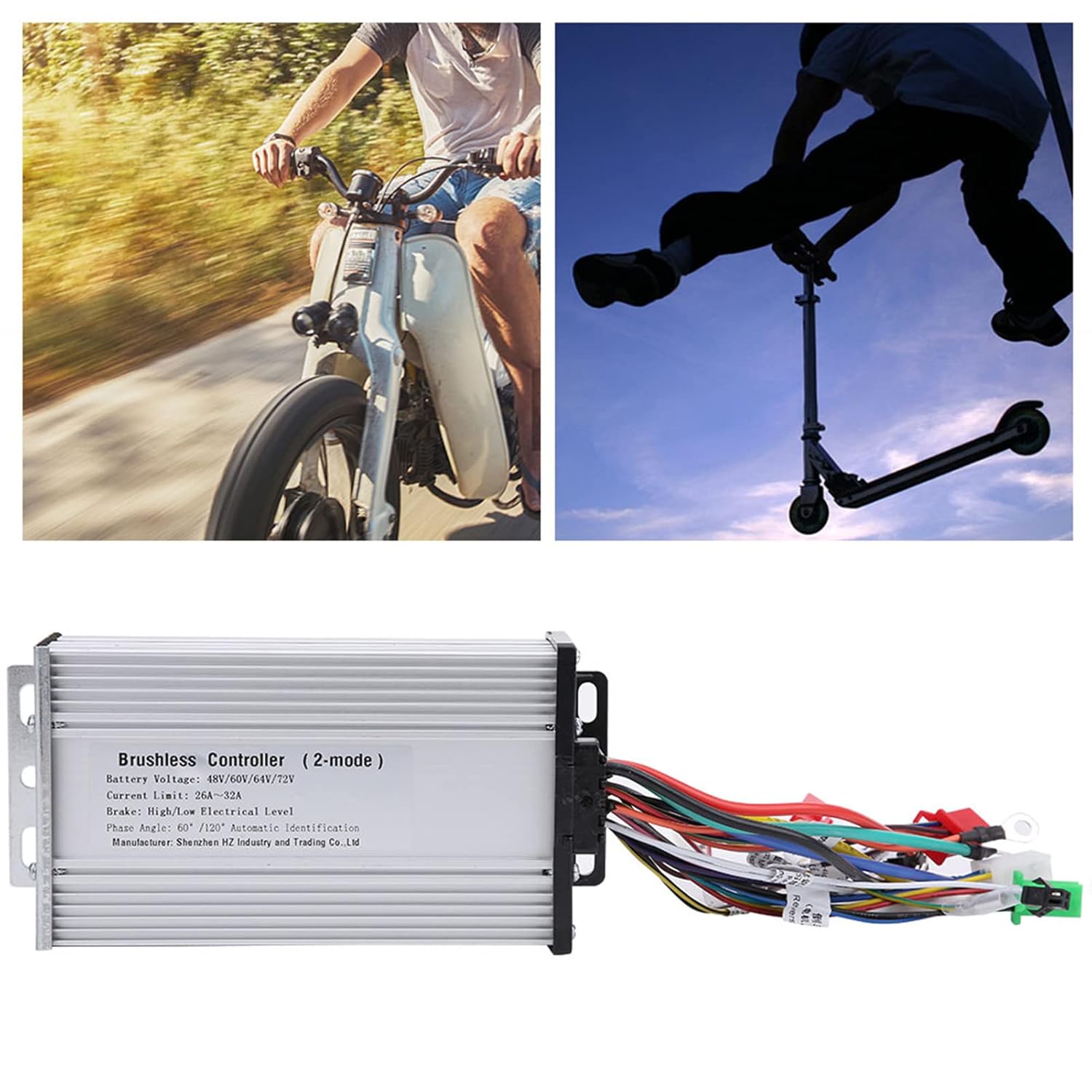
Image: The Pissente Brushless Motor Controller, showcasing its robust metal housing and the array of connection wires.
4. Specifications
| Feature | Specification |
|---|---|
| Brand | Pissente |
| Model Name | Pissentesbhzoepfnk |
| Voltage Compatibility | 48V, 60V, 64V, 72V (Universal) |
| Power Range | 1000W - 1500W |
| Current Limit | 26A - 32A |
| Controller Type | 12-Tube Dual Mode Rectangular |
| Material | Metal |
| Dimensions (L x W x H) | Approx. 17.7 x 8.4 x 4.3 cm (7 x 3.3 x 1.7 inches) |
| Item Weight | Approx. 560 grams (1.23 pounds) |

Image: Dimensions of the Pissente Brushless Motor Controller, showing its length, width, and height.
5. Setup and Installation
Careful installation is crucial for the proper functioning of the motor controller. Ensure all connections are made correctly before applying power.
5.1 Pre-installation Checks
- Confirm that your electric bike or scooter's motor is compatible with a dual-mode rectangular brushless controller.
- Ensure the battery voltage matches the controller's universal voltage range (48V-72V).
- Gather necessary tools for installation (e.g., screwdrivers, wire strippers, electrical tape).
5.2 Wiring Connections
The controller features multiple wires for various functions. Due to potential variations in wire coloring or labeling, it is critical to identify each wire's function accurately before connecting. Refer to the following list of functions:
- Positive Power Supply: Connects to the positive terminal of the battery.
- Negative Power Supply: Connects to the negative terminal of the battery.
- Electric Door Lock: Connects to the ignition switch or electric lock.
- Motor Phase Lines: Connects to the motor's three phase wires (typically thicker wires).
- Hall Line: Connects to the motor's Hall sensor wires (if applicable and present).
- Accelerator Throttle Grip Line: Connects to the throttle for speed control.
- Three-Speed Shift Line: For connecting a three-speed switch (if available).
- Low-Level Brake Line: Connects to the brake lever for low-level braking signal.
- High-Level Brake Line: Connects to the brake lever for high-level braking signal.
- Ordinary Instrument Line: For connecting to a standard display or instrument panel.
- Anti-Theft Alarm Power Line: For connecting to an anti-theft alarm system's power.
- Anti-Theft Alarm Signal Line: For connecting to an anti-theft alarm system's signal.
- Reversing Line: For connecting a reverse function switch (if available).
- Intelligent Identification Self-Learning Line: Used for initial motor pairing and self-learning.
Important: If wire labels are not clear, consult a qualified technician or refer to a detailed wiring diagram specific to your motor and vehicle before making connections. Incorrect wiring can cause severe damage to the controller, motor, or battery.
5.3 Mounting the Controller
- Choose a secure location on your electric bike or scooter that is protected from direct impact, water, and excessive heat.
- Ensure adequate airflow around the controller for optimal heat dissipation.
- Use appropriate fasteners to securely mount the controller.

Image: The Pissente Brushless Motor Controller shown in context with an electric bicycle, illustrating its application.
6. Operating Instructions
Once the controller is correctly installed and all connections are verified, you can begin operation.
6.1 Initial Power-On and Self-Learning
- Ensure all connections are secure and the motor is free to rotate.
- Turn on the electric door lock or ignition.
- Connect the Intelligent Identification Self-Learning Line. The motor should start to rotate. If it rotates in the wrong direction, disconnect and reconnect the self-learning line.
- Once the motor rotates smoothly in the correct direction, disconnect the self-learning line. The controller has now learned the motor's parameters.
6.2 Basic Operation
- Power On/Off: Use the electric door lock or ignition switch to power the system on or off.
- Speed Control: Rotate the accelerator throttle grip to control the motor speed.
- Braking: Activating the brake levers will cut power to the motor.
6.3 Advanced Functions
- Three-Speed Function: If a three-speed switch is connected, use it to select between different speed modes.
- Anti-Theft Alarm: If an anti-theft alarm system is connected, refer to its specific instructions for operation.
- Reversing Function: If a reverse switch is connected, activate it to engage reverse motion.
7. Maintenance
Regular maintenance helps ensure the longevity and optimal performance of your motor controller.
- Cleaning: Keep the controller clean and free from dust, dirt, and debris. Use a dry, soft cloth for cleaning. Do not use water or solvents.
- Inspection: Periodically check all wiring connections for tightness and signs of wear or damage. Ensure the controller is securely mounted.
- Heat Dissipation: Ensure the controller's fins are not obstructed to allow for proper heat dissipation.
- Storage: If storing the vehicle for an extended period, disconnect the battery from the controller.
8. Troubleshooting
This section addresses common issues you might encounter. For problems not listed here, contact customer support.
| Problem | Possible Cause | Solution |
|---|---|---|
| Motor does not run | No power, loose connections, incorrect wiring, faulty throttle, motor issue. | Check battery charge. Verify all power and motor phase connections. Ensure throttle is functioning. Perform self-learning procedure. |
| Motor runs intermittently or roughly | Loose connections, motor phase wire issue, Hall sensor issue (if applicable). | Inspect all wiring for secure connections. Re-perform self-learning. Ensure motor is compatible. |
| Motor runs in wrong direction after self-learning | Self-learning initiated incorrectly. | Disconnect and immediately reconnect the Intelligent Identification Self-Learning Line to reverse direction. |
| Controller gets excessively hot | Overload, insufficient airflow, short circuit. | Reduce load. Ensure controller is mounted in a well-ventilated area. Check for short circuits in wiring. |
| No response from throttle | Throttle not connected, faulty throttle, brake engaged. | Check throttle wiring. Ensure brake levers are not engaged. Test throttle functionality. |
Note on Wiring: As wire labeling can sometimes be absent or unclear, always double-check the function of each wire using a multimeter or by carefully tracing connections if you are experienced. If uncertain, consult a professional to avoid damage.
9. Warranty and Support
For warranty information, please refer to the terms and conditions provided at the point of purchase or contact your seller directly. If you require technical assistance or have questions regarding your Pissente Brushless Motor Controller, please reach out to the seller or manufacturer's customer support channels.