
1. Introduction
The tenlamp G1 Live Sound Card is an integrated audio mixer designed for live streaming, podcasting, recording, singing, and gaming. This equipment bundle includes the G1 audio console and two 3.5mm studio condenser microphones, providing a comprehensive solution for audio production. This manual provides detailed instructions for setting up, operating, maintaining, and troubleshooting your G1 system.
2. Package Contents
Before proceeding, please verify that all items are present in your package:
- tenlamp G1 Audio Console
- 2 x 3.5mm Studio Condenser Microphones
- Microphone Stands and Pop Filters
- USB-C to USB-A Cable (for power and data)
- 3.5mm TRRS Audio Cables (for mobile device connection)
- User Manual
3. Product Overview
The tenlamp G1 audio console features multiple inputs and outputs, along with various controls for audio mixing and effects. Familiarize yourself with the layout before setup.

Image: The tenlamp G1 Live Sound Card and two condenser microphones set up for a two-person podcast, demonstrating a typical usage scenario.
3.1 Front Panel Controls
- Mic VOL Fader: Adjusts the input volume of the connected microphones.
- Music VOL Fader: Adjusts the volume of the background music input.
- Monitor VOL Knob: Controls the volume of the monitoring headphones.
- Output VOL Knob: Controls the main output volume.
- Reverb Effect Fader: Adjusts the intensity of the reverb effect.
- Treble/Bass EQ: Adjusts high and low frequencies for microphone input.
- Voice-change Buttons: Activates various voice modulation effects.
- Sound Pad Buttons: Triggers pre-loaded sound effects.
- Noise Reduction Buttons: Activates different levels of intelligent noise reduction.
3.2 Rear Panel Connections

Image: A detailed view of the tenlamp G1 audio console's rear panel, showing various input and output ports including USB-C, Output, Music, Monitor, Headset, and Mic inputs.
- USB-C Port: For power supply, data transfer to computer, and digital audio I/O. Note: Does not support USB mic connection via this port.
- Output Ports (TRRS): Connects to mobile devices for live streaming or recording.
- Music Input: Connects external audio sources (e.g., phone, tablet) for background music.
- Monitor Output: Connects monitoring headphones.
- Headset Input: Connects a headset with integrated microphone.
- Mic Inputs (3.5mm): Connects the included 3.5mm condenser microphones.
4. Setup Guide
Follow these steps to set up your tenlamp G1 Live Sound Card for optimal performance.
- Connect Microphones: Insert the 3.5mm plugs of the condenser microphones into the designated Mic input jacks on the rear panel of the G1 console. Secure microphones on their stands.
- Connect Monitoring Headphones: Plug your headphones into the Monitor output jack.
- Connect to Power/Computer: Connect the USB-C end of the provided cable to the USB-C port on the G1 console and the USB-A end to your computer's USB port or a power adapter. The device will power on.
- Connect to Mobile Device (Optional): If live streaming or recording on a mobile device, use the TRRS audio cables to connect the Output ports on the G1 to your mobile device's headphone jack.
- Connect Music Source (Optional): If using external background music, connect your music device to the Music input jack.
5. Operating Instructions
This section details how to use the various features of your tenlamp G1 Live Sound Card.
5.1 Basic Audio Mixing
- Adjust Microphone Volume: Use the Mic VOL fader to control the loudness of your voice.
- Adjust Music Volume: Use the Music VOL fader to balance the background music with your voice.
- Monitor Your Audio: Adjust the Monitor VOL knob to set a comfortable listening level in your headphones.
- Control Output Volume: The Output VOL knob controls the overall volume sent to your recording device or live stream.

Image: A close-up of the tenlamp G1 audio console, illustrating the various knobs and faders for fine-tuning audio parameters such as microphone volume, music volume, monitoring, output, reverb, treble/bass, and voice effects.
5.2 Noise Reduction
The G1 features intelligent noise reduction to enhance audio clarity.
- Press the dedicated Noise Reduction buttons (e.g., "Denoise1", "Denoise2", "Denoise3") to activate different levels of noise cancellation. Experiment to find the best setting for your environment.

Image: The tenlamp G1 audio console displaying its noise reduction capabilities, with three distinct levels labeled "Cheer Denoise1", "Kiss Denoise2", and "Guffaw Denoise3" for clear and clean audio recording.
5.3 Special Streaming Features
Enhance your live streams and recordings with these integrated functions:
- Dodge (Auto Ducking): When activated, this feature automatically lowers background music volume when you speak into the microphone, making your voice clearer.
- Remove Vocals: This function attempts to remove the vocal track from accompaniment music, allowing you to sing over instrumental versions.
- Loopback: Enables recording of internal PC audio along with your microphone input via the USB-C connection.

Image: The tenlamp G1 audio console showcasing convenient features for streaming, including "Dodge" for auto-ducking microphone input, "Remove Vocals" to eliminate vocals from accompaniment, and "Loopback" for recording PC internal audio via USB-C.
5.4 Creating Atmosphere
Utilize the built-in effects to customize your audio environment:
- Voice Changers: Select from 4 different voice modulation effects.
- Reverb Modes: Choose from 5 preset reverb modes to add depth to your vocals.
- Auto Tune: Apply 12-step auto-tune for pitch correction.
- Sound Pads: Trigger various sound effects using the dedicated buttons.
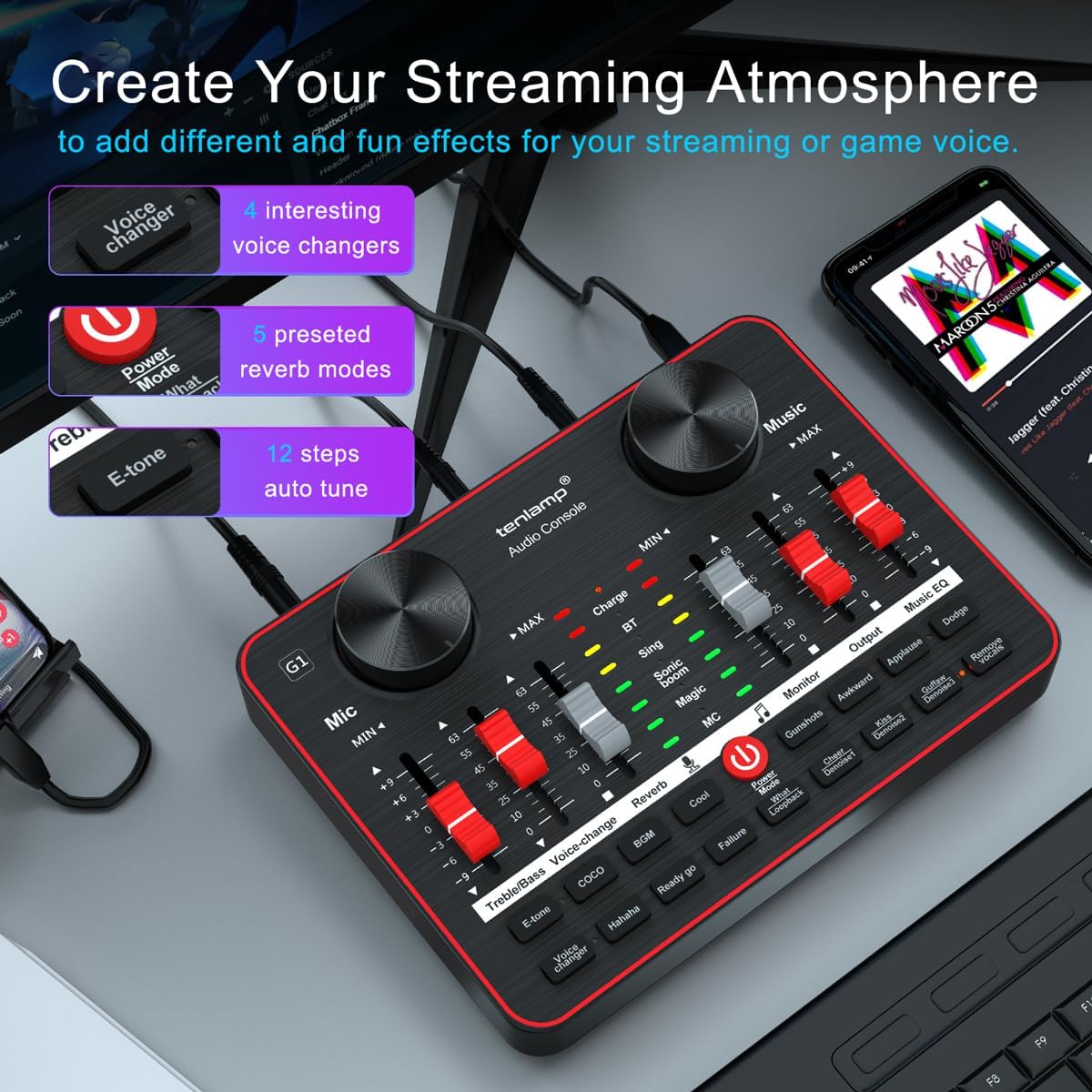
Image: The tenlamp G1 audio console highlighting features designed to create a streaming atmosphere, such as 4 interesting voice changers, 5 preset reverb modes, and 12 steps of auto-tune.
6. Maintenance
Proper care ensures the longevity and performance of your tenlamp G1 system.
- Cleaning: Use a soft, dry cloth to wipe the surface of the audio console and microphones. Avoid liquid cleaners or abrasive materials.
- Storage: Store the device in a cool, dry place away from direct sunlight and extreme temperatures when not in use.
- Cable Management: Avoid bending or crimping cables excessively to prevent damage.
- Microphone Care: Keep microphones dry and free from dust. Use pop filters to protect against moisture and plosives.
7. Troubleshooting
If you encounter issues, refer to the following common problems and solutions:
| Problem | Possible Cause | Solution |
|---|---|---|
| No sound output | Incorrect cable connection, low volume settings, device not powered on. | Check all cable connections. Ensure G1 is powered. Adjust Mic VOL, Music VOL, Monitor VOL, and Output VOL faders/knobs. Verify computer/mobile device audio settings. |
| Microphone not working | Microphone not properly connected, Mic VOL too low, faulty microphone. | Ensure microphone is securely plugged into the correct 3.5mm Mic input. Increase Mic VOL. Test with the second microphone to rule out a faulty unit. |
| Poor audio quality/noise | High gain, environmental noise, incorrect noise reduction setting. | Lower Mic VOL if distortion occurs. Activate or adjust noise reduction levels. Ensure proper microphone placement (e.g., close to mouth, away from noise sources). |
| Device not recognized by computer | USB cable issue, driver problem (rare for plug-and-play), computer settings. | Try a different USB port or cable. Restart your computer. Check your computer's sound settings to ensure the G1 is selected as the input/output device. |
8. Specifications
Key technical specifications for the tenlamp G1 Live Sound Card:
- Brand: tenlamp
- Model: G1
- Number of Channels: 5
- Connectivity Technology: USB
- Power Source: Corded Electric (via USB)
- Output Connector Type: TRS
- Audio Input: USB, XLR (via 3.5mm adapter for condenser mics)
9. Warranty and Support
For warranty information or technical support, please refer to the documentation included with your purchase or visit the official tenlamp website. You can also contact tenlamp customer service through their brand store on Amazon:


