
Introduction
This manual provides detailed instructions for the installation, operation, and maintenance of your Gavigain KL 180 1000W 2-Channel Car Audio Amplifier Board. Designed for car audio enthusiasts, this amplifier delivers powerful and clear sound, enhancing your in-car audio experience. Please read this manual thoroughly before installation and use to ensure proper function and safety.
Safety Information
- Professional Installation Recommended: Due to the complexity of car electrical systems, professional installation is highly recommended to prevent damage to the amplifier, vehicle, or personal injury.
- Power Source: This amplifier is designed for 12V DC car electrical systems. Connecting it to other voltage sources may cause damage.
- Wiring: Ensure all wiring is correctly connected and insulated to prevent short circuits. Use appropriate gauge wires for power and ground connections.
- Ventilation: Install the amplifier in a location with adequate ventilation to prevent overheating. Do not cover the heat sink fins.
- Moisture: Keep the amplifier away from moisture and water to prevent electrical hazards.
- Fuse Protection: The amplifier includes fuse protection. Always replace fuses with the correct type and rating.
- Volume Levels: Prolonged exposure to high volume levels can cause hearing damage. Adjust volume responsibly.
Product Overview
The Gavigain KL 180 is a powerful 1000W 2-channel car audio amplifier board, crafted from premium aluminum alloy for efficient heat dissipation and durability. It supports a wide range of speaker sizes (8, 10, and 12-inch bass speakers) and features multiple protection mechanisms for reliable performance.

Image: The Gavigain KL 180 amplifier board, showcasing its robust aluminum alloy heat sink design, with a subtle background of a car interior, indicating its intended use.

Image: A top-down view of the Gavigain KL 180 amplifier board, highlighting the control knobs for Level, LPF/FULL/SELECTION, and Volume, along with the power and audio input terminals.
Specifications
| Feature | Specification |
|---|---|
| Model | KL 180 |
| Power Output | 1000W (Peak) |
| Channels | 2 Channel |
| Voltage | 12V DC |
| Impedance | 4Ω |
| THD (Total Harmonic Distortion) | Less Than 0.1% |
| Frequency Response | 20Hz-250KHz |
| Material | Aluminum Alloy |
| Mounting Type | Surface Mount |
| Item Weight | 1.91 pounds |
Setup and Installation
Proper installation is critical for optimal performance and safety. Ensure the vehicle's battery is disconnected before beginning any wiring.
1. Power and Ground Wiring
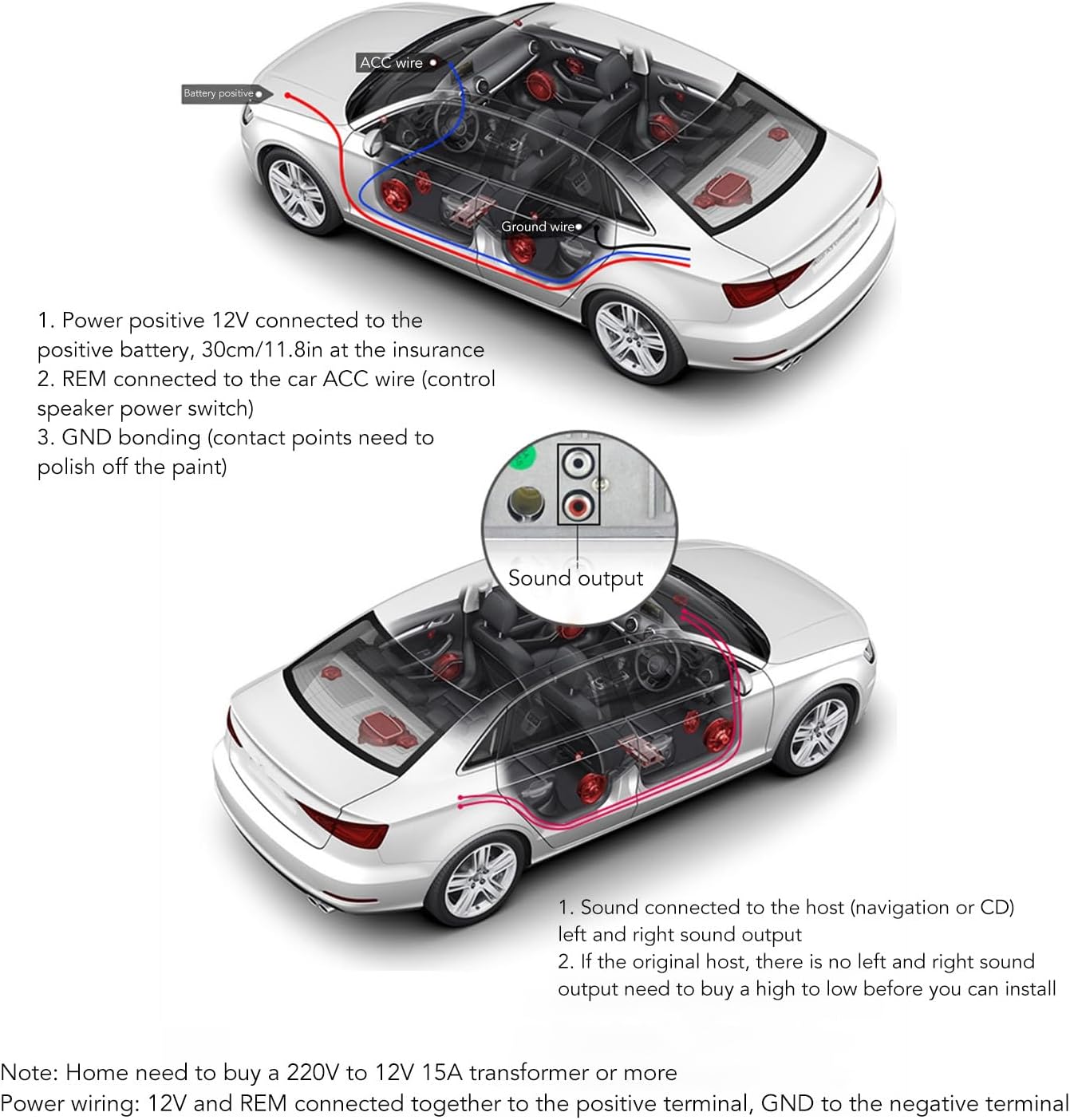
Image: Diagram illustrating the power, ground, and remote wire connections from the car battery and ACC wire to the amplifier, along with sound output connections to the car's head unit.
- Power Positive (12V): Connect the 12V power positive wire to the positive terminal of the car battery. Install an inline fuse holder within 30cm (11.8 inches) of the battery for protection.
- Remote (REM): Connect the REM wire to the car's ACC (Accessory) wire or the remote output from your head unit. This wire turns the amplifier on and off with the car's ignition or head unit.
- Ground (GND): Connect the GND wire to a clean, unpainted metal surface on the car chassis. Ensure good electrical contact by sanding off any paint or rust at the connection point.
- Sound Output: Connect the sound output from your car's head unit (navigation or CD player) to the amplifier's audio input (RCA L/R). If your original head unit lacks dedicated left and right sound outputs, you may need a high-to-low level converter before connecting to the amplifier.
Note: For home use, a 220V to 12V 15A (or higher) transformer is required to power the amplifier. This product is primarily designed for automotive 12V systems.
2. Subwoofer Control Installation Methods

Image: Diagrams illustrating three different methods for connecting the amplifier to control a subwoofer, including scenarios where the subwoofer is not controlled by the car key, controlled by the car key, and audio is sent from the original CD player.
- Method 1: Subwoofer Not Controlled by Car Key:
- Connect the +12V, REM, and GND terminals of the amplifier directly to the car battery (positive, remote, and ground respectively).
- Connect the sound input to the amplifier and the sound output from the amplifier to the subwoofer.
- In this setup, the amplifier will be continuously powered when the car battery is connected, regardless of the car key position.
- Method 2: Car Key Controlled Subwoofer Switch:
- Connect the +12V terminal to the car battery positive.
- Connect the REM terminal to the car's ACC wire (which is controlled by the car key).
- Connect the GND terminal to the car chassis.
- Connect the sound input to the amplifier and the sound output from the amplifier to the subwoofer.
- This method ensures the amplifier powers on and off with the car's ignition.
- Method 3: Original CD Player Audio Sent to Subwoofer:
- Connect the +12V, REM, and GND terminals as described in Method 2 (car key controlled).
- Connect the audio output from the original car CD player directly to the amplifier's sound input.
- The amplifier will then power the subwoofer using the audio signal from the CD player.
Operating Instructions
Once installed, operate your Gavigain KL 180 amplifier using the controls on the board.

Image: A detailed view of the control panel on the Gavigain KL 180 amplifier, showing the Level, LPF/FULL/SELECTION, and Volume knobs, along with the power LED and fuse holder.
- Power LED: A green LED light indicates that the amplifier is powered on and functioning correctly.
- Level (Gain) Control: Adjust this knob to match the output voltage of your head unit. Start with the gain at minimum and slowly increase it until the desired volume is achieved without distortion.
- LPF (Low Pass Filter) / FULL / SELECTION Switch:
- LPF: Activates the Low Pass Filter, allowing only low frequencies (bass) to pass through to the speakers. This is typically used for subwoofers.
- FULL: Allows the full range of frequencies to pass through. Use this setting for full-range speakers.
- SELECTION: This likely refers to the frequency adjustment for the LPF.
- Frequency Adjustment (30Hz - 280Hz): When LPF is selected, use this knob to set the cutoff frequency for the low pass filter. Frequencies below this setting will be amplified.
- Volume Control: This knob provides an additional level of volume adjustment for the amplifier's output.
Always make small adjustments and listen carefully to avoid damaging your speakers or amplifier.
Maintenance
- Cleaning: Keep the amplifier clean and free from dust. Use a soft, dry cloth to wipe the surface. Do not use liquid cleaners or solvents.
- Ventilation: Ensure the heat sink fins remain clear of obstructions to allow for proper airflow and heat dissipation.
- Connections: Periodically check all wiring connections to ensure they are secure and free from corrosion. Loose connections can lead to poor performance or damage.
- Fuse Check: If the amplifier stops working, check the fuse. If blown, replace it with a fuse of the exact same rating (e.g., 15A). Never use a higher-rated fuse.
Troubleshooting
| Problem | Possible Cause | Solution |
|---|---|---|
| No Power / Power LED Off |
|
|
| No Sound Output |
|
|
| Distorted Sound |
|
|
| Amplifier Overheating |
|
|
Warranty and Support
Gavigain products are manufactured to high-quality standards. For specific warranty information, please refer to the product packaging or contact your retailer. If you encounter any issues not covered in this troubleshooting guide, please contact Gavigain customer support or your authorized dealer for assistance.
Additional protection plans may be available for purchase from your retailer to extend coverage beyond the standard warranty period.