
1. Introduction
Thank you for choosing the Crivit Auriol Radio-Controlled Projection Alarm Clock. This device combines a precise radio-controlled clock with a clear LCD display, dual alarms, and a convenient projection feature. This manual will guide you through the setup, operation, and maintenance of your new alarm clock.

Front view of the alarm clock displaying time, date, and temperature.
2. Safety Instructions
- Read all instructions carefully before use and keep them for future reference.
- Do not expose the device to extreme temperatures, direct sunlight, or high humidity.
- Avoid dropping or subjecting the device to strong impacts.
- Do not attempt to disassemble or repair the device yourself. Contact qualified service personnel.
- Keep batteries out of reach of children. Dispose of used batteries according to local regulations.
- Use only the provided AC adapter or one with identical specifications.
3. Package Contents
Please check the package for the following items:
- Crivit Auriol Radio-Controlled Projection Alarm Clock (Model 373928)
- AC Power Adapter
- Batteries (pre-installed or separate)
- User Manual (this document)

Included AC power adapter.
4. Product Features
- Radio-Controlled Time: Automatic time synchronization for precise timekeeping.
- Projection Function: Projects time, alarm times, or ambient temperature onto a wall or ceiling.
- Pivoting Projection Arm: Adjustable projection angle with easy focus adjustment.
- LCD Display: Clear screen showing time, day, month, week number/day of the week, and indoor temperature.
- Dual Alarms: Two independent alarm settings with snooze function.
- Touch Sensor: Activates short-term projection and screen backlight.
- Power Options: Operates via AC adapter or batteries.
- USB-A Charging Port: Convenient 5V, 800mA output for charging external devices.
- Adjustable Brightness: Customizable display brightness.
5. Component Identification
Front View:
Front view with LCD display.
- LCD Display: Shows time, date, temperature, alarm status, and radio control signal.
- Touch Sensor Area: Located above the display, for temporary backlight and projection.
- Projection Indicator: Icon indicating projection is active.
- Alarm Indicators: Icons for Alarm 1 and Alarm 2.
- Rotation Button: Adjusts projection orientation.
Side View (Projection Arm):
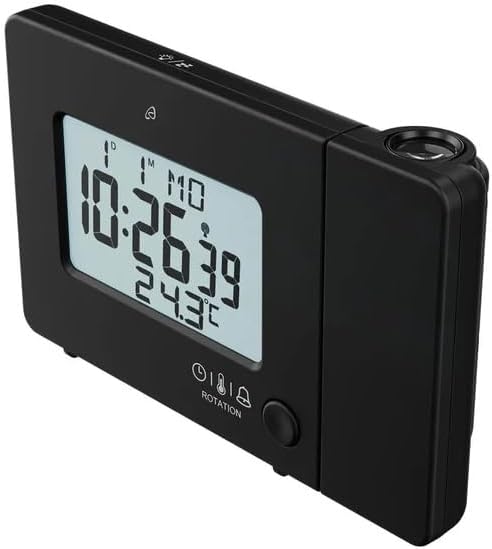
Side view with projection arm extended.
- Projection Arm: Pivots to direct the projection.
- Focus Wheel: Adjusts the clarity of the projected image.
- Projection Lens: Emits the time/temperature display.
Rear View:

Rear view with control buttons and ports.
- -/WEEK Button: Decreases values, sets week display.
- +/ZONE Button: Increases values, sets time zone.
- °C/°F Button: Toggles temperature unit.
- LANG Button: Selects display language for day of the week.
- 12/24 Button: Toggles 12/24 hour format.
- MODE Button: Cycles through settings modes (Time, Alarm 1, Alarm 2).
- SET Button: Enters setting mode for current display.
- RESET Button: Resets the device to factory defaults (use a pointed object).
- Battery Compartment: For backup batteries.
- DC IN Port: For connecting the AC power adapter.
- USB-A Output Port: For charging external devices.
6. Setup
6.1. Powering On
The alarm clock can be powered by either the included AC adapter or batteries for backup.
- Battery Installation: Open the battery compartment on the rear of the unit. Insert the included batteries, observing the correct polarity (+/-). Batteries primarily serve as backup in case of power outage.
- AC Adapter Connection: Connect the small plug of the AC adapter into the DC IN port on the back of the alarm clock. Plug the AC adapter into a standard wall outlet. The display will light up.
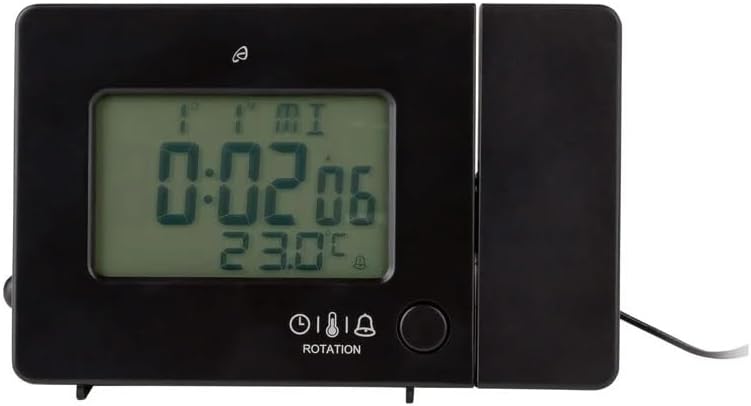
Alarm clock connected to power.
6.2. Initial Setup and Radio Control Synchronization
Upon first power-up or after a reset, the clock will automatically attempt to synchronize with the radio-controlled time signal (DCF77). This process can take several minutes to an hour, depending on your location and signal strength. During synchronization, a radio tower icon will flash on the display.
- Place the clock near a window for better signal reception.
- Avoid placing it near electronic devices that may cause interference.
- Once synchronized, the radio tower icon will appear solid on the display.
If the radio signal is not received, you may need to set the time manually (see Section 7.1).
6.3. Basic Settings (if not automatically set or for adjustment)
Press the SET button to enter setting mode. Use the -/WEEK and +/ZONE buttons to adjust values, and SET to confirm and move to the next setting.
- Time Zone: Adjust if you are not in the standard time zone for the radio signal.
- 12/24 Hour Format: Press the 12/24 button to toggle between 12-hour (with AM/PM) and 24-hour formats.
- Temperature Unit: Press the °C/°F button to switch between Celsius and Fahrenheit.
- Display Language: Press the LANG button to select the language for the day of the week display (5 languages available).
7. Operating Instructions
7.1. Setting Time Manually
If the radio-controlled time signal is weak or unavailable, you can set the time manually:
- Press and hold the SET button until the hour digits flash.
- Use the -/WEEK and +/ZONE buttons to adjust the hour.
- Press SET to confirm and move to minutes, then year, month, and day.
- Press SET again to exit manual time setting.
7.2. Setting Alarms (Alarm 1 and Alarm 2)
The clock features two independent alarms.
- Press the MODE button once to display Alarm 1 time, or twice for Alarm 2 time. The corresponding alarm icon (e.g., A1) will flash.
- While the alarm time is displayed, press and hold the SET button until the hour digits flash.
- Use the -/WEEK and +/ZONE buttons to adjust the hour.
- Press SET to confirm and move to minutes. Adjust minutes using -/WEEK and +/ZONE.
- Press SET again to confirm and exit alarm setting.
- To activate/deactivate an alarm, press the MODE button to display the desired alarm, then press the +/ZONE button. The alarm icon (bell) will appear/disappear on the display.
7.3. Snooze Function
When an alarm sounds, touch the Touch Sensor Area or press the SNOOZE/LIGHT button (if available, otherwise use the touch sensor) to activate the snooze function. The alarm will pause for approximately 5 minutes and then sound again. To stop the alarm completely, press any other button.
7.4. Projection Function
The alarm clock can project the time, alarm times, or ambient temperature onto a wall or ceiling.
- Activate Projection: The projection is continuously active when powered by the AC adapter. If running on batteries, touch the Touch Sensor Area for short-term projection.
- Adjust Projection Angle: Pivot the projection arm to direct the image to your desired location.
- Adjust Focus: Use the Focus Wheel on the projection arm to sharpen the projected image.
- Change Projected Content: Press the MODE button repeatedly to cycle through projecting Time, Alarm 1, Alarm 2, or Temperature.
- Rotate Projection: Press the ROTATION button to rotate the projected image by 90-degree increments (4 orientations available).

Time projected onto a surface.
7.5. Display Backlight
When powered by the AC adapter, the display backlight is continuously on. When running on batteries, touch the Touch Sensor Area to activate the backlight for a few seconds.
7.6. USB Charging Output
The USB-A port on the back of the unit provides a 5V, 800mA output for charging small electronic devices like smartphones or tablets. Connect your device's USB charging cable to this port.
8. Maintenance
- Cleaning: Wipe the device with a soft, dry cloth. Do not use abrasive cleaners or solvents.
- Battery Replacement: If using batteries for backup, replace them annually or when the display becomes dim during power outages. Ensure correct polarity.
- Storage: If storing the device for an extended period, remove the batteries to prevent leakage.
9. Troubleshooting
| Problem | Possible Cause | Solution |
|---|---|---|
| Display is blank or dim. | No power, dead batteries, or AC adapter not connected. | Ensure AC adapter is securely connected. Replace batteries if using for backup. |
| Radio-controlled time not synchronizing. | Weak signal, interference, or incorrect time zone. | Move the clock to a window or open area. Avoid electronic devices. Manually set time if necessary. Check time zone setting. |
| Projection is blurry. | Focus not adjusted. | Adjust the Focus Wheel on the projection arm. |
| Alarm does not sound. | Alarm not activated or set incorrectly. | Ensure the alarm icon is visible on the display. Recheck alarm time settings. |
| USB charging not working. | Device not properly connected, or device requires more power than 800mA. | Ensure the USB cable is securely connected. Check if your device's charging requirements exceed 5V/800mA. |
10. Specifications

Product dimensions.
- Model Number: 373928
- Dimensions (L x W x H): 15 x 3.81 x 9.5 cm (approx. 15l x 9.5H centimeters)
- Material: Plastic
- Display Type: Digital LCD
- Power Source: AC Adapter (included) or Batteries (included)
- USB Output: 5V, 800mA
- Special Features: Adjustable brightness, Snooze, Projection, Radio-controlled time
- Movement Type: Quartz
- Mounting Type: Tabletop
- Indoor/Outdoor Use: Indoor
11. Warranty and Support
This Crivit Auriol Projection Alarm Clock comes with a standard manufacturer's warranty. Please refer to the warranty card included in your package or contact your retailer for specific warranty terms and conditions.
For technical support or inquiries, please contact the customer service department of your retailer or the Crivit support line as indicated on the product packaging or official website.