
TEANDE GMD5276-r1
TEANDE 2000W Electric Pressure Washer User Manual
Model: GMD5276-r1
Introduction
Thank you for choosing the TEANDE 2000W Electric Pressure Washer. This powerful and versatile cleaning tool is designed to efficiently remove stubborn dirt and grime from various surfaces, including cars, patios, fences, and more. This manual provides essential information for the safe operation, assembly, maintenance, and troubleshooting of your pressure washer. Please read it thoroughly before first use and retain it for future reference.
Safety Information
Always observe basic safety precautions when using this product to reduce the risk of injury, electric shock, or damage to the unit. This pressure washer is equipped with a Ground Fault Circuit Interrupter (GFCI) for electrical safety and a Total Stop System (TSS) to prolong pump life.
- Ensure the power supply matches the voltage specified on the product label.
- Do not operate the pressure washer if the power cord or plug is damaged.
- Keep children and pets away from the operating area.
- Wear appropriate personal protective equipment, including eye protection.
- Never direct the water jet at people, animals, or electrical equipment.
- Always disconnect the power supply before performing any maintenance or cleaning.
- Do not use flammable liquids with the pressure washer.
- Engage the safety lock on the spray gun handle when not spraying to prevent accidental activation.
Product Overview and Components
Familiarize yourself with the parts of your TEANDE Electric Pressure Washer.

Image: The TEANDE Electric Pressure Washer unit shown with its main components including the spray gun, high-pressure hose, and foam cannon.
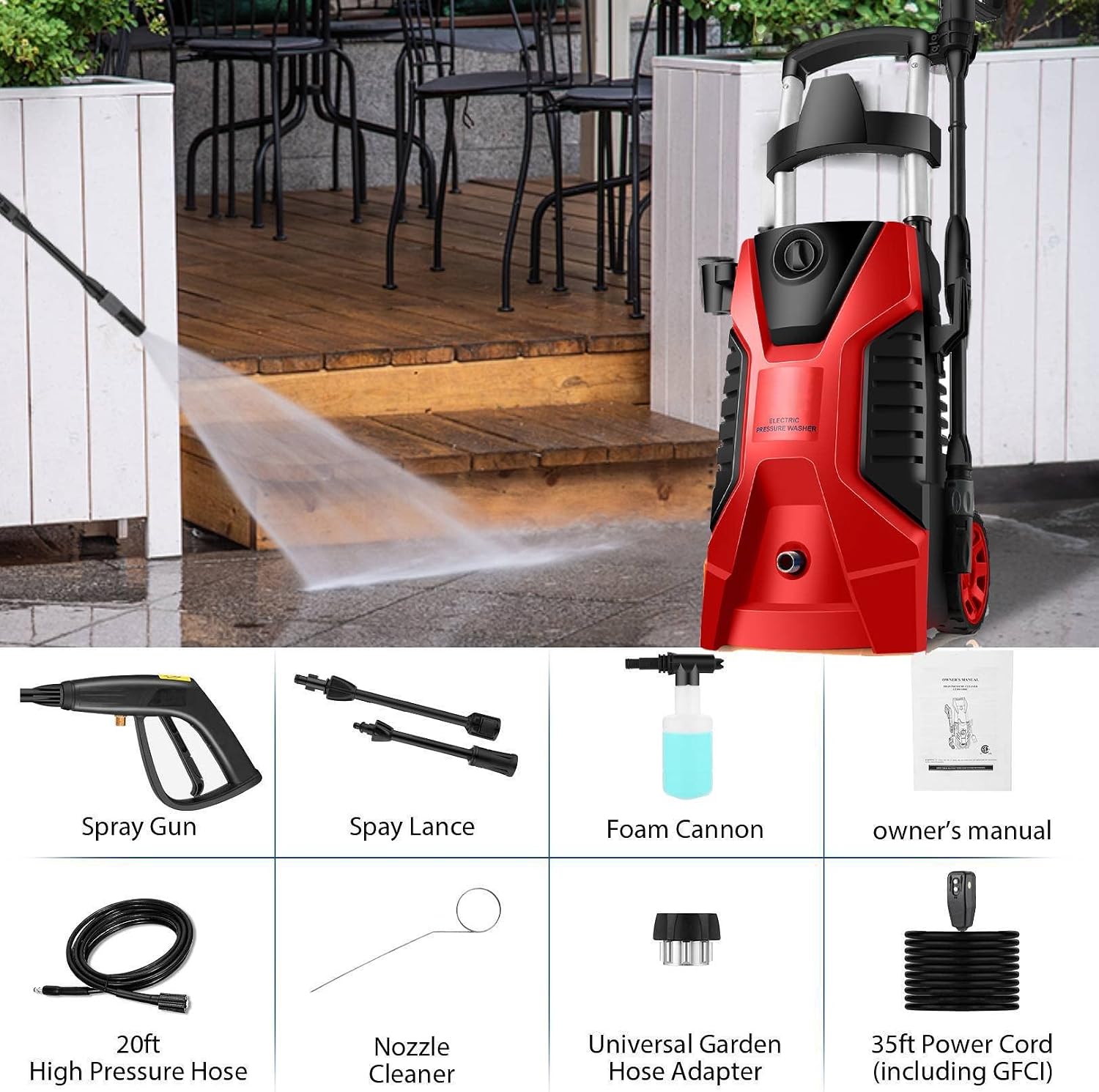
Image: A visual representation of all items included in the package: Spray Gun, Spay Lance, Foam Cannon, Owner's Manual, 20ft High Pressure Hose, Nozzle Cleaner, Universal Garden Hose Adapter, and 35ft Power Cord (including GFCI).
Key Features:
- 2000W Upgraded Brushless DC Motor: Provides high efficiency and torque for stubborn stain removal.
- Maximum Water Output 2.2 GPM: Suitable for large area washing.
- Adjustable Nozzle: Rotate to change spray angle from high pressure to low pressure, and foam mode.
- TSS (Total Stop System): Automatically shuts off the pump when the trigger is not engaged, saving energy and prolonging pump life.
- GFCI (Ground Fault Circuit Interrupter): Integrated into the power cord for enhanced electrical safety.
- Safety Lock: Prevents accidental activation of the spray gun.
- Durable Construction: Metal inlet and outlet connectors for improved longevity.

Image: Close-up views highlighting the Wand Holder, Softy Lock on the spray gun, Soap Bottle Rack, and Metal Connector for durability.
Setup Instructions
Follow these steps to set up your pressure washer before first use.
- Assemble the Handle: Attach the handle to the main unit if it is not pre-assembled, securing it with the provided screws.
- Connect the High-Pressure Hose: Connect one end of the high-pressure hose to the outlet on the pressure washer unit and the other end to the spray gun. Ensure connections are tight.
- Connect the Water Supply:
- Attach a standard garden hose (not included) to the water inlet connector on the pressure washer.
- Ensure the garden hose is free of kinks and has a minimum diameter of 1/2 inch.
- Turn on the water supply fully.
- Purge Air from the System: Before plugging in the unit, squeeze the trigger on the spray gun to allow water to flow through the system and expel any trapped air. Continue until a steady stream of water emerges from the nozzle.
- Connect to Power: Plug the GFCI-equipped power cord into a grounded electrical outlet. Press the "RESET" button on the GFCI plug if necessary.
Operating Instructions
Learn how to effectively use your pressure washer for various cleaning tasks.
Starting the Pressure Washer:
- Ensure the water supply is fully open.
- Turn on the pressure washer's power switch.
- Disengage the safety lock on the spray gun.
- Squeeze the trigger to begin spraying. The motor will start automatically due to the TSS.
Adjusting the Nozzle:
The adjustable nozzle allows you to change the spray pattern by rotating it. Different patterns are suitable for different cleaning needs.

Image: Diagram showing the adjustable nozzle with settings for High Pressure (narrow stream), Low Pressure (wider fan), and Foam Mode (for detergent application).
- High Pressure (Narrow Stream): For concentrated cleaning of tough stains. Use with caution on delicate surfaces.
- Low Pressure (Wider Fan): For general cleaning, rinsing, and covering larger areas.
- Foam Mode: For applying detergent or soap. Fill the foam cannon with appropriate cleaning solution and attach it to the spray gun.
Cleaning Applications:
The TEANDE pressure washer is suitable for a variety of tasks:

Image: Examples of pressure washer applications including washing cars, cleaning outdoor chairs, washing patios, and cleaning roofs.
- Vehicle Washing: Use foam mode for soap application, then rinse with a wide fan spray.
- Patio and Deck Cleaning: Start with a wider fan and adjust to a narrower stream for stubborn spots.
- Fence and Wall Cleaning: Maintain a safe distance to avoid damaging surfaces.
- Outdoor Furniture: Use a low-pressure setting to avoid damage.

Image: A collage demonstrating the "before" and "after" cleaning results on various surfaces like wooden decks, concrete, and car mirrors, showcasing the effectiveness of the pressure washer.

Image: A side-by-side comparison showing a dirty wooden deck "before" cleaning and the same deck "after" cleaning with the pressure washer, highlighting the significant improvement in cleanliness.
Maintenance
Proper maintenance ensures the longevity and optimal performance of your pressure washer.
- After Each Use:
- Turn off the power switch and disconnect the power cord.
- Turn off the water supply.
- Squeeze the spray gun trigger to release any remaining pressure in the system.
- Disconnect the garden hose and high-pressure hose.
- Drain all water from the pump, hoses, and spray gun to prevent freezing damage.
- Clean the exterior of the unit with a damp cloth.
- Nozzle Cleaning: If the nozzle becomes clogged, use the provided nozzle cleaning tool to clear any debris.
- Water Inlet Filter: Regularly check and clean the water inlet filter to prevent debris from entering the pump.
- Storage: Store the pressure washer in a dry, frost-free environment. Do not store it outdoors or in areas where temperatures can drop below freezing.
Troubleshooting
Refer to this section for common issues and their solutions.
| Problem | Possible Cause | Solution |
|---|---|---|
| Motor does not start. | No power supply; GFCI tripped; Power switch off. | Check power connection; Reset GFCI; Turn power switch ON. |
| Low pressure. | Insufficient water supply; Clogged nozzle; Air in pump; Kinked hose. | Ensure full water flow; Clean nozzle; Purge air from system; Straighten hose. |
| Pulsating pressure. | Air in pump; Water supply restriction; Clogged nozzle. | Purge air; Check water inlet filter; Clean nozzle. |
| Water leaks. | Loose connections; Damaged O-rings. | Tighten all connections; Replace worn O-rings. |
If the problem persists after attempting these solutions, please contact customer support.
Specifications
| Feature | Detail |
|---|---|
| Model Number | GMD5276-r1 |
| Power | 2000W |
| Max Water Output | 2.2 GPM (Gallons Per Minute) |
| Motor Type | Brushless DC Motor |
| Product Dimensions | 35.99 x 34.01 x 54.99 cm |
| Item Weight | 10.09 kg |
| Color | Red |
| Safety Features | TSS (Total Stop System), GFCI (Ground Fault Circuit Interrupter), Safety Lock |
Warranty and Support
TEANDE products are manufactured to high-quality standards. For warranty information or technical support, please refer to the warranty card included with your product or contact TEANDE customer service directly.
Manufacturer: TEANDE
For assistance, please visit the official TEANDE website or contact their customer support channels as listed in your product packaging or on their website.
Ask a question about this manual
Ask about setup, troubleshooting, compatibility, parts, safety, or missing instructions. Manuals+ will review the question and use this page’s manual context to help answer it.