
1. Introduction
Thank you for choosing the Upperizon Portable Monitor. This 16-inch 2K QHD (2560x1600) monitor is designed to enhance your productivity and entertainment experience with its high resolution, fast refresh rate, and versatile connectivity. This manual provides essential information for setting up, operating, maintaining, and troubleshooting your new monitor.

Image: Overview of the Upperizon 16-inch 2.5K 144Hz QHD Portable Monitor's key features.
2. Package Contents
Please check the box for the following items:
- 1 × Upperizon 16-inch Portable Monitor
- 1 × 30W Power Adapter
- 2 × USB-C to USB-C Display Cables (for both video & power)
- 1 × HDMI to HDMI Cable (for video only)
- 1 × Protective Sleeve Case

Image: All items included in the product package.
3. Setup Instructions
3.1 Connecting to a Laptop/PC via USB-C
For devices with a full-featured USB-C port (Thunderbolt 3/4/5 or DisplayPort Alt Mode support), a single USB-C to USB-C cable can transmit both video and power.
- Connect one end of the USB-C to USB-C cable to the monitor's USB-C port.
- Connect the other end of the USB-C to USB-C cable to your laptop's full-featured USB-C port.
- The monitor should automatically detect the signal and power on. If the screen flickers, please use the original power adapter for stable power supply.

Image: Single USB-C connection for power and video. Ensure your device's USB-C port supports Thunderbolt 3/4/5 or DisplayPort Alt Mode.
3.2 Connecting to a Laptop/PC via HDMI
For devices without a full-featured USB-C port, or for gaming consoles, use the HDMI and power adapter for connection.
- Connect one end of the HDMI cable to the monitor's HDMI port.
- Connect the other end of the HDMI cable to your device's HDMI output.
- Connect the provided 30W power adapter to the monitor's USB-C power input port and to a power outlet.
- The monitor should power on and display the signal.

Image: HDMI and power cable connection for devices that require separate power input.
3.3 Connecting to Mac Devices
The 16:10 aspect ratio of this monitor is designed to seamlessly match 16-inch MacBook screens without black bars. For MacBooks with full-featured USB-C (Thunderbolt) ports, a single USB-C cable is sufficient. Older MacBooks may require a Mini DisplayPort to HDMI adapter.
For Mac Mini, connect to the rear USB-C ports. Do not connect to the front USB-C ports.

Image: The 16:10 aspect ratio of the Upperizon monitor provides a perfect match for MacBooks.

Image: Connecting the portable monitor to a Mac Mini using the rear USB-C ports.
3.4 Connecting to Gaming Consoles
The monitor is compatible with PS4/5, Xbox, and Steam Deck. Please use an HDMI cable for connecting to Nintendo Switch, as USB-C is not compatible with Switch.

Image: Portable monitor connected to a gaming console, supporting 60Hz SDR/HDR and 120Hz SDR/HDR.
3.5 Using the Integrated Kickstand and VESA Mount
The monitor features an integrated kickstand that allows for 0° to 180° adjustment, supporting both landscape and portrait modes. For a more permanent setup, the monitor is VESA compatible (M4*6mm, 75x75mm) for mounting on a desktop arm or wall mount (VESA stand not included).
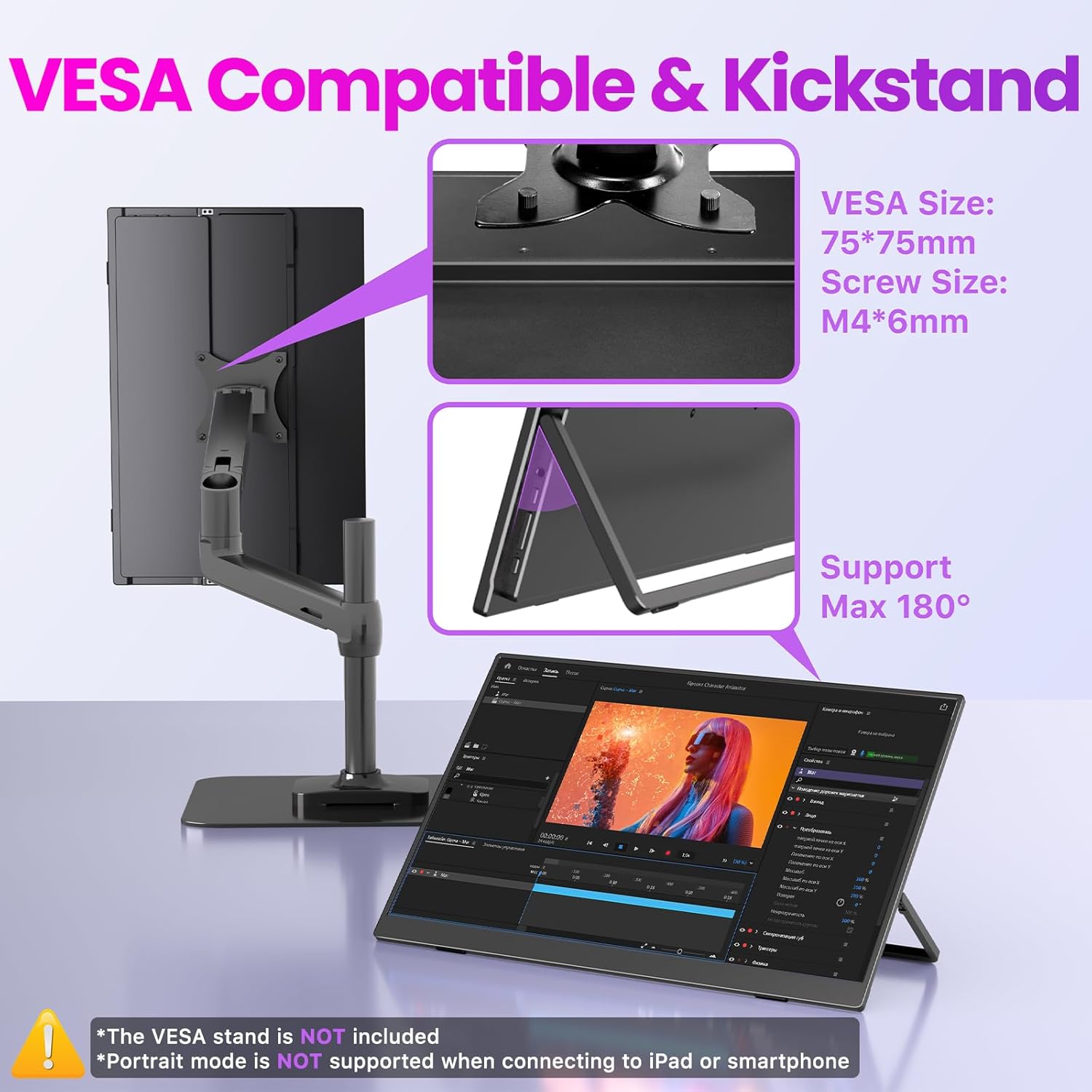
Image: The monitor's integrated kickstand and VESA compatibility for flexible placement.

Image: The adjustable kickstand allows for optimal viewing angles in both landscape and portrait modes.

Image: VESA compatible mounting for a clean and professional workstation setup.
4. Operating Instructions
4.1 Monitor Controls
The monitor features intuitive controls for power, menu navigation, brightness, and volume adjustments.
- Power/Exit Button: Press to turn the monitor on/off. Use to exit the OSD menu.
- Down/Up Button: Navigate through OSD menu options. Quick press for volume/brightness adjustment.
- Menu/Confirm Button: Press to enter the OSD menu. Use to confirm selections within the menu.

Image: Overview of the monitor's control buttons and ports.
4.2 On-Screen Display (OSD) Menu
To access the OSD menu, press the Menu/Confirm button. Use the Up/Down buttons to navigate and the Menu/Confirm button to select options. The OSD menu allows you to adjust various settings such as:
- Brightness/Contrast: Adjust display luminance.
- Color Settings: Modify color temperature, hue, and saturation.
- Input Source: Manually select between USB-C and HDMI inputs.
- HDR Mode: Enable or disable High Dynamic Range.
- Aspect Ratio: Adjust display aspect ratio.
- Audio: Control volume and mute.
4.3 Audio Features
The monitor includes built-in speakers for convenience. For private listening, a 3.5mm audio jack is available for connecting headphones or external speakers.

Image: The monitor's built-in speakers provide audio for media and games.
5. Display Features
5.1 High Resolution and Refresh Rate
Experience crisp visuals with 2560x1600 QHD resolution. The monitor supports a 144Hz refresh rate via USB-C and 120Hz via HDMI, providing smooth motion for gaming and fast-paced content.

Image: Comparison of 60Hz vs. 144Hz refresh rates for gaming, highlighting smoother visuals.

Image: Visual comparison of 2.5K QHD versus 1080P resolution.
5.2 Color Accuracy and Brightness
The monitor boasts 145% sRGB and 100% DCI-P3 wide color gamut, along with 1.07 billion colors (10-bit color depth) and 400 nits brightness, ensuring vibrant and accurate color reproduction. Advanced low blue light and flicker-free technology reduce eye strain.

Image: High color fidelity features for expressive hues.

Image: Comparison of 100% DCI-P3 & 145% sRGB wide color gamut for a better viewing experience.

Image: HDR (High Dynamic Range) support for an immersive visual experience.
6. Maintenance
6.1 Cleaning the Monitor
- Always power off the monitor and disconnect all cables before cleaning.
- Use a soft, lint-free cloth lightly dampened with water or a non-abrasive screen cleaner.
- Do not spray cleaner directly onto the screen.
- Avoid using alcohol, ammonia, or abrasive cleaners, as they can damage the screen surface.
6.2 Storage
- When not in use, store the monitor in its protective sleeve case to prevent scratches and dust accumulation.
- Keep the monitor in a cool, dry place away from direct sunlight and extreme temperatures.
7. Troubleshooting
7.1 No Signal / Black Screen
- Ensure all cables (USB-C or HDMI + Power) are securely connected to both the monitor and your device.
- Verify that your device's USB-C port supports video output (DisplayPort Alt Mode or Thunderbolt).
- Try connecting the monitor to a different device to rule out an issue with the source device.
- If using HDMI, ensure the power adapter is connected to the monitor.
- Check the OSD menu to ensure the correct input source is selected.
7.2 Screen Flickering
- Ensure the monitor is receiving sufficient power. Use the provided 30W power adapter, especially when using HDMI or if your device's USB-C port cannot provide enough power.
- Try a different USB-C or HDMI cable.
- Adjust the refresh rate settings on your connected device.
7.3 No Sound from Speakers
- Check the volume settings on both the monitor (via OSD menu) and your connected device.
- Ensure the monitor is not muted.
- If using HDMI, ensure your device is configured to output audio through HDMI.
- Test with headphones connected to the monitor's audio jack.
8. Specifications
| Feature | Specification |
|---|---|
| Screen Size | 16 Inches |
| Resolution | 2560 x 1600 Pixels (2K QHD) |
| Aspect Ratio | 16:10 |
| Refresh Rate | 144Hz (USB-C), 120Hz (HDMI) |
| Color Gamut | 145% sRGB, 100% DCI-P3 |
| Color Depth | 1.07 Billion colors (10-bit) |
| Brightness | 400 Candela (nits) |
| Contrast Ratio | 1200:1 |
| Screen Surface | Matte IPS |
| HDR Support | Yes |
| Connectivity | 2 x Full-featured USB-C, 1 x HDMI |
| Audio | Built-in Speakers, 3.5mm Audio Jack |
| Mounting | Integrated Kickstand (0-180°), VESA Compatible (75x75mm, M4*6mm) |
| Product Dimensions | 14.06 x 9.49 x 0.55 inches |
| Item Weight | 1.56 pounds |
| Model Number | U16LS |

Image: Physical dimensions of the Upperizon 16-inch Portable Monitor.
9. Warranty and Support
This product comes with a 2-Year Warranty. For any support inquiries or warranty claims, please contact Upperizon customer service. You can find contact information on the warranty card included in your package or by visiting the official Upperizon website.
Manufacturer: Upperizon
Seller: Upperizon