
1. Product Overview
The EEMB LIR2050 is a 3.7V rechargeable lithium-ion button battery designed for various compact electronic devices. This manual provides essential information for safe and effective use, including specifications, installation, operation, maintenance, and safety precautions.

This image displays a pack of four EEMB LIR2050 rechargeable lithium-ion button batteries, each marked with 'LIR2050', 'EEMB', '3.7V', and 'Rechargeable'.
Key Features:
- Voltage: 3.7V
- Capacity: 110mAh (Nominal)
- Rechargeable Lithium-ion chemistry
- Compact coin cell design
Applications:
These batteries are suitable for a range of small electronic devices, including but not limited to:
- Earphones and Bluetooth headsets
- Wearable devices
- Watches
- Glucose meters
- Hearing aids
- Capsule gastroscopes
- Solar flashlights and sensors
- Airtags and Fob keys
- Calorie counters and stopwatches

This image illustrates various applications for the LIR2050 battery, such as Bluetooth headsets, glucose meters, hearing aids, and capsule gastroscopes, demonstrating its versatility in small electronic devices.
2. Specifications
Refer to the table below for detailed technical specifications of the EEMB LIR2050 battery.
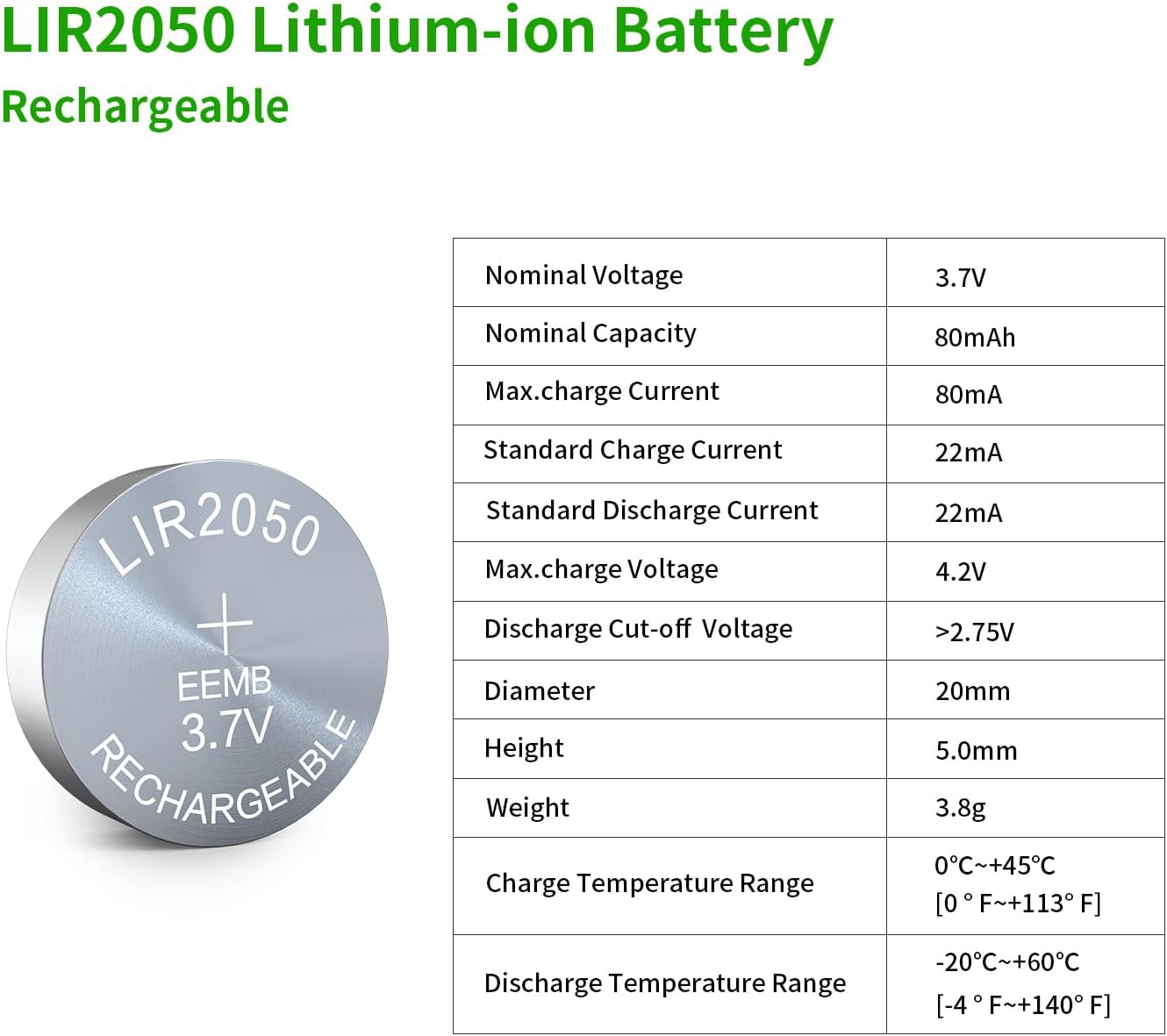
A single EEMB LIR2050 rechargeable lithium-ion button battery is shown alongside a table listing its technical specifications, including nominal voltage, capacity, charge/discharge currents, dimensions, and temperature ranges.
| Specification | Value |
|---|---|
| Nominal Voltage | 3.7V |
| Nominal Capacity | 110mAh |
| Max. Charge Current | 80mA |
| Standard Charge Current | 22mA |
| Standard Discharge Current | 22mA |
| Max. Charge Voltage | 4.2V |
| Discharge Cut-off Voltage | >2.75V |
| Diameter | 20mm |
| Height | 5.0mm |
| Weight | 3.8g |
| Charge Temperature Range | 0°C ~ +45°C [0°F ~ +113°F] |
| Discharge Temperature Range | -20°C ~ +60°C [-4°F ~ +140°F] |
3. Installation and Operation
Installation:
When installing the LIR2050 battery into your device, ensure correct polarity. The positive (+) and negative (-) terminals must align with the device's battery compartment markings. Avoid forcing the battery into place.
A series of diagrams showing correct and incorrect methods for handling and installing button cell batteries, emphasizing avoiding short circuits, improper contact, and physical damage.
Charging:
The LIR2050 battery must be charged using an EEMB dedicated charger. Using an incompatible charger may damage the battery or pose safety risks.
- Connect the battery to the dedicated EEMB charger.
- Ensure the charger is connected to a suitable power source.
- Follow the charger's instructions for charging duration and indicators.
Operation:
Once installed and charged, the battery will power your compatible electronic device. Refer to your device's manual for specific operating instructions.
4. Maintenance and Storage
Storage:
For optimal battery life and safety during long periods of disuse:
- Keep the cells in a 40%-60% charged state.
- Store the battery in a cool and dry place.
- Avoid direct sunlight, high temperature, and high humidity.
- Store batteries in their original packaging to prevent contact between terminals.
Maintenance:
- We recommend charging the battery every three months upon receipt to maintain voltage, especially during long-term storage.
- Charge the battery to 50-70% of its capacity after discharging for long-term storage.
5. Safety Warnings
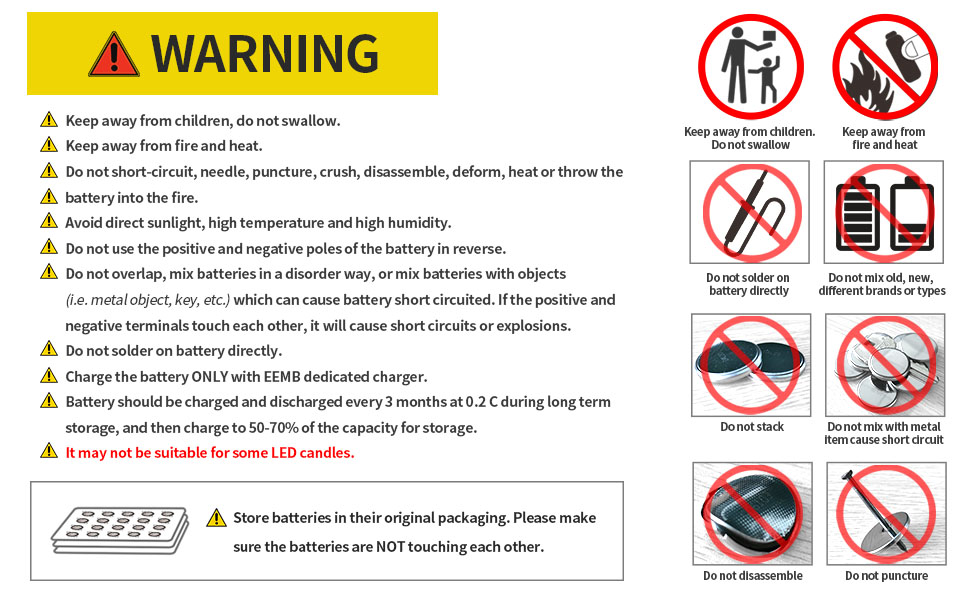
Failure to follow these safety warnings can result in serious injury, fire, or explosion. Please read carefully.

A prominent warning graphic with various symbols indicating actions to avoid, such as keeping batteries away from children, fire, soldering, mixing, stacking, disassembling, and puncturing, along with text explanations.
- KEEP OUT OF REACH OF CHILDREN. DO NOT SWALLOW. Ingestion can lead to severe injury or death. Seek immediate medical attention if swallowed.
- DO NOT SHORT CIRCUIT: Do not overlap or mix batteries in a disorderly way. If the positive and negative terminals touch each other, it will cause short circuits or explosions. Do not allow metal objects to contact both terminals simultaneously.
- AVOID HEAT AND FIRE: Keep away from fire and heat sources. Do not dispose of in fire.
- DO NOT SOLDER DIRECTLY: Do not solder on the battery directly.
- DO NOT MIX BATTERIES: Do not mix old, new, different brands, or different types of batteries.
- DO NOT STACK: Avoid stacking multiple batteries without proper insulation.
- DO NOT DISASSEMBLE OR PUNCTURE: Do not disassemble, crush, puncture, deform, or modify the battery.
- USE DEDICATED CHARGER: Charge the battery ONLY with an EEMB dedicated charger.
- CORRECT POLARITY: Do not use the positive and negative poles of the battery in reverse.
6. Certifications
EEMB batteries, including the LIR2050, undergo rigorous safety testing to ensure compliance with international standards.
- UL Certified: The LIR2050 battery is safety tested by UL according to IEC 62133 standards.
- More than 400 EEMB battery models are UL certified.
- You can verify EEMB UL certification information by searching "MH20555" on the UL website.

This image displays a document indicating EEMB's UL certification for over 400 battery models, including details about IEC 62133 safety tests and the UL certification number MH20555.
7. Troubleshooting
Device Not Powering On:
- Ensure the battery is fully charged.
- Verify correct battery installation and polarity within the device.
- Check if the device itself is functioning correctly with another known good battery (if applicable).
Special Notice:
The LIR2050 battery may not be suitable for some LED candles, LED lights, and other LED devices. If your LED device is not functioning, consider if this battery type is compatible.
8. Customer Support
EEMB is committed to providing high levels of customer satisfaction and offers global technical support. With over 20 years of experience in the lithium battery business, we are here to assist you.
- If you have any questions or concerns regarding our products, please send us a message.
- We aim to respond to all inquiries within 24 hours.