
1. Introduction and Overview
The OOYCYOO PWM 10A Solar Charge Controller is an intelligent, multi-purpose solar charge and discharge controller designed for 12V/24V lead-acid batteries. It features an integrated industrial microcontroller, an LCD display, PWM charging mode, and dual 5V USB ports. This controller is suitable for various home photovoltaic applications, including lighting systems, and automatically recognizes 12V or 24V battery systems.
This manual provides essential information for the safe and efficient operation of your solar charge controller. Please read it thoroughly before installation and use.
2. Safety Instructions
- Ensure all connections are correct and secure before powering on the system.
- Critical Connection Order: Always connect the battery to the charge controller first. Then, connect the solar panel. Finally, connect the load.
- Critical Disconnection Order: When disconnecting the system, follow the reverse order: disconnect the load, then the solar panel, and finally the battery. Incorrect connection or disconnection sequence can cause damage to the controller.
- The controller is designed for 12V/24V lead-acid batteries (GEL, LEAD-ACID, Flooded). Do not use it with other battery types unless specified.
- Install the controller in a well-ventilated area, away from flammable materials and moisture.
- Avoid exposing the controller to direct sunlight or extreme temperatures.
- Do not attempt to repair or modify the controller yourself. Contact qualified personnel for service.
3. Product Features
- Integrated industrial microcontroller for stable operation.
- Clear LCD graphic symbol display.
- Automatic 12V/24V battery voltage identification.
- PWM charging mode.
- Dual 5V/3A USB outputs for charging mobile devices.
- Adjustable charge and discharge parameters.
- Built-in protections: short-circuit, open-circuit, reverse polarity, overload.
- Dual MOSFET reverse current protection, low heat production.
- Automatic memory function for stored settings.
4. Setup and Installation
Follow these steps carefully to install your solar charge controller. Ensure all power sources are disconnected before making any connections.
- Connect the Battery: Connect the battery to the charge controller's battery terminals (marked with a battery symbol). Ensure correct polarity: positive to positive (+), negative to negative (-).
- Connect the Solar Panel: Connect the solar photovoltaic module (solar panel) to the charge controller's solar panel terminals (marked with a solar panel symbol). Ensure correct polarity.
- Connect the Load: Connect the DC load (consumer) to the charge controller's load terminals (marked with a light bulb symbol). Ensure correct polarity.
Important Note: When uninstalling the system, always disconnect in the reverse order: first the load, then the solar panel, and finally the battery. Failure to follow this sequence can damage the controller.
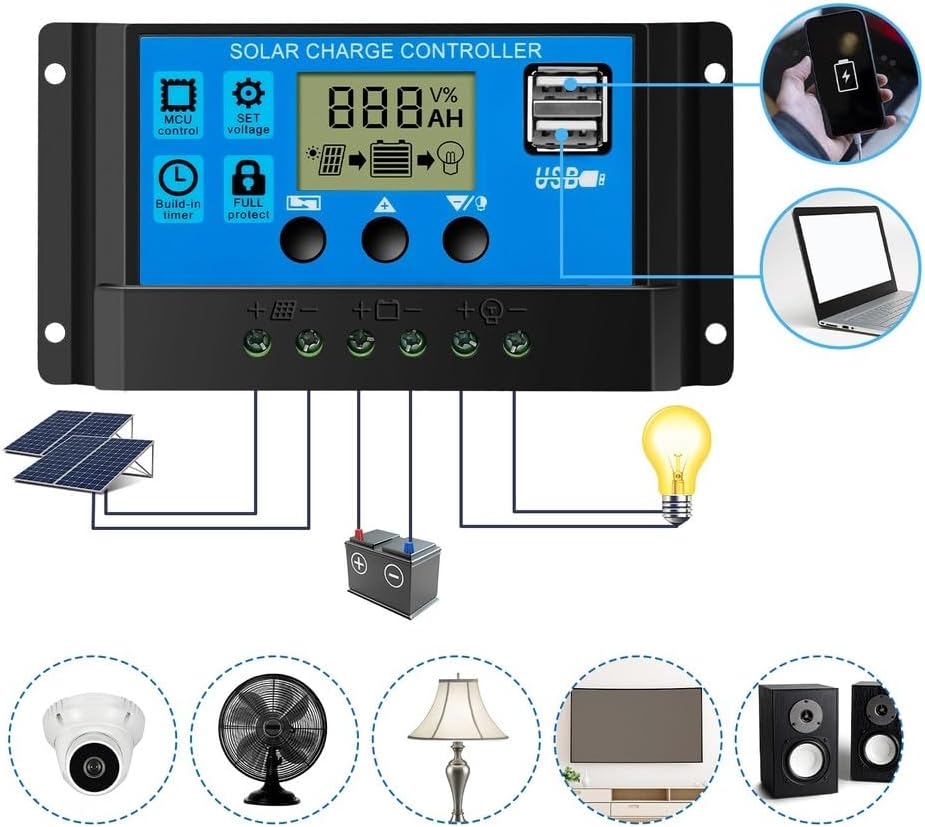
Image: Connection diagram for the OOYCYOO Solar Charge Controller, showing connections for solar panels, battery, and DC load, along with USB outputs.
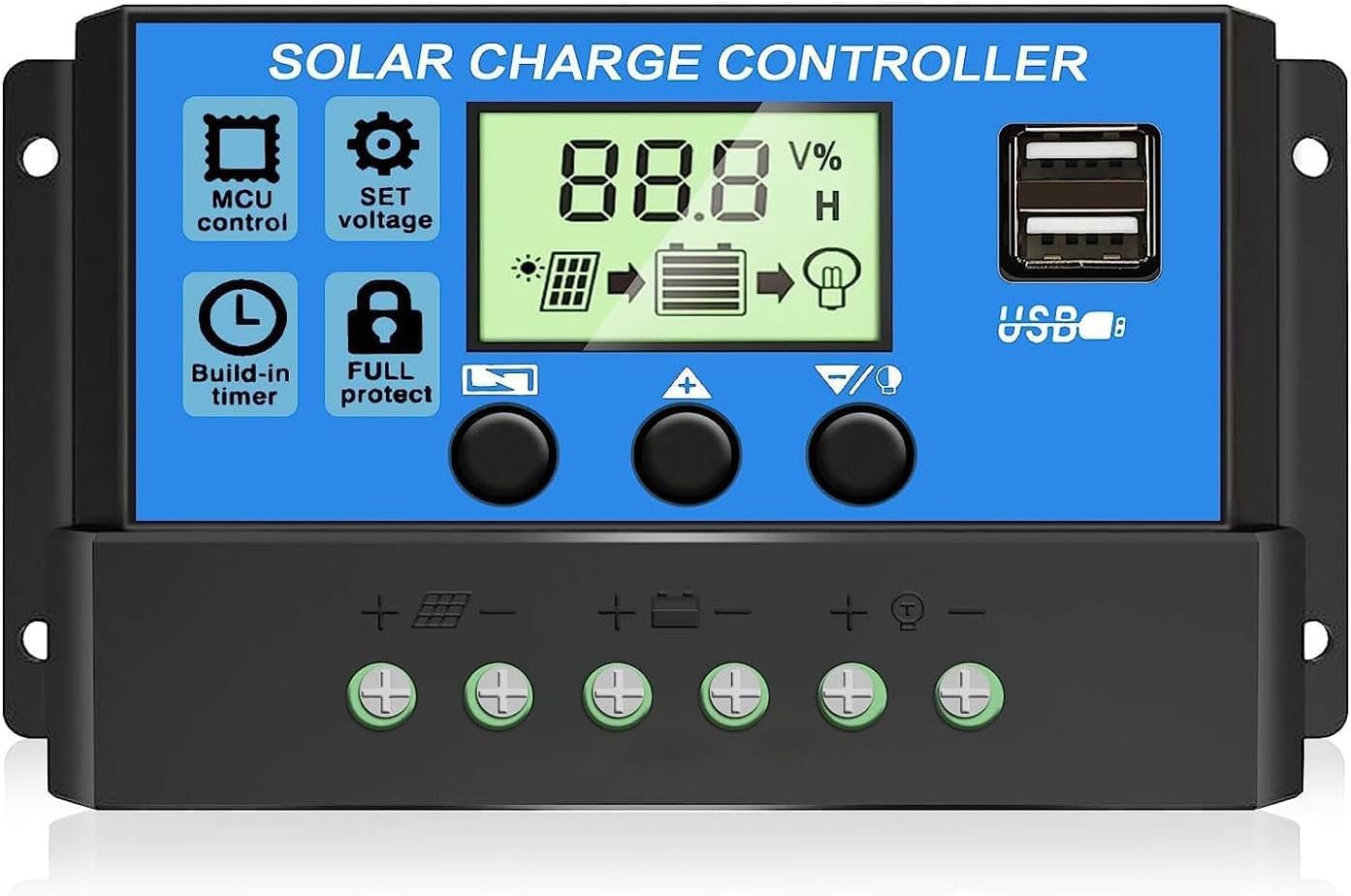
Image: Front view of the OOYCYOO Solar Charge Controller, displaying its LCD screen, control buttons, dual USB ports, and overall dimensions (approximately 5.2 inches wide, 2.7 inches high).
5. Operating Instructions
The controller features an LCD display and three buttons for operation: MENU, UP, and DOWN.
5.1 Browsing Interfaces
Press the MENU button to cycle through different display interfaces. The typical sequence includes:
- Main Display (Current battery voltage, charge/discharge status)
- Float Voltage
- Solar Panel Connected Status
- Discharge Connected Status
- Working Mode (Load control timer)
- Battery Type

Image: Detailed view of the LCD display on the OOYCYOO Solar Charge Controller, highlighting various indicators such as voltage, current, battery level, and load identification symbols.
5.2 Parameter Settings
To enter parameter setting mode:
- While browsing interfaces (typically from interface 2 to 5), long press the MENU button until the displayed value starts flashing.
- Use the UP and DOWN buttons to adjust the parameter value.
- Long press the MENU button again to save the setting and exit the parameter adjustment mode.
- To restore a parameter to its default value, long press the DOWN button while the parameter is flashing.

Image: Flowchart illustrating the navigation and setting process for the OOYCYOO Solar Charge Controller's LCD display, showing how to browse interfaces and adjust parameters like float voltage, load mode, and battery type.
6. Parameter Settings Details
The following parameters can be adjusted:
- Float Charge Voltage (HVD): Adjustable from 13.3V to 15V. This is the voltage at which the battery is maintained after being fully charged.
- Recovery After Voltage (LVD): Adjustable from 11V to 13.5V. This is the voltage at which the load will reconnect after being disconnected due to low battery voltage.
- Under Voltage Protection (RVD): Adjustable from 9V to 12.3V. This is the voltage at which the load will be disconnected to protect the battery from over-discharge.
- Load Mode: Options include 24 hours (load always on), 1 to 23 hours (load on for a set duration after dusk), or 0 hours (load off).
- Battery Option: Select the battery type: B01 (Sealed 14.4V), B02 (Gel 14.2V), B03 (Flooded 14.6V).
- Equalization Charge: Specific voltage settings for different battery types during equalization.
- Float Charge: Default 13.7V (adjustable).
- Discharge Stop: Default 10.7V (adjustable).
- Discharge Reconnect: Default 12.6V (adjustable).
7. Troubleshooting
If you encounter issues with your solar charge controller, consider the following:
- No Display/No Power: Check battery connections and ensure the battery has sufficient charge. Verify the connection order.
- Battery Not Charging: Check solar panel connections and ensure the panel is receiving adequate sunlight. Verify the connection order. Check for open-circuit protection activation.
- Load Not Working: Check load connections and ensure the load is not drawing excessive current (overload protection). Verify the load mode settings. Check for short-circuit protection activation or under-voltage protection.
- Incorrect Voltage Readings: Ensure all connections are tight and free from corrosion.
- Controller Overheating: Ensure the controller is installed in a well-ventilated area. The dual MOSFET reverse current protection helps minimize heat, but proper airflow is still important.
If problems persist, refer to the connection instructions and parameter settings. For further assistance, contact customer support.
8. Specifications
| Feature | Specification |
|---|---|
| Model | PWM 10A |
| Battery Voltage | 12V/24V Auto |
| Charge Current | 10A |
| Discharge Current | 10A |
| USB Output | Dual 5V/3A |
| Operating Temperature | -35°C to +60°C |
| Product Dimensions (L x W x H) | 13.3 x 7 x 3.5 cm |
| Material | Plastic |
| Display Type | LCD |
| UPC | 768420064315 |
9. Application Scenarios
The OOYCYOO Solar Charge Controller is versatile and can be used in various off-grid solar applications, including:
- Home solar power systems
- RV and camper solar setups
- Remote monitoring stations
- Garden lighting systems
- Small off-grid cabins

Image: Collage showing various application scenarios for the OOYCYOO Solar Charge Controller, including camping, RV use, home solar installations, and street lighting.
10. Maintenance
To ensure optimal performance and longevity of your solar charge controller:
- Regularly check all wiring connections for tightness and corrosion.
- Keep the controller clean and free from dust and debris. Use a dry cloth for cleaning.
- Ensure adequate ventilation around the controller to prevent overheating.
- Monitor the LCD display for any error codes or unusual readings.
11. Warranty and Support
For warranty information or technical support, please refer to the product packaging or contact your retailer/manufacturer directly. Keep your purchase receipt as proof of purchase.


