
1. Introduction
This manual provides detailed instructions for the installation, operation, and maintenance of your Flylin DC 6-60V 30A PWM DC Motor Speed Controller. This device is designed to precisely control the speed of DC brush motors within a voltage range of 6V to 60V, with a maximum current of 30A. It features a digital display for speed percentage, a momentary start/stop switch, and a speed control potentiometer for stepless adjustment.
2. Safety Information
- Ensure the input voltage is within the specified range of DC 6V-60V. Exceeding this range can damage the device.
- Always disconnect power before making any wiring connections or disconnections.
- Observe correct polarity for power input and motor connections. Incorrect wiring can lead to malfunction or damage.
- This controller is designed for DC brush motors. Do not use it with AC motors or other motor types.
- Avoid short circuits on the output terminals.
- Install the controller in a well-ventilated area to prevent overheating, especially during prolonged high-current operation.
- Keep the device away from moisture, dust, and corrosive substances.
3. Product Overview
The Flylin DC Motor Speed Controller integrates a digital display, a speed adjustment potentiometer, and a start/stop switch for convenient motor speed management.


Key Components:
- Main Control Unit: Houses the circuit board and LED digital display.
- LED Digital Display: Shows the motor speed as a percentage (0-100%).
- Speed Control Potentiometer: Rotary knob for adjusting motor speed.
- Start/Stop Switch: Momentary push-button to start or stop the motor.
- Screw Terminals: For secure power input and motor output connections.


4. Specifications
Refer to the table below for detailed technical specifications of the Flylin DC Motor Speed Controller.
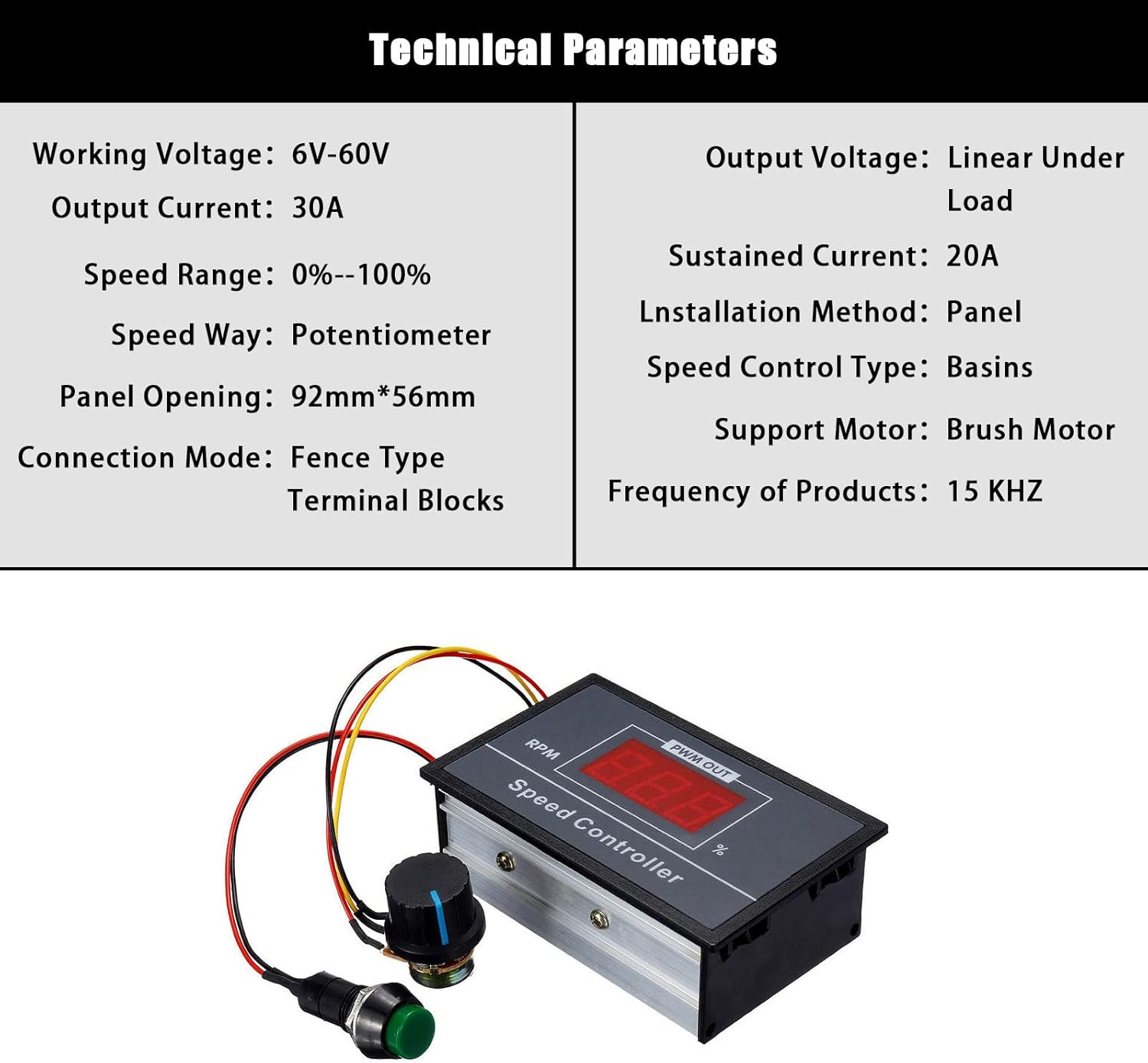
| Parameter | Value |
|---|---|
| Working Voltage | DC 6V-60V |
| Output Current | 0A-30A |
| Sustained Current | 20A |
| Speed Range | 0% - 100% |
| Speed Control Type | Potentiometer |
| Support Motor | DC Brush Motor |
| PWM Frequency | 15 KHz |
| Installation Method | Panel Mount |
| Panel Opening Size | 92mm x 56mm |
| Connection Mode | Fence Type Terminal Blocks |
| Material | Copper (internal components) |
| Item Weight | 1.41 ounces (approx. 0.04 kg) |
| Dimensions | 9.5cm x 6cm x 3.2cm (approx. 3.74in x 2.36in x 1.25in) |

5. Setup and Wiring
Proper wiring is crucial for the safe and correct operation of the speed controller. Follow these steps carefully.
Wiring Diagram:


Connection Steps:
- Power Input: Connect your DC power supply (6V-60V) to the terminals labeled 'Power+' and 'Power-'. Ensure correct polarity.
- Motor Output: Connect your DC brush motor to the terminals labeled 'Motor+' and 'Motor-'. The motor's rotation direction can be reversed by swapping these connections if needed.
- Potentiometer and Switch: The speed control potentiometer and start/stop switch are pre-wired to the main control unit. Ensure these connections are secure.

Use appropriate gauge wires for your application to handle the maximum current of 30A. Secure all connections firmly using the screw terminals.
6. Operation
Once properly wired, operating the speed controller is straightforward.
- Power On: Apply power to the controller. The LED digital display will illuminate, showing the current speed percentage (initially 0% if the motor is stopped).
- Start Motor: Press the green momentary start/stop button to start the motor. The display will show the current speed setting.
- Adjust Speed: Rotate the potentiometer knob clockwise to increase motor speed and counter-clockwise to decrease it. The LED display will update in real-time to show the new speed percentage.
- Stop Motor: Press the green momentary start/stop button again to stop the motor. The display will show 0%.
The speed can be adjusted steplessly from 0% to 100% of the motor's maximum speed at the given input voltage.
7. Maintenance
The Flylin DC Motor Speed Controller is designed for durability and requires minimal maintenance.
- Cleaning: Periodically clean the exterior of the controller with a dry, soft cloth. Do not use liquid cleaners or solvents.
- Connections: Regularly check all wiring connections to ensure they remain tight and secure. Loose connections can lead to intermittent operation or overheating.
- Ventilation: Ensure that the controller's housing is not obstructed, allowing for proper heat dissipation.
- Environmental Conditions: Operate the controller within its specified environmental conditions (temperature, humidity) to prolong its lifespan.
8. Troubleshooting
If you encounter issues with your speed controller, refer to the following troubleshooting guide:
| Problem | Possible Cause | Solution |
|---|---|---|
| Controller does not power on / LED display is off. | No power input or incorrect wiring. | Check power supply connection and polarity. Ensure power source is active. |
| Motor does not start. | Motor not connected, start/stop button not pressed, or potentiometer at 0%. | Verify motor connections. Press the start/stop button. Rotate potentiometer to increase speed. |
| Motor speed cannot be adjusted. | Potentiometer faulty or disconnected. | Check potentiometer connections. If faulty, replacement may be necessary. |
| Motor runs erratically or at incorrect speed. | Loose wiring, motor overload, or incompatible motor. | Check all wiring connections. Ensure motor current does not exceed 30A. Verify motor type is a DC brush motor. |
| Controller overheats. | Excessive load on motor, poor ventilation, or sustained current above 20A. | Reduce motor load. Ensure adequate ventilation around the controller. Avoid prolonged operation above 20A. |
9. Warranty and Support
For warranty information or technical support, please refer to the retailer or manufacturer's official website. Keep your purchase receipt for any warranty claims.