Introduction
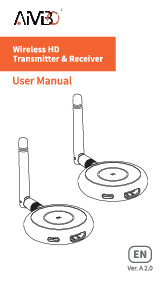
This manual provides detailed instructions for the installation, operation, and maintenance of your AIMIBO HDMI Wireless Transmitter and Receiver system. This device allows for wireless transmission of HDMI video and audio signals, supporting various configurations including one-to-one, one-to-many (Splitter Mode), and many-to-one (Switch Mode) setups. It also features KVM functionality, IR remote control extension, and an HDMI loop-out port.
Package Contents
- 1 x Transmitter Unit (TX)
- 1 x Receiver Unit (RX)
- 1 x IR Remote Control
- Power Adapters (Quantity may vary based on kit, typically one per unit)
- User Manual (This document)
Product Overview
Familiarize yourself with the components and ports of the Transmitter (TX) and Receiver (RX) units.

Image: Front and rear views of the AIMIBO Wireless HDMI Transmitter (left) and Receiver (right), highlighting ports such as USB, HDMI In/Out, Power, IR Remote, and indicator lights.
Transmitter (TX) Unit
- USB Port (KVM output): Connects to the source PC for KVM functionality.
- MODE Button: Switches between different operating modes.
- Indicator Lights: Display status, connection, and ID.
- ID Switch: Used for setting device ID in multi-unit setups.
- SW/SP Switch: Selects between Switch (SW) and Splitter (SP) modes.
- Power Port (DC/12V): Connects to the power adapter.
- HDMI IN: Connects to the HDMI source device (e.g., laptop, set-top box).
- HDMI OUT (Loop-Out): Connects to a local display for monitoring the source.
- IR Remote Port: Connects to the IR blaster cable for controlling the source device.
- Reset Button: Resets the unit.
Receiver (RX) Unit
- USB Ports (Keyboard & Mouse): Connects keyboard and mouse for KVM control.
- MODE Button: Switches between different operating modes.
- Indicator Lights: Display status, connection, and ID.
- ID Switch: Used for setting device ID in multi-unit setups.
- SW/SP Switch: Selects between Switch (SW) and Splitter (SP) modes.
- Power Port (DC/12V): Connects to the power adapter.
- HDMI OUT: Connects to the display device (e.g., TV, projector, monitor).
- Audio Port: For audio output (if applicable).
- IR Remote Port: Connects to the IR receiver cable for receiving signals from your remote.
- Reset Button: Resets the unit.
Setup Instructions
Follow these steps to set up your AIMIBO wireless HDMI system for basic one-to-one operation.
- Connect the Transmitter (TX):
- Connect your HDMI source device (e.g., laptop, Blu-ray player) to the HDMI IN port of the TX unit using an HDMI cable.
- (Optional) If you wish to monitor the source locally, connect a display to the HDMI OUT (Loop-Out) port of the TX unit.
- Connect the power adapter to the DC/12V port of the TX unit and plug it into a power outlet.
- (Optional) For KVM functionality, connect a USB cable from the TX unit's USB port to your source PC.
- (Optional) For IR control, connect the IR blaster cable to the IR Remote port on the TX unit and position the blaster near the IR receiver of your source device.
- Connect the Receiver (RX):
- Connect your display device (e.g., TV, projector, monitor) to the HDMI OUT port of the RX unit using an HDMI cable.
- Connect the power adapter to the DC/12V port of the RX unit and plug it into a power outlet.
- (Optional) For KVM functionality, connect your keyboard and mouse to the USB ports on the RX unit.
- (Optional) For IR control, connect the IR receiver cable to the IR Remote port on the RX unit and position the receiver where it can pick up signals from your remote control.
- Power On: Ensure both TX and RX units are powered on. The indicator lights will illuminate.
- Pairing: If the units do not connect automatically, refer to the "Pairing Instructions" section.
Operating Modes
The AIMIBO system supports various operating configurations to suit different needs.
1. One-to-One Mode
This is the standard configuration where one Transmitter (TX) sends signals to one Receiver (RX). Both TX and RX units should have their SW/SP switch set to the default position (often indicated as "1-to-1" or similar, or simply ensure they are not in SP or SW mode if no specific 1-to-1 switch is present, and ID matches).

Image: Illustration of a single Transmitter (TX) wirelessly connected to a single Receiver (RX), demonstrating Full HD 1080p transmission to a display.
2. Splitter Mode (SP Mode: 1 TX to up to 8 RXs)
In this mode, one Transmitter (TX) can send the same video and audio signal to multiple Receivers (RXs) simultaneously, allowing for multiple displays of the same content.
- Set the SW/SP switch on the Transmitter (TX) unit to SP mode.
- Set the SW/SP switch on all Receiver (RX) units to SP mode.
- Ensure all RX units are paired with the TX unit. If not, follow the pairing instructions.
- Each RX unit can be assigned a unique ID using the ID Switch if needed for specific configurations, though in SP mode, all RXs typically receive from the same TX.

Image: An example of Splitter (SP) Mode, where one Transmitter (TX) broadcasts content from a laptop to four separate Receivers (RXs), each connected to a display.
3. Switch Mode (SW Mode: 1 RX to up to 8 TXs)
This mode allows a single Receiver (RX) to switch between multiple Transmitter (TX) sources, displaying content from one TX at a time. This is useful for presentations where multiple presenters need to share a single display.
- Set the SW/SP switch on all Transmitter (TX) units to SW mode.
- Set the SW/SP switch on the Receiver (RX) unit to SW mode.
- Assign a unique ID to each TX unit using its ID Switch.
- On the RX unit, use the MODE button to cycle through the available TX sources (by their assigned IDs).

Image: An example of Switch (SW) Mode, illustrating how a single Receiver (RX) can display content from one of several Transmitters (TXs), each connected to a laptop, on a large projector screen in a meeting room setting.

Image: A comprehensive diagram summarizing the different operating modes: One-to-One (SW Mode 1TX to 1RX), Switch Mode (1 RX to up to 8 TXs), and Splitter Mode (1 TX to up to 8 RXs), showing various source and display connections.
KVM Functionality
The KVM (Keyboard, Video, Mouse) function allows you to control the source computer connected to the Transmitter (TX) from the location of the Receiver (RX) using a keyboard and mouse.
- Connect a USB cable from the USB port on the TX unit to a USB port on your source PC.
- Connect your keyboard and mouse to the USB ports on the RX unit.
- Once connected and the wireless link is established, you can operate the source PC remotely using the keyboard and mouse connected to the RX.

Image: Illustration of the KVM function, demonstrating how a user can control a source laptop connected to the Transmitter (TX) by using a keyboard and mouse connected to the Receiver (RX) at a remote display.
IR Remote Control Extension
The IR extension feature allows you to control your HDMI source device (e.g., cable box, DVD player) from the location of your display (where the RX unit is located) using its original remote control.
- Connect the IR blaster cable to the IR Remote port on the TX unit. Position the IR blaster head directly in front of the IR receiver window of your source device.
- Connect the IR receiver cable to the IR Remote port on the RX unit. Position the IR receiver head where it can easily receive signals from your remote control.
- Point your source device's remote control at the IR receiver connected to the RX unit to send commands to the source device connected to the TX unit.
HDMI Loop-Out
The Transmitter (TX) unit is equipped with an HDMI Loop-Out port, which allows you to connect a local display directly to the TX unit. This is useful for monitoring the source content without wireless transmission or for having a local display in addition to the remote wireless display.
- Connect an HDMI cable from the HDMI OUT (Loop-Out) port on the TX unit to your local display.
- The content from your HDMI source will be displayed on both the local monitor and wirelessly transmitted to the RX unit.

Image: Illustration of the HDMI Loop-Out feature, showing a laptop connected to the Transmitter (TX), which simultaneously outputs to a local monitor via HDMI cable and wirelessly transmits to a remote TV.
Pairing Instructions
If your Transmitter (TX) and Receiver (RX) units do not automatically establish a connection, you may need to pair them manually. This process ensures the units communicate correctly, especially in multi-unit setups or after a reset.
- Power On TX: Connect the Transmitter to its power adapter and plug it in.
- Power On RX: Connect the Receiver to its power adapter and plug it in.
- Set Mode: Ensure both the TX and RX units have their SW/SP switch set to the desired operating mode (e.g., SP mode for splitter, SW mode for switch, or default for one-to-one).
- Connect HDMI: Connect an HDMI cable from the TX unit's HDMI IN port to your source device, and another HDMI cable from the RX unit's HDMI OUT port to your display.
- Initiate Pairing: On both the TX and RX units, press and hold the MODE button for approximately 3-5 seconds until the "STA" indicator light begins to flash. This indicates the units are in pairing mode.
- Confirm Pairing: Once pairing is successful, the "STA" indicator light on both units will become solid, indicating a stable wireless connection. The display connected to the RX unit should now show the source content.

Image: Step-by-step visual guide for pairing the Receiver (RX) with the Transmitter (TX), detailing power connections, mode selection, HDMI connections, and observing the STA light for successful pairing.
Troubleshooting
If you encounter issues, refer to the following common problems and solutions.
| Problem | Possible Cause | Solution |
|---|---|---|
| No video/audio output |
|
|
| Video flickering or unstable signal |
|
|
| KVM function not working |
|
|
| IR remote control not responding |
|
|
Specifications
| Feature | Detail |
|---|---|
| Model Number | afb54dc4-e759-43af-a395-53688112cdba |
| Brand | AIMIBO |
| Connectivity Technology | Wireless (5.8G), HDMI, USB |
| Connector Type | HDMI |
| Resolution Support | Up to 1080p@60Hz (480P, 576P, 720P, 1080P) |
| Transmission Range | Up to 656 feet (200 meters) line-of-sight |
| Latency | Approximately 0.1 seconds |
| Video Codec | H.264, H.265/HEVC |
| KVM Function | Supported (Keyboard & Mouse control) |
| IR Remote Control | Supported |
| HDMI Loop-Out | Supported on Transmitter (TX) |
| Operating Modes | One-to-One, Splitter (1 TX to 8 RXs), Switch (1 RX to 8 TXs) |
| Material | Aluminum Alloy |
Maintenance
Proper care and maintenance will ensure the longevity and optimal performance of your AIMIBO wireless HDMI system.
- Cleaning: Use a soft, dry cloth to clean the units. Do not use liquid cleaners or aerosols.
- Environment: Keep the units in a cool, dry place, away from direct sunlight, heat sources, and excessive moisture.
- Ventilation: Ensure adequate airflow around the units to prevent overheating. Do not block ventilation openings.
- Handling: Handle the units with care. Avoid dropping or subjecting them to strong impacts.
- Power: Use only the provided power adapters. Disconnect power during electrical storms or when unused for long periods.
Warranty and Support
AIMIBO products typically come with a manufacturer's warranty. For specific warranty details, duration, and terms, please refer to the warranty card included with your product or contact AIMIBO customer support directly. For technical assistance, troubleshooting beyond this manual, or service inquiries, please visit the official AIMIBO website or contact their customer service department.
Manufacturer: AIMIBO