
Newparts TPMS5
Genuine OEM Tire Pressure Monitoring System (TPMS) Sensor User Manual
Model: TPMS5 | Brand: Newparts
1. Product Overview
This manual provides essential information for the installation, operation, and maintenance of your Newparts Genuine OEM Tire Pressure Monitoring System (TPMS) Sensor, model TPMS5. This sensor is designed for use with 7.0 X 16" Forged Aluminum Wheels and is a direct replacement for original equipment manufacturer (OEM) parts.
The TPMS sensor plays a critical role in vehicle safety by continuously monitoring the air pressure inside your tires and transmitting this data to your vehicle's onboard computer. This allows the vehicle to alert the driver to under-inflated tires, which can improve fuel efficiency, extend tire life, and enhance driving safety.
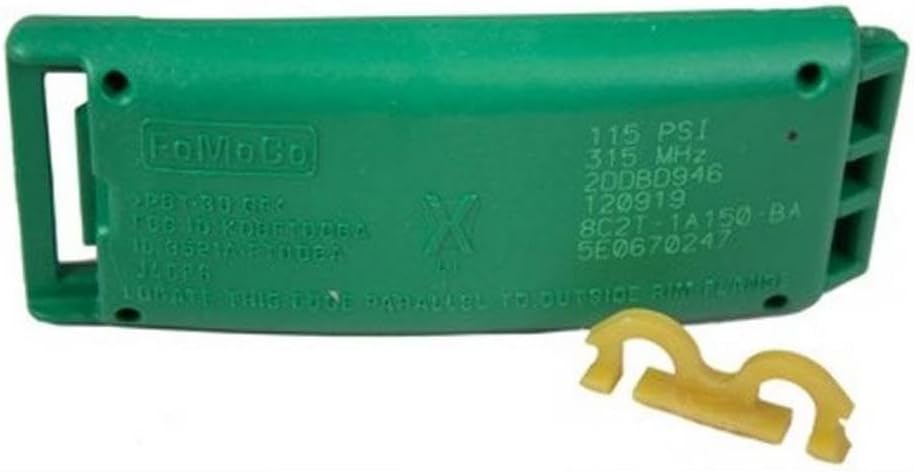
Figure 1: Newparts Genuine OEM TPMS Sensor (Model TPMS5). This image shows the green rectangular sensor unit with "FoMoCo" branding and technical specifications such as "115 PSI" and "315 MHz" printed on its surface. Two small yellow plastic clips are visible in the foreground, likely for securing the sensor.
2. Installation and Setup
Proper installation of the TPMS sensor is crucial for its correct function and vehicle safety. It is highly recommended that installation be performed by a qualified automotive technician using appropriate tools and procedures.
2.1 Pre-Installation Checks
- Verify that the sensor model (TPMS5) is compatible with your vehicle's make, model, and year, specifically for 7.0 X 16" Forged Aluminum Wheels.
- Inspect the sensor for any visible damage before installation.
- Ensure all necessary mounting hardware (e.g., valve stem, nuts, washers, yellow clips) is present and in good condition.
2.2 Installation Procedure (General Guidelines)
- Safely lift the vehicle and remove the wheel.
- Deflate the tire and break the tire bead from the rim.
- Remove the old TPMS sensor (if applicable) and its valve stem.
- Install the new TPMS5 sensor according to the vehicle manufacturer's specifications. Ensure the sensor is correctly oriented and secured. The sensor should be located parallel to the outside rim flange.
- Mount the new valve stem and tighten to the manufacturer's specified torque.
- Re-seat the tire bead and inflate the tire to the recommended pressure.
- Perform a leak check on the tire and valve stem assembly.
- Reinstall the wheel on the vehicle and lower the vehicle safely.
2.3 Sensor Relearn Procedure
After installing a new TPMS sensor, it must be "relearned" or "reprogrammed" to the vehicle's TPMS control module. This process varies significantly by vehicle manufacturer and model. Common relearn methods include:
- Auto Relearn: Some vehicles automatically detect new sensors after driving for a certain period at a specific speed.
- Manual Relearn: Requires a specific sequence of ignition cycles, brake presses, or other actions. Refer to your vehicle's owner's manual for detailed instructions.
- OBDII Relearn: Requires a specialized TPMS diagnostic tool to communicate with the vehicle's OBDII port and program the new sensor IDs.
- TPMS Tool Relearn: Requires a dedicated TPMS activation tool to activate each sensor and then upload the IDs to the vehicle.
Important: Failure to perform the correct relearn procedure will result in the TPMS warning light remaining on and the system not functioning correctly.
3. Operating Principles
Once properly installed and relearned, the TPMS5 sensor continuously monitors the tire pressure. Each sensor transmits a radio frequency (RF) signal containing its unique ID, tire pressure, and temperature data to the vehicle's TPMS receiver.
- If a tire's pressure drops below a predetermined threshold (typically 25% below the recommended cold inflation pressure), the TPMS warning light on your dashboard will illuminate.
- Some advanced TPMS systems may also display the individual tire pressures on the vehicle's information screen.
- The sensor operates at a frequency of 315 MHz, as indicated on the sensor itself.
Always refer to your vehicle's owner's manual for specific information regarding your vehicle's TPMS operation and warning indicators.
4. Maintenance
TPMS sensors are generally maintenance-free, but certain considerations can help ensure their longevity and proper function:
- Regular Tire Pressure Checks: Even with TPMS, it is recommended to manually check your tire pressures regularly with a reliable gauge. TPMS is a warning system, not a substitute for proper tire maintenance.
- Valve Stem Service: When tires are replaced or repaired, it is good practice to replace the TPMS valve stem components (cap, core, nut, washer, and rubber seal). These components can degrade over time and lead to air leaks.
- Battery Life: TPMS sensors are powered by an internal, non-replaceable battery. The typical lifespan of a TPMS sensor battery is 5-10 years, depending on usage and environmental factors. When the battery dies, the sensor will stop transmitting, and the TPMS warning light will illuminate. The entire sensor unit must be replaced in this scenario.
- Avoid Tire Sealants: Some tire sealants can damage TPMS sensors. If you must use a sealant for an emergency, have the tire and sensor inspected by a professional as soon as possible.
5. Troubleshooting
If your TPMS warning light illuminates or you suspect a sensor issue, consider the following common scenarios:
| Symptom | Possible Cause | Solution |
|---|---|---|
| TPMS light is on, steady. | One or more tires are under-inflated. | Check all tire pressures with a gauge and inflate to recommended levels. Drive for a few minutes to allow the light to reset. |
| TPMS light flashes, then stays on. | TPMS system malfunction or sensor battery low/dead. | Have the system diagnosed by a professional. A sensor may need replacement and relearning. |
| TPMS light on after tire rotation or replacement. | Sensors need to be relearned to the vehicle. | Perform the appropriate TPMS relearn procedure for your vehicle. |
| Incorrect pressure readings. | Faulty sensor or interference. | Verify with a manual gauge. If discrepancy persists, professional diagnosis is recommended. |
If troubleshooting steps do not resolve the issue, consult a certified automotive technician for diagnosis and repair.
6. Specifications
| Attribute | Detail |
|---|---|
| Brand | Newparts |
| Model Number | 4344370 |
| OEM Part Number | TPMS5 |
| Product Dimensions | 5 x 5 x 5 inches |
| Item Weight | 899 pounds (Note: This weight seems unusually high for a single sensor and may be a data entry error. Actual sensor weight is typically a few ounces.) |
| Operating Frequency | 315 MHz (as indicated on sensor) |
| Max Pressure Rating | 115 PSI (as indicated on sensor) |
| Compatibility | Designed for 7.0 X 16" Forged Aluminum Wheels |
7. Warranty and Support
Newparts offers a 30-day easy returns policy for this product. For specific warranty details, claims, or technical support, please refer to the official Newparts customer service channels or the retailer from whom the product was purchased.
You can typically find customer support information on the Newparts official website or through your purchase platform. When contacting support, please have your product model number (TPMS5) and any relevant purchase details ready.
For general inquiries or to initiate a return within the eligible period, please contact the seller, Newparts, directly through the platform where you made your purchase.
Ask a question about this manual
Ask about setup, troubleshooting, compatibility, parts, safety, or missing instructions. Manuals+ will review the question and use this page’s manual context to help answer it.