
Superlux UK82
Superlux UK82 Dual-Channel UHF Wireless Microphone System User Manual
Model: UK82
1. Introduction
This manual provides detailed instructions for the proper setup, operation, and maintenance of your Superlux UK82 Dual-Channel UHF Wireless Microphone System. The UK82 system is designed for reliable audio transmission in various applications, including live performances, presentations, and events. It features a dual-channel UHF receiver and two handheld wireless transmitters, allowing for simultaneous use of both microphones.
The system incorporates advanced frequency-hopping spread spectrum (FHSS) technology and offers up to 200 manually selectable frequencies to ensure stable performance even in environments with high radio frequency interference. With a practical outdoor range of up to 50 meters (line-of-sight), it provides freedom of movement. The receiver offers both balanced XLR and standard 1/4-inch output options for versatile connectivity with professional mixers and PA systems.
2. Package Contents
Carefully unpack the box and ensure all items are present and in good condition. If any items are missing or damaged, please contact your Superlux dealer.
- 1 x UK82 Dual-Channel UHF Wireless Receiver
- 2 x Handheld UHF Wireless Transmitters (Microphones)
- 1 x Power Adapter for Receiver
- 2 x Antennas for Receiver
- 1 x 1/4-inch to 1/4-inch Audio Cable
- User Manual (this document)

Image: Superlux UK82 system components as packaged.
3. System Components Overview
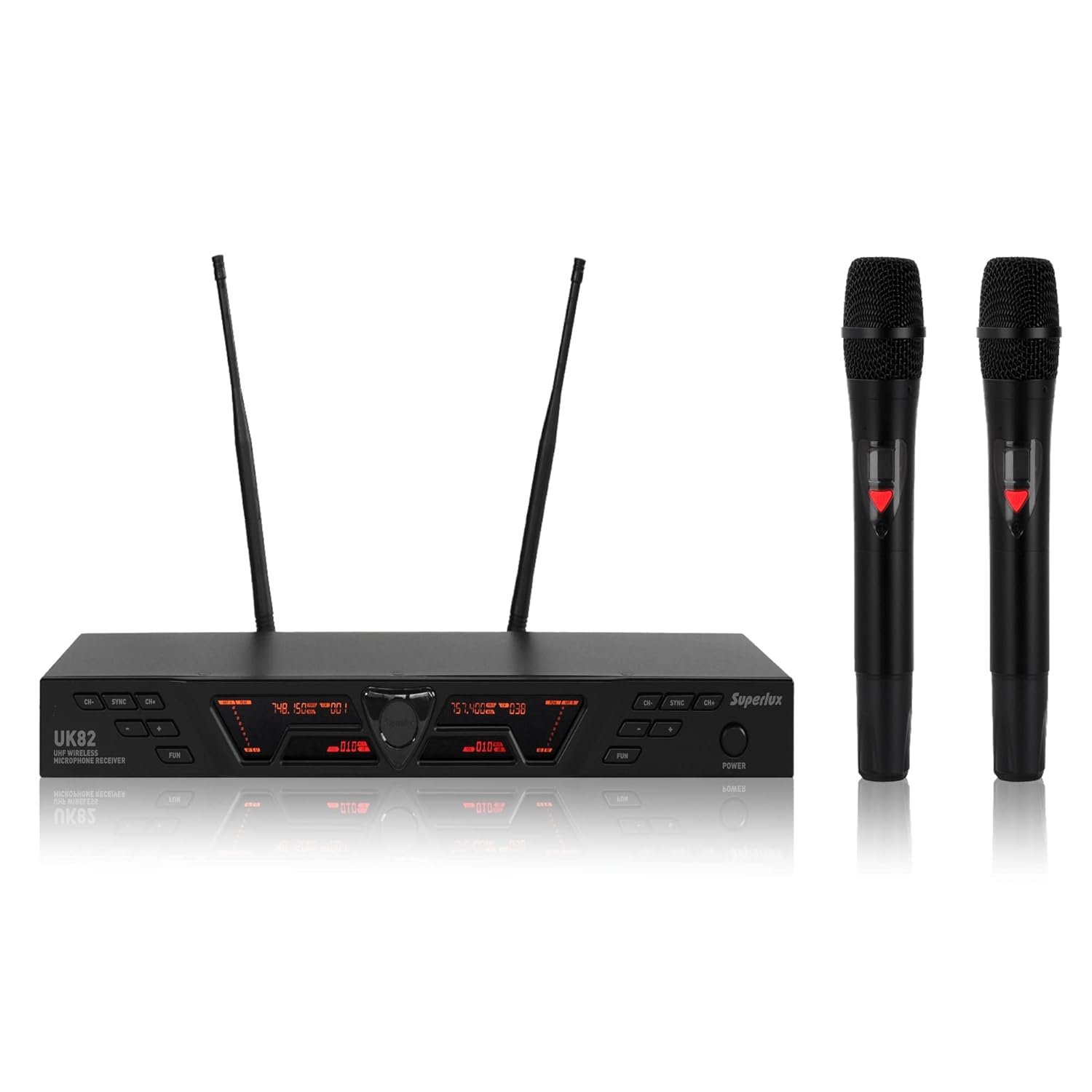
Image: Superlux UK82 Receiver and Handheld Microphones.
3.1. UK82 Receiver
The receiver unit processes the wireless audio signals from the microphones. It features:
- Dual-Channel Operation: Simultaneously receives signals from two microphones.
- LCD Display: Shows channel information, frequency, and signal strength.
- Frequency Selection Buttons: For manual frequency adjustment.
- IR Sync Function: For quick and easy pairing with transmitters.
- Volume Controls: Independent volume adjustment for each channel.
- Output Ports: Balanced XLR outputs (for professional mixers) and a mixed 1/4-inch output (for simpler PA systems).
- Antenna Ports: Connect the included antennas for optimal signal reception.
3.2. Handheld Transmitters (Microphones)
The two handheld microphones transmit audio wirelessly to the receiver. Each microphone features:
- Ergonomic Design: Comfortable for extended use.
- LCD Display: Indicates battery status and current channel/frequency.
- Power Button: On/Off control.
- IR Sensor: For synchronization with the receiver.
- Battery Compartment: Houses two AA batteries (not included).
4. Setup Guide
- Connect Antennas: Screw the two antennas onto the antenna connectors on the rear panel of the UK82 receiver. Position them vertically for best reception.
- Power the Receiver: Connect the provided power adapter to the DC IN port on the receiver and plug it into a suitable power outlet. Press the POWER button on the receiver's front panel. The display should illuminate.
- Connect to Audio System:
- For Professional Mixers (XLR): Use XLR cables (not included) to connect the BALANCED XLR OUTPUTS (CH1 and CH2) on the receiver to the corresponding input channels on your mixer.
- For PA Systems (1/4-inch): Use the supplied 1/4-inch audio cable to connect the MIXED 1/4-inch OUTPUT on the receiver to an available input on your PA system or amplifier.
- Install Batteries in Microphones: Unscrew the bottom part of each handheld microphone to reveal the battery compartment. Insert two AA batteries into each microphone, observing the correct polarity (+/-). Screw the bottom part back on securely.
- Power On Microphones: Press and hold the power button on each handheld microphone until its LCD display illuminates.
- Frequency Synchronization (IR Sync):
- On the receiver, select the desired channel (CH1 or CH2) using the corresponding frequency selection buttons.
- Press the SYNC button on the receiver for the selected channel. The IR indicator on the receiver will flash.
- Align the IR sensor on the handheld microphone (usually near the bottom of the display) with the IR window on the receiver. Hold them close (within 10-20 cm) until the microphone's display shows the same frequency as the receiver and the SYNC indicator on the receiver stops flashing.
- Repeat this process for the second microphone on the other channel.
- Initial Sound Check: Speak into each microphone while observing the audio level indicators on your mixer or PA system. Adjust the volume controls on the receiver and your audio system as needed.
5. Operating Instructions
5.1. Adjusting Volume
Each channel on the receiver has an independent volume control knob. Rotate the knob clockwise to increase volume and counter-clockwise to decrease it. Always start with lower volume settings and gradually increase to avoid sudden loud noises.
5.2. Changing Frequencies
The UK82 system offers up to 200 selectable frequencies to avoid interference. If you experience signal dropouts or interference, change the operating frequency:
- On the receiver, press the UP/DOWN buttons for the desired channel to cycle through available frequencies.
- Once a new frequency is selected on the receiver, perform an IR Sync (as described in Section 4.6) to update the corresponding handheld microphone.
5.3. Receiver Lock Function
To prevent accidental changes to settings during operation, the receiver features a lock function. Consult the receiver's specific controls for activation and deactivation of this feature. Typically, it involves holding down a combination of buttons for a few seconds.
5.4. Idle Mute Function
The system may include an idle-mute functionality to suppress noise when a microphone is not in use. This feature automatically mutes the audio output from a channel if no signal is detected for a certain period. Refer to the receiver's display or manual for indicators related to this function.

Image: Superlux UK82 in various usage scenarios.
6. Troubleshooting
| Problem | Possible Cause | Solution |
|---|---|---|
| No sound output |
|
|
| Interference or signal dropouts |
|
|
| Microphone display not working |
|
|
7. Technical Specifications

Image: Superlux UK82 Technical Specifications.
| Feature | Detail |
|---|---|
| Model | UK82 |
| Microphone Form Factor | Microphone System (Handheld) |
| Connectivity Technology | Wireless UHF |
| Number of Channels | 2 (Dual-Channel) |
| Frequency Range | 640-690 MHz (200 selectable frequencies) |
| Operation Distance | Up to 50 m (line-of-sight, outdoor) |
| Polar Pattern | Unidirectional |
| Receiver Output Connectors | Balanced XLR (2), Mixed 1/4-inch (1) |
| Receiver Power Source | Corded Electric (AC 100-240V, DC 12V 2000mA) |
| Transmitter Power Source | 2 x AA Batteries (per microphone) |
| Item Weight | 2.2 Kilograms (System) |
| Dimensions (L x W x H) | 20 x 42 x 4.5 Centimeters (Receiver) |
| Material | Metal |
| Special Features | Dual Channel UHF System, Interference-Free Signal, FHSS/Auto-Scan Technology, Receiver Lock Function, Idle-Mute Function |
8. Care and Maintenance
- Cleaning: Use a soft, dry cloth to clean the receiver and microphones. Do not use liquid cleaners or solvents, as they may damage the finish or internal components.
- Battery Replacement: Replace microphone batteries promptly when the low-battery indicator appears on the microphone's LCD display. Remove batteries if the microphones will not be used for an extended period to prevent leakage.
- Storage: Store the system in a cool, dry place away from direct sunlight and extreme temperatures. When transporting, use appropriate padding to protect components from physical shock.
- Antennas: Handle antennas carefully. Do not bend them excessively. Ensure they are securely attached during operation.
9. Warranty and Support
For warranty information and technical support, please contact your local Superlux distributor or the retailer from whom you purchased the product. Keep your purchase receipt as proof of purchase.
Manufacturer: Goang-Fann Co. Ltd, Taiwan (SUPERLUX)
Importer/Packer (India): MX-MDR TECHNOLOGIES LIMITED
- Address: Plot 101 Sector 1 Gauraipada Vasai (East) Palghar - 401208 Mumbai INDIA
- Email: info@mdrelectronics.com / dipesh@mdrelectronics.com / mx-mdr@mdrelectronics.com
- Contact No.: 9552529345 / 8805029016 (for Packer), 9552529341 / 8805029016 (for Importer)
- Website: www.mdrelectronics.com
Related documentsUK82

Ask a question about this manual
Ask about setup, troubleshooting, compatibility, parts, safety, or missing instructions. Manuals+ will review the question and use this page’s manual context to help answer it.