
1. Introduction
The EVTSCAN HTP Series Pressure Sensor Transmitter is designed for precise pressure measurement in various applications. This sensor is suitable for fluid media compatible with ceramics, copper, and fluoroelastomers. It features a customized amplifier circuit to convert sensor signals into standard output signals, ensuring high stability and strong anti-interference capabilities.
Key applications include frequency conversion water pumps, digital display intelligent water pumps, air compressors, building pipes, air conditioning, and refrigeration systems.
2. Product Specifications
| Specification | Value |
|---|---|
| Item Type | Pressure Sensor |
| Model | HTP |
| Power Supply | 5V, 3.3V universal |
| Range | 0-1MPA |
| Caliber | G3/8 |
| Maximum Overload Pressure | 2 times the range |
| Accuracy Level | 1% |
| Operating Temperature Range | 0-80 ℃ |
| Output Voltage Output | 0.5-4.5V, 0.33-2.97V universal (10% -90% of the supply voltage) |
| Zero Deviation | 1.0% FS |
| Range Deviation | 1.0% FS |
| Electrical Interface | DJ7034 waterproof connector |
| Power Consumption | <1W |
| Shell Protection Grade | IP65 |
| Main Application Scope | Frequency conversion water pump, digital display water pump, air compressor |
| Tested Medium | Fluid compatible with ceramics, copper and fluorine rubber |
| Item Weight | 2.82 ounces |
The product undergoes strict testing and 24-hour aging screening to ensure excellent performance, strong anti-interference ability, small temperature drift, and high stability.

Image: The EVTSCAN HTP Pressure Sensor Transmitter, showing its G3/8 threaded connection and waterproof electrical connector.
3. Working Principle
The pressure sensor operates on the principle of piezoresistivity. When pressure acts on the front surface of the ceramic film, it causes a slight deformation of the diaphragm. A thick film resistor, connected to a Wheatstone bridge, is printed on the back of this ceramic film. Due to the piezoresistive effect of the varistor, the bridge produces a voltage signal.
This voltage signal is highly linear and proportional to the applied pressure, as well as proportional to the excitation voltage. This signal is then read and calculated by a controller, allowing the real-time pressure value to be displayed on a digital tube or integrated into a control system.

Image: The pressure sensor, illustrating its internal mechanism for linear correction and temperature compensation through highly integrated chips, ensuring accurate readings.
4. Setup
4.1 Mechanical Installation
- Ensure the fluid medium is compatible with ceramics, copper, and fluoroelastomers to prevent damage to the sensor.
- Identify the G3/8 caliber threaded connection on the sensor.
- Carefully thread the sensor into the appropriate port of your system (e.g., water pump, air compressor). Ensure a secure, leak-free connection. Do not overtighten.
4.2 Electrical Connection
- Locate the DJ7034 waterproof electrical connector on the sensor cable.
- Connect the sensor to a compatible power supply (3.3V or 5V universal). Refer to your system's wiring diagram for correct polarity.
- Ensure the electrical connections are secure and protected from moisture, utilizing the waterproof connector design.

Image: The EVTSCAN Pressure Sensor shown alongside its connecting cable, highlighting the G3/8 thread and the three-wire electrical connection for integration into a system.
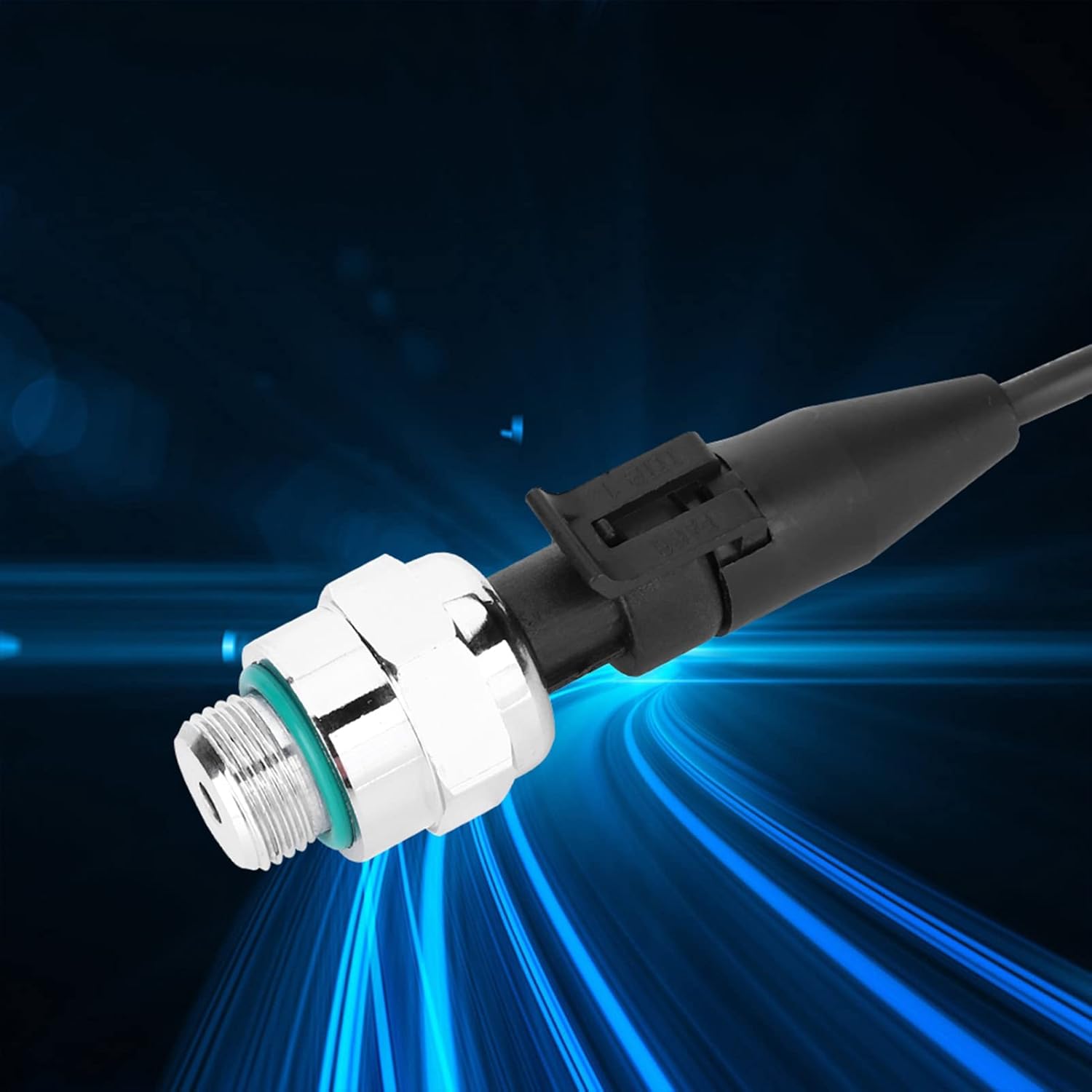
Image: A detailed view of the EVTSCAN Pressure Sensor, showing the secure connection of the waterproof electrical interface to the sensor body.
5. Operating Instructions
Once the sensor is mechanically installed and electrically connected, it will begin to measure pressure. The output voltage will vary proportionally to the detected pressure.
- Power Supply: The sensor operates with a 3.3V or 5V universal power supply.
- Output Voltage: The sensor provides an output voltage of 0.5-4.5V (for 5V supply) or 0.33-2.97V (for 3.3V supply), representing 10%-90% of the supply voltage. This analog signal can be read by a microcontroller or display unit.
- Monitoring: Connect the output signal to a compatible display or control system to monitor real-time pressure values.

Image: The pressure sensor with a visual representation of electrical currents, emphasizing its customized amplifier circuit that converts the sensor signal into a standard output signal.
6. Maintenance
The EVTSCAN HTP Pressure Sensor Transmitter is designed for durability and reliability with an IP65 protection grade. Minimal maintenance is required.
- Regular Inspection: Periodically inspect the sensor and its connections for any signs of physical damage, corrosion, or leaks.
- Cleaning: If necessary, gently clean the exterior of the sensor with a soft, damp cloth. Avoid using harsh chemicals or abrasive materials that could damage the housing or seals.
- Fluid Compatibility: Ensure that the fluid being measured remains compatible with the sensor's materials (ceramics, copper, fluoroelastomers) to prevent long-term degradation.
7. Troubleshooting
If you encounter issues with your EVTSCAN HTP Pressure Sensor Transmitter, consider the following:
- No Output/Incorrect Reading:
- Verify the power supply voltage is within the specified range (3.3V or 5V).
- Check all electrical connections for proper wiring and secure contact.
- Ensure the sensor is correctly installed and not obstructed.
- Confirm the fluid medium is compatible with the sensor.
- Leakage:
- Tighten the G3/8 threaded connection, ensuring a proper seal. Do not overtighten.
- Inspect the sealing washer or O-ring for damage and replace if necessary.
- Inconsistent Readings:
- Check for air bubbles or debris in the fluid line that might affect pressure readings.
- Ensure the operating temperature is within the 0-80 ℃ range.
- Verify the stability of the power supply.
If problems persist, contact EVTSCAN customer support for further assistance.
8. Important Notes
Please be aware that due to manufacturing variations, the new type and old type of this product may be shipped randomly. Both types meet the specified performance and quality standards.

Image: A comparison of the new and old models of the EVTSCAN Pressure Sensor, clarifying that either version may be received upon purchase.
9. Warranty and Support
Specific warranty information for this product is not provided in the available documentation. For detailed warranty terms, technical support, or further inquiries, please refer to the official EVTSCAN brand store or contact their customer service directly.
Visit the EVTSCAN Store for more information.