
1. Introduction
The EC Buying ZK-PP1K is a versatile PWM and pulse signal generator designed for various electronic applications. This device offers two primary modes: PWM mode for continuous frequency and duty cycle control, and Pulse mode for adjustable positive/negative pulse width, delay, and pulse count. It features a wide voltage input range and anti-reverse connection protection, making it suitable for controlling DC motors, stepper motors, servo motors, and replacing PLC pulse signals.
2. Product Features
- Dual Mode Operation: Switch between PWM mode (continuous frequency and duty cycle) and PULSE mode (adjustable positive/negative pulse width, delay, and pulse count).
- Start/Stop Functionality: Includes a dedicated button for controlling signal output (ON/OFF). The ZK-PP1K also supports external switch control.
- Wide Voltage Input: Operates within a 3.3V to 30V range, featuring built-in anti-reverse polarity protection.
- Clear LED Display: Provides real-time display of frequency, duty cycle, pulse count, and other parameters.
3. Product Specifications

This image displays the ZK-PP1K PWM Pulse Signal Generator alongside its key specifications, including working voltage, frequency range, duty cycle range, number of pulses, delay output time, positive and negative pulse width length, and signal carrying capacity.
| Specification | Value |
|---|---|
| Working Voltage | 3.3V ~ 30V (with anti-reverse polarity protection) |
| Frequency Range | 1Hz ~ 150KHz (accuracy approx. 1%) |
| Duty Cycle Range | 0-100% (1% step) |
| Number of Pulses | 1-9999, or infinite (displayed as '----') |
| Delay Output Time | 0.000s - 9999s (minimum 1ms) |
| Positive/Negative Pulse Width Length | 0.000s - 9999s (minimum 1ms) |
| Signal Carrying Capacity | Less than 30mA (for ZK-PP1K) |
| Display Type | LED |
| Material | Plastic |
| Dimensions | Approximately 2.79 inches x 1.57 inches (7.09 cm x 3.99 cm) |
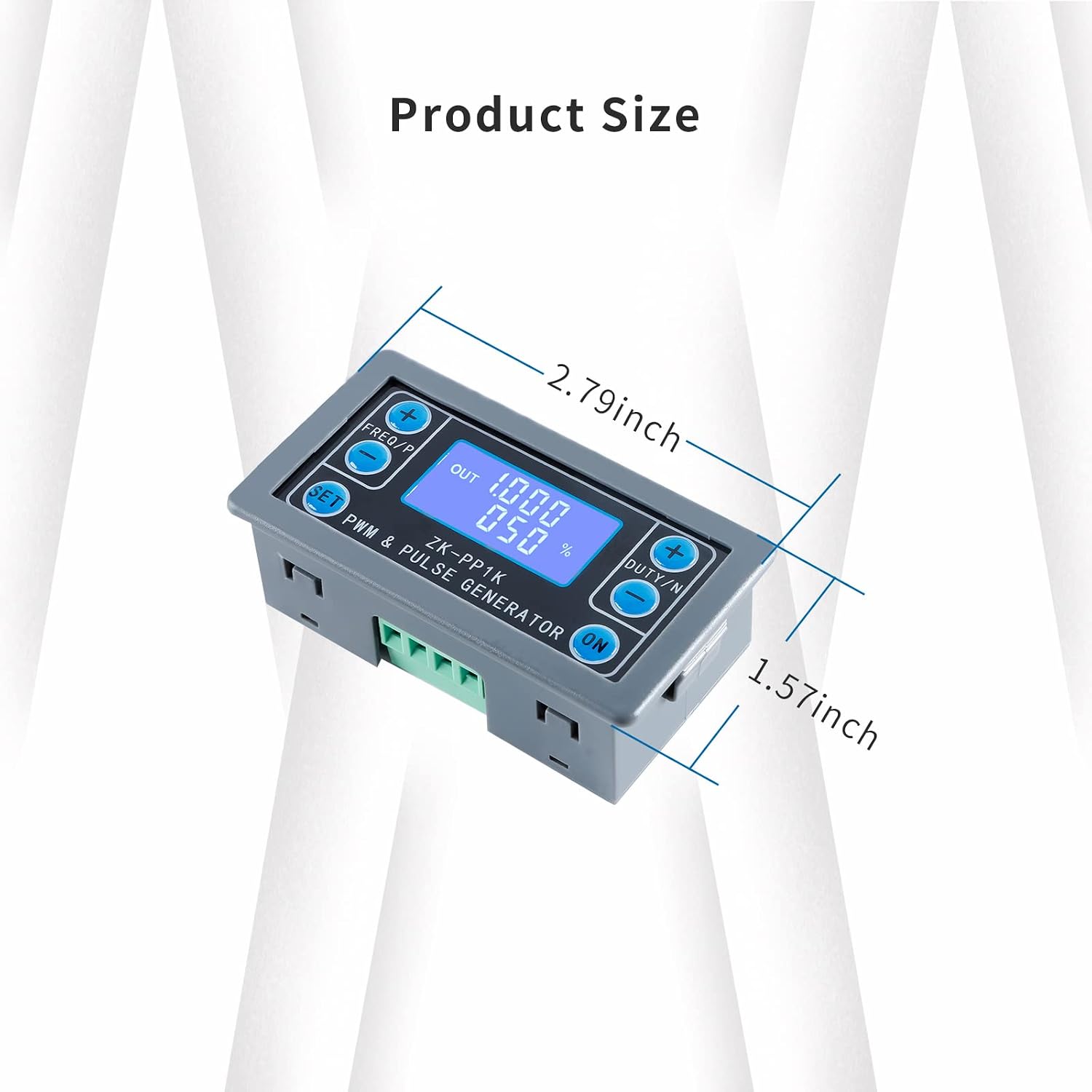
This image illustrates the physical dimensions of the ZK-PP1K module, indicating its length as approximately 2.79 inches and width as 1.57 inches.
4. Setup
Before operation, ensure proper power supply and connections. The ZK-PP1K requires a working voltage between 3.3V and 30V. It features anti-reverse polarity protection for safety.
4.1 Wiring Diagram

This diagram shows the connection points for the ZK-PP1K. Connect the power input positive to V+ and power input negative to V-. The PWM output positive pole connects to PWM, and the PWM output negative pole connects to GND. An external switch signal or 3.3V level signal can be connected to the 'STOP' terminal to control PWM output ON/OFF.
- Power Input: Connect your DC power source (3.3V-30V) to the V+ (positive) and V- (negative) terminals.
- PWM Output: Connect the device or circuit you wish to control to the PWM (positive) and GND (negative) output terminals.
- External Control (Optional): For external ON/OFF control, connect a switch or 3.3V level signal to the 'STOP' terminal.
5. Operating Instructions
The ZK-PP1K offers two main operating modes: PWM mode and PULSE mode. Only one mode can be active at a time, but you can switch between them as needed.

This image provides a comprehensive table detailing the button functions for both PWM and PULSE modes, including how to switch modes, adjust parameters, and control output.
5.1 General Operation
- Upon powering on, the device will output a waveform.
- The waveform amplitude is equal to the power supply voltage.
- If the number of output pulses reaches the set value (in PULSE mode), the output will automatically stop, and 'OUT' will disappear from the display.
- Press the ON key to control the presence or absence of the waveform. If 'OUT' disappears, there is no output waveform, and the output is 0.
- To restart output or recalculate the number of pulses, power cycle the device or press the ON key.
5.2 PWM Mode
In PWM mode, you can adjust the frequency and duty cycle. The output is continuous.
- Switching to PWM Mode: Long press the SET button for more than 6 seconds.
- Adjusting Frequency: Use the FREQ/P + and FREQ/P - buttons.
- Adjusting Duty Cycle: Use the DUTY/N + and DUTY/N - buttons.
5.3 PULSE Mode
In PULSE mode, you can set positive pulse width, negative pulse width, delay start time, and the number of pulses.
- Switching to PULSE Mode: Long press the SET button for more than 6 seconds.
- Adjusting Positive Pulse Width: Use the FREQ/P + and FREQ/P - buttons.
- Adjusting Negative Pulse Width: Use the DUTY/N + and DUTY/N - buttons.
- Adjusting Power-on Delay: Long press the SET button for more than 2 seconds to enter delay settings, then use FREQ/P + and FREQ/P -.
- Adjusting Number of Pulses: Long press the SET button for more than 2 seconds to enter pulse count settings, then use DUTY/N + and DUTY/N -.

This image provides a detailed view of the ZK-PP1K's LED display and control buttons, which are used for adjusting frequency, duty cycle, and other parameters in both PWM and Pulse modes.
5.4 Function Demonstration Video
This video demonstrates the ZK-PP1K PWM Pulse Signal Generator in operation, showing how to adjust frequency and duty cycle while observing the waveform on an oscilloscope. It highlights the device's functionality and ease of parameter adjustment.
6. Application Scenarios
- Generating square wave and rectangular wave signals.
- Controlling DC motor or stepper motor drivers.
- Applications involving servo motors, stepper motors, and electric grippers.
- Replacing PLC pulse signals in automation systems.
- Can be paired with drivers for dimming, speed regulation, and controlling solenoid valves. Note: The ZK-PP1K cannot directly drive high-current loads such as electric light motors or large solenoid valves without an appropriate driver.
7. Maintenance
To ensure the longevity and optimal performance of your ZK-PP1K PWM Pulse Signal Generator, follow these general maintenance guidelines:
- Keep the device clean and free from dust and debris. Use a soft, dry cloth for cleaning.
- Avoid exposing the device to extreme temperatures, humidity, or direct sunlight.
- Ensure proper ventilation to prevent overheating during extended operation.
- Handle the device with care to prevent physical damage to the casing or internal components.
- Regularly check all connections for secure fit to prevent intermittent operation or short circuits.
8. Troubleshooting
If you encounter issues with your ZK-PP1K, consider the following troubleshooting steps:
| Problem | Possible Cause | Solution |
|---|---|---|
| No display or power | Incorrect power supply voltage, reverse polarity, or loose connection. | Verify power supply is within 3.3V-30V. Check wiring for correct polarity. Ensure power cables are securely connected. |
| No output signal | Output is turned OFF, incorrect mode settings, or faulty connection to load. | Press the ON button to ensure output is active ('OUT' should be visible). Check mode settings (PWM/PULSE) and parameters. Verify connections to the load. |
| Incorrect frequency/duty cycle | Parameters not set correctly. | Refer to Section 5.2 (PWM Mode) or 5.3 (PULSE Mode) for correct parameter adjustment procedures. |
| Output stops prematurely in PULSE mode | Set number of pulses reached. | This is normal operation. To restart, power cycle or press the ON button. Adjust the number of pulses if continuous output is desired (set to '----' for infinite). |
9. Warranty and Support
This product is typically covered by a standard return policy. Please refer to your purchase platform for specific return and warranty details. For technical support or further inquiries, please contact EC Buying customer service through the retailer where the product was purchased.
Return Policy: A 30-day return policy is generally available for this product. Please check with your vendor for exact terms.