
1. Introduction
This manual provides essential information for the safe and effective operation of your DJI Mavic 3 drone. The DJI Mavic 3 is a high-performance camera drone featuring a dual-camera system, including a 20MP wide-angle Hasselblad camera with a 4/3" CMOS sensor and a 12MP telephoto camera with a 1/2" CMOS sensor. It is designed for professional-quality aerial imaging, offering 5.1K video capabilities, omnidirectional obstacle sensing, and extended flight times.
Please read this manual thoroughly before operating the aircraft to ensure proper usage and to prevent damage or injury. Keep this manual for future reference.
2. Safety Information
Operating the DJI Mavic 3 requires adherence to safety guidelines to prevent accidents and ensure legal compliance. Always prioritize safety during flight operations.
- Pre-Flight Check: Before each flight, inspect the drone, propellers, battery, and remote controller for any damage or abnormalities. Ensure all components are securely attached.
- Flight Environment: Fly in open areas, away from people, buildings, and obstacles. Avoid flying near airports, power lines, or in restricted airspace. Check local regulations before flying.
- Weather Conditions: Do not fly in strong winds, rain, snow, or fog. Optimal flight conditions are clear and calm.
- Battery Safety: Use only genuine DJI batteries and chargers. Do not overcharge or discharge batteries. Store batteries in a cool, dry place.
- Maintain Line of Sight: Always keep the drone within your visual line of sight during flight.
- Respect Privacy: Be mindful of privacy concerns when operating the drone, especially when recording video or taking photos.
- Emergency Procedures: Familiarize yourself with the Return to Home (RTH) function and emergency stop procedures.
3. Package Contents
Verify that all items are present in your package. If any items are missing or damaged, contact your retailer or DJI support.

Image: DJI Mavic 3 drone and included accessories.

Image: Detailed view of various accessories.
Manufacturer Included Items:
- DJI Mavic 3 Aircraft
- RC-N1 Remote Controller
- Intelligent Flight Battery
- 3 x Pair of Low-Noise Propellers
- 65W Portable Charger
- Storage Cover
- RC-N1 Remote Controller Sticks (Pair)
- RC-N1 Remote Controller USB Type-C Cable
- RC-N1 Remote Controller Micro-USB Cable
- RC-N1 Remote Controller Lightning Cable
- USB Type-C Cable
Bundle Items (if applicable):
- Sandisk Extreme Pro 64GB Micro SDXC Card
- Pro Sling Backpack
- Memory Card Reader
- Cleaning Kit
- Memory Card Wallet
4. Product Overview
The DJI Mavic 3 integrates advanced technology for superior aerial photography and videography. Key components and features are outlined below.
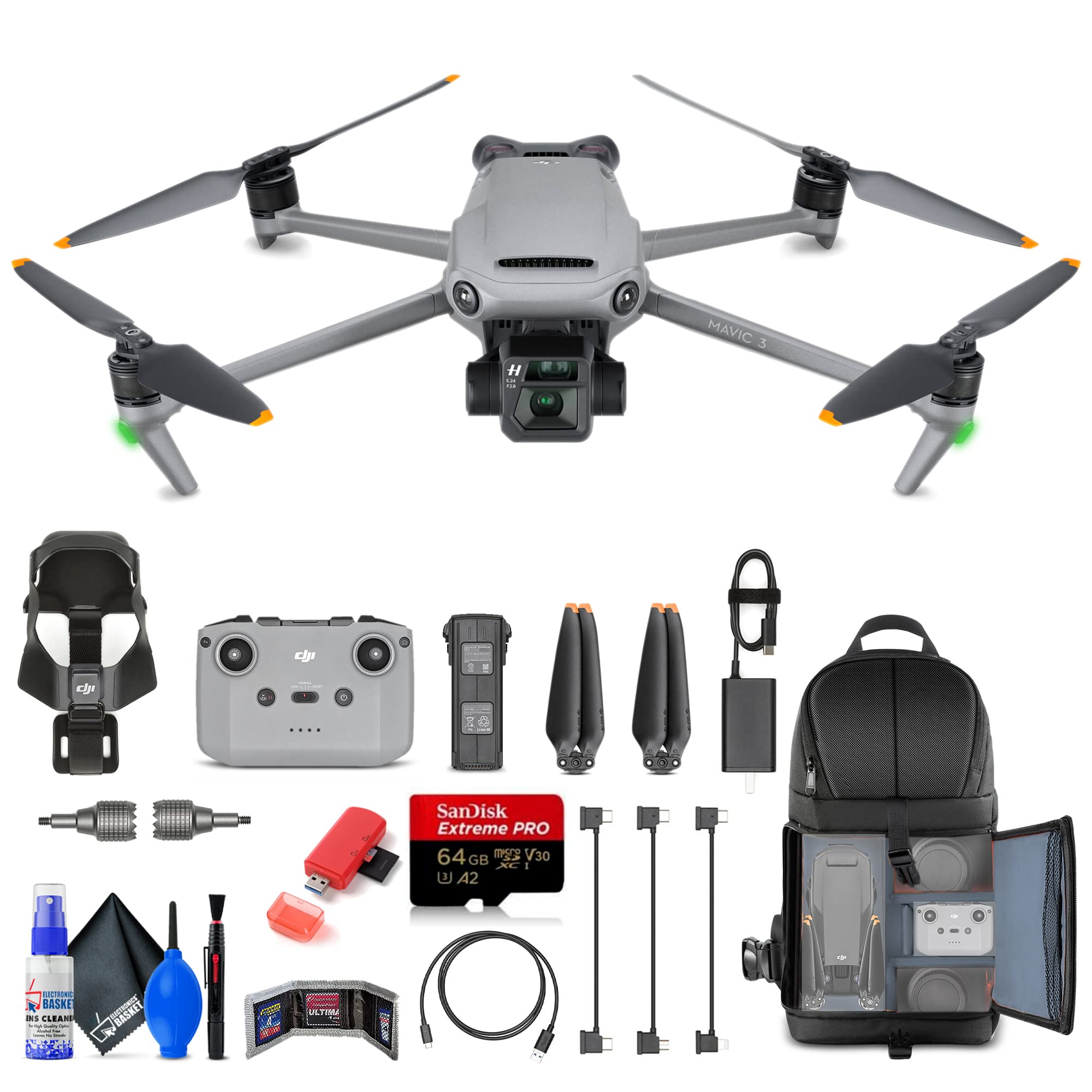
Image: DJI Mavic 3 unfolded, ready for flight.

Image: DJI Mavic 3 in its folded, compact state.
Aircraft Features:
- Dual Camera System: Features a 20MP 4/3" CMOS Hasselblad wide-angle camera capable of 5.1K video, and a 12MP 1/2" CMOS telephoto camera with 28x hybrid zoom.
- 3-Axis Gimbal: Provides stable footage and precise camera control.
- Omnidirectional Obstacle Sensing: Multiple wide-angle vision sensors detect obstacles in all directions, enabling the drone to plan safe flight routes.
- Extended Flight Time: Up to 46 minutes of flight on a single charge.
- Advanced Auto Return (RTH): Automatically plans the optimal route back to its home point, considering wind speed and power consumption.
- OcuSync 2.0 Transmission: Offers a transmission range of up to 9.3 miles (15 km) for reliable video feed.
- 10-Bit D-Log Color Profile & HNCS: For professional-grade color grading and natural color reproduction.
- Internal Storage: 8GB of internal storage space.
Remote Controller (RC-N1):
The RC-N1 remote controller provides intuitive control over the aircraft and camera. It connects to your smartphone for live video feed and advanced settings via the DJI Fly app.
Image: RC-N1 Remote Controller.
5. Setup
Follow these steps to prepare your DJI Mavic 3 for its first flight.
5.1 Charging Batteries
- Connect the 65W Portable Charger to a power outlet.
- Connect the Intelligent Flight Battery to the charger using the provided USB Type-C cable.
- Charge the RC-N1 Remote Controller using its respective USB cable.
- Ensure both the flight battery and remote controller are fully charged before flight.
5.2 Attaching Propellers
- Unfold the drone arms.
- Match the propellers with the corresponding motor mounts. Propellers with orange marks should be attached to motors with orange marks. Propellers without marks attach to motors without marks.
- Press the propeller down onto the motor mount and rotate in the lock direction until it is secure.
- Verify that all propellers are securely attached and free from damage.
Image: DJI Mavic 3 with propellers correctly installed.
5.3 Installing the Flight Battery
- Ensure the Intelligent Flight Battery is fully charged.
- Slide the battery into the battery compartment on the rear of the aircraft until it clicks into place.
- Gently pull on the battery to ensure it is securely locked.
5.4 Remote Controller Setup
- Attach the control sticks to the remote controller.
- Pull out the mobile device holder and attach your smartphone.
- Connect your smartphone to the remote controller using the appropriate RC cable (USB Type-C, Micro-USB, or Lightning).
- Download and install the DJI Fly app on your smartphone.
6. Operating the DJI Mavic 3
This section covers basic flight operations and camera controls.
6.1 Powering On/Off
- To Power On: Press the power button once, then press and hold for two seconds. The battery level indicators will light up.
- To Power Off: Press the power button once, then press and hold for two seconds.
6.2 Takeoff and Landing
- Automatic Takeoff: In the DJI Fly app, tap the auto takeoff icon and confirm. The drone will take off and hover at a safe altitude.
- Manual Takeoff: Push both control sticks to the bottom inner or outer corners to start the motors. Slowly push the left stick (throttle) up to ascend.
- Automatic Landing: In the DJI Fly app, tap the auto landing icon and confirm. The drone will land automatically.
- Manual Landing: Slowly pull the left stick (throttle) down to descend. Once landed, push both sticks to the bottom inner or outer corners to stop the motors.
6.3 Flight Controls (Mode 2)
| Control Stick | Movement | Function |
|---|---|---|
| Left Stick | Up/Down | Ascend/Descend (Throttle) |
| Left Stick | Left/Right | Rotate Left/Right (Yaw) |
| Right Stick | Up/Down | Forward/Backward (Pitch) |
| Right Stick | Left/Right | Left/Right (Roll) |
6.4 Camera Operation
- Switching Cameras: Use the DJI Fly app to switch between the Hasselblad wide-angle camera and the telephoto camera.
- Photo/Video: Use the dedicated buttons on the remote controller or the app interface to capture photos or start/stop video recording.
- Gimbal Control: Use the gimbal dial on the remote controller to adjust the camera's tilt angle.
- Zoom: The telephoto camera offers 28x hybrid zoom, controllable via the DJI Fly app.
6.5 Obstacle Sensing and Avoidance
The Mavic 3 features omnidirectional obstacle sensing. The drone will automatically detect and attempt to avoid obstacles in its flight path. This system enhances flight safety, but it is not a substitute for pilot vigilance. Always monitor your surroundings.
6.6 Return to Home (RTH)
The RTH function allows the aircraft to return to its recorded home point automatically. This can be initiated manually via the remote controller or the app, or it can be triggered automatically in cases of low battery or loss of signal.
- Ensure the home point is recorded before takeoff.
- Clear the flight path around the home point for safe landing.
7. Maintenance
Proper maintenance ensures the longevity and optimal performance of your DJI Mavic 3.
7.1 Cleaning
- Wipe the aircraft body with a soft, dry cloth.
- Use a lens cleaning cloth for the camera and vision sensors. Avoid harsh chemicals.
- Remove any debris from motors and propeller mounts.
7.2 Storage
- Store the drone in a cool, dry place, away from direct sunlight.
- Remove the Intelligent Flight Battery from the aircraft if storing for extended periods.
- Store batteries at approximately 50-60% charge for optimal longevity.
- Use the provided storage cover to protect the gimbal and camera.
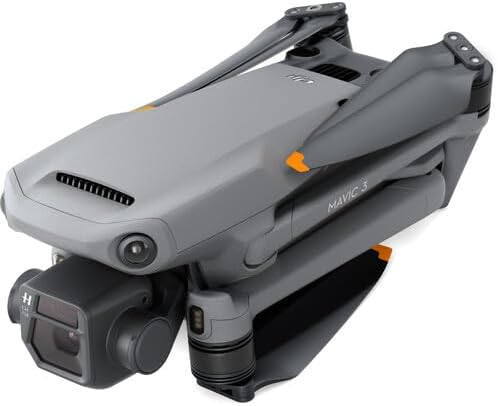
Image: DJI Mavic 3 folded with its storage cover.
8. Troubleshooting
This section addresses common issues you might encounter with your DJI Mavic 3.
| Problem | Possible Cause | Solution |
|---|---|---|
| Drone does not power on | Low battery; incorrect power-on procedure | Charge the Intelligent Flight Battery; press power button once, then press and hold for two seconds. |
| No video feed in DJI Fly app | Loose cable connection; app not running; remote controller not linked | Ensure smartphone is securely connected to RC; restart app; link remote controller to aircraft. |
| Drone drifts during flight | IMU calibration needed; strong winds | Perform IMU calibration via DJI Fly app; avoid flying in strong winds. |
| Obstacle avoidance not working | Sensors obstructed; low light conditions; system disabled | Clean sensors; fly in adequate lighting; ensure obstacle avoidance is enabled in app. |
| Poor image/video quality | Dirty lens; incorrect camera settings; insufficient lighting | Clean camera lens; adjust camera settings (ISO, shutter speed, white balance); ensure adequate lighting. |
9. Specifications
Detailed technical specifications for the DJI Mavic 3 drone.
| Feature | Specification |
|---|---|
| Brand | DJI |
| Model Name | CP.MA.00000439.01 |
| Camera | 20MP 4/3" CMOS Hasselblad (Wide-Angle), 12MP 1/2" CMOS (Telephoto) |
| Video Resolution | Up to 5.1K (Hasselblad), 4K (Telephoto) |
| Max Flight Time | 46 Minutes |
| Transmission Range | Up to 9.3 miles (15 km) |
| Obstacle Sensing | Omnidirectional |
| Item Weight | 6.92 Pounds (approx. 3.14 kg) |
| Dimensions (L x W x H) | 13.7"L x 4.2"W x 11.1"H (folded, approximate) |
| Internal Storage | 8GB |
| Connectivity | USB, Wi-Fi (for remote controller) |
| Control Type | Remote Control |
| Optical Sensor Technology | CMOS |
| Media Type | SDXC (for external storage) |
10. Warranty and Support
The DJI Mavic 3 is covered by a manufacturer's warranty. For detailed warranty terms and conditions, please refer to the official DJI website or the warranty card included with your product.
For technical support, troubleshooting assistance, or service requests, please contact DJI Customer Support through their official channels. You can typically find contact information on the DJI website:
Always provide your product model number (CP.MA.00000439.01) and proof of purchase when seeking support.


