
Song Chuan HF2160-1A-12DE
HF2160-1A-12DE 30A 12VDC Air Conditioner Water Heater Relay
Brand: Song Chuan | Model: HF2160-1A-12DE
Product Overview
The Song Chuan HF2160-1A-12DE is a robust 30A 12VDC relay designed for various applications, including air conditioning and water heater systems. It features a 1 Form A contact configuration and PCB termination, making it suitable for heavy-duty loads. This relay is engineered for reliable performance and durability in demanding environments.
Key features include:
- 30A switching capability.
- PCB coil terminals ideal for heavy duty load.
- 2.5kV dielectric strength (between coil and contacts).
- Wash tight and Flux proofed types available.
- Class F insulation available.
Technical Specifications
| Parameter | Value |
|---|---|
| Nominal Coil Voltage | 12 VDC |
| Contact Form | 1 Form A |
| Termination | PCB |
| Contact Material | AgCdO (Silver Cadmium Oxide) |
| Operate Time | 15ms Max. |
| Release Time | 10ms Max. |
| Insulation Resistance | 1000MΩ at 500VDC |
| Ambient Temperature (Class B) | -55°C to 100°C |
| Ambient Temperature (Class F) | -55°C to 125°C |
| Weight | Approx. 35 g |
| Current Rating | 30 Amps |
| Mounting Type | PCB Mount |
| Connector Type | Through Hole |
Setup and Installation
The HF2160-1A-12DE relay is designed for PCB (Printed Circuit Board) mounting. Proper installation is crucial for safe and reliable operation.
Physical Dimensions and Layout
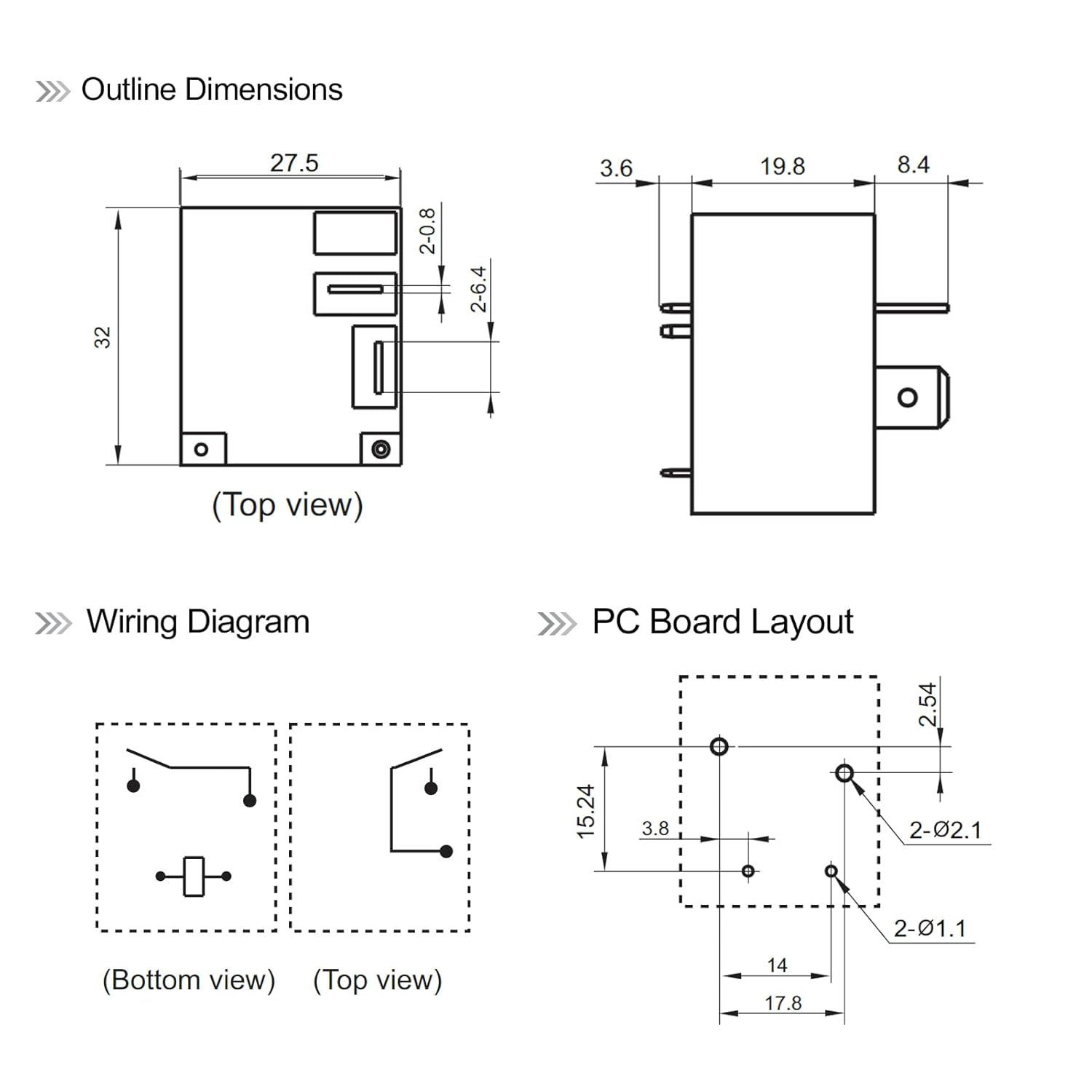
This image displays the outline dimensions (top view), wiring diagram (bottom and top view), and PC board layout for the HF2160-1A-12DE relay. It provides critical measurements and pin configurations necessary for correct PCB integration.
- Preparation: Ensure the power supply to the circuit is completely disconnected before beginning installation. Verify that the PCB is clean and free of debris.
- Pin Alignment: Carefully align the relay's pins with the corresponding holes on the printed circuit board. Refer to the provided PC Board Layout diagram for correct orientation and spacing.
- Insertion: Gently insert the relay pins into the PCB holes. Do not force the relay, as this may bend or damage the pins.
- Soldering: Solder each pin securely to the PCB using appropriate soldering techniques. Ensure good solder joints for reliable electrical connection and mechanical stability.
- Wiring: Connect the coil and contact terminals according to your circuit's wiring diagram. Pay close attention to the Nominal Coil Voltage (12 VDC) and Contact Form (1 Form A) to ensure correct operation.
- Verification: After soldering, visually inspect all connections for any shorts, cold solder joints, or misalignments.
Important Safety Note:
- Do not switch the contacts without any load, as the contact resistance may increase rapidly.
- Do not use relays that exceed coil ratings, contact ratings, and life expectancy, as doing so may result in a risk of overheating.
- Installation should only be performed by qualified personnel familiar with electrical circuits and safety procedures.
Operating Principles
The HF2160-1A-12DE is an electromagnetic relay that operates by using an electrical current to activate a switch. When the nominal coil voltage (12 VDC) is applied to the coil terminals, an electromagnetic field is generated. This field attracts an armature, causing the contact to switch from its normally open (NO) state to a closed state, completing the circuit for the load.


These images show different views of the HF2160-1A-12DE relay, highlighting its compact design and terminal configuration. The markings on the relay indicate its model number, voltage ratings, and manufacturer.
When the coil voltage is removed, the electromagnetic field collapses, and a spring mechanism returns the contact to its original normally open position, breaking the circuit. The operate time (15ms Max.) and release time (10ms Max.) indicate the speed at which the relay switches states.
This relay is commonly used in applications requiring high current switching, such as controlling compressors in air conditioners or heating elements in water heaters, where a low-power control signal needs to switch a high-power load.
Maintenance
The HF2160-1A-12DE relay is a sealed component and generally requires minimal maintenance. However, regular inspection of the surrounding circuit and operating environment can help ensure its longevity and reliable performance.
- Environmental Conditions: Ensure the relay operates within its specified ambient temperature range (-55°C to 125°C for Class F insulation). Extreme temperatures can degrade performance and lifespan.
- Cleanliness: Keep the area around the relay clean and free from dust, moisture, and corrosive substances. While the relay is available in wash-tight and flux-proofed types, excessive contamination can still affect performance or lead to short circuits on the PCB.
- Connection Integrity: Periodically inspect the solder joints and PCB traces connected to the relay for any signs of corrosion, cracking, or loosening. Poor connections can lead to intermittent operation or overheating.
- Load Management: Always ensure that the load being switched does not exceed the relay's contact ratings (30A). Overloading can cause premature wear, contact welding, or failure due to overheating.
- Coil Voltage: Verify that the coil voltage supplied to the relay remains within the specified 12 VDC. Fluctuations outside this range can lead to unreliable switching or damage to the coil.
If the relay shows signs of malfunction (e.g., inconsistent switching, audible buzzing, or visible damage), it should be replaced immediately. Do not attempt to open or repair the sealed relay unit.
Troubleshooting
This section provides guidance for common issues encountered with the HF2160-1A-12DE relay. Always ensure power is disconnected before performing any inspection or maintenance.
| Problem | Possible Cause | Solution |
|---|---|---|
| Relay does not switch (no click sound) |
|
|
| Relay switches but load does not activate |
|
|
| Relay overheats |
|
|
| Intermittent operation |
|
|
Warning:
Always disconnect power before inspecting or working on electrical components. If you are unsure about any troubleshooting step, consult a qualified electrician or technician.
Warranty and Support
For specific warranty information regarding the Song Chuan HF2160-1A-12DE relay, please refer to the terms and conditions provided by your point of purchase or the official Song Chuan documentation that accompanied your product.
In most cases, relays are covered against manufacturing defects for a limited period from the date of purchase. Damage resulting from improper installation, exceeding specified ratings, environmental factors, or unauthorized modifications is typically not covered under warranty.
Customer Support
If you require technical assistance, have questions about product compatibility, or need to report a potential defect, please contact the seller or distributor from whom you purchased the relay. They can provide guidance or direct you to the appropriate support channels.
When contacting support, please be prepared to provide the following information:
- Product Model: HF2160-1A-12DE
- Date of Purchase
- Description of the issue
- Details of your application (e.g., type of circuit, load, operating conditions)
For general information about Song Chuan products, you may visit their official website (if available, a placeholder link is used as no specific link was provided): www.songchuan.com
Related Documents - HF2160-1A-12DE
 |
i-Autoc KSMD...D Series DC Output Solid State Relays: Technical Specifications and Installation Guide Comprehensive technical specifications, product overview, model selection, wiring diagrams, and installation instructions for i-Autoc KSMD...D series DC output solid state relays, designed for PLC control applications. |
 |
HFK7-T 汽车继电器技术规格书 宏发 HFK7-T 汽车继电器详细技术规格书,包括其特点、性能参数、触点规格、线圈数据、尺寸和订购信息。 |
 |
Kia Sedona (Carnival) Fuse Box and Relay Diagram Detailed guide to the fuse box and relay assignments for the Kia Sedona (Carnival), including passenger compartment and engine compartment locations, fuse designations, and relay functions. |
 |
TinySine TSRx430 30A Relay Board User Manual User manual for the TinySine TSRx430 30A Relay Board. This document details how to use the four-channel relay module, offering control via USB, Bluetooth, or WiFi. It covers specifications, setup, commands, and features like adjustable relay delay times. |
 |
Altronix RB30 Relay Module: Specifications and Operation Detailed specifications and operating instructions for the Altronix RB30 Relay Module, featuring 12VDC/24VDC operation, 30A contacts, and UL recognition. |
 |
ESP8266 8-Channel 30A Wi-Fi Relay Module: Hardware and Programming Guide Detailed hardware introduction, interface description, GPIO pinout, and step-by-step guide for setting up the Arduino IDE and programming the ESP8266 8-channel 30A Wi-Fi relay module. |
Ask a question about this manual
Ask about setup, troubleshooting, compatibility, parts, safety, or missing instructions. Manuals+ will review the question and use this page’s manual context to help answer it.