
1. Product Overview
The MAIWO K3016CL is a versatile M.2 SATA/NVMe Docking Station designed for efficient data management. It supports both M.2 NVMe and M.2 SATA SSDs, as well as SD Express 7.0/7.1 cards, offering high-speed data transfer and convenient offline cloning capabilities. This device is ideal for system disk migration, data backup, and recovery tasks.

Figure 1.1: MAIWO K3016CL Docking Station with M.2 SSDs
This image displays the MAIWO K3016CL M.2 SATA/NVMe Docking Station from a front-top perspective, showcasing two M.2 SSDs vertically inserted into its slots. The device features an SD Express slot at the front and LED indicators for clone progress.
2. Key Features
- One-Key Offline Clone: Easily duplicate drives without a computer. Supports 4 clone modes: NVMe to SATA, SATA to NVMe, SD to NVMe, and SD to SATA. Perfect for system disk migration, backup, and data recovery.
- 10Gbps High-Speed USB-C: Features USB 3.1 Gen 2 Type-C interface, delivering transfer speeds up to 10Gbps. Plug & play, no drivers or tools required. LED indicators clearly display the working status.
- Stable Power Supply: Comes with a 5V 3A power adapter, ensuring faster and more stable SSD performance. Provides reliable and consistent power for long-term operation.
- Efficient Heat Dissipation: Equipped with bottom cooling holes and non-slip silicone pads, ensuring stable performance and extended SSD lifespan while keeping the docking station secure on your desk.
- Wide Compatibility: Works with M.2 SATA SSDs, M.2 NVMe SSDs, and SD Express 7.0/7.1 cards. Supports reading/writing of two M.2 SSDs simultaneously. Fully compatible with Windows / Mac / Linux systems.
3. Package Contents
Upon opening the package, please verify that all components are present and in good condition:
- MAIWO K3016CL M.2 Clone Duplicator (Docking Station)
- 5V 3A Power Adapter
- USB-C to USB-C Cable
- User Manual (this document)
4. Setup Guide
4.1 Installing M.2 SSDs
- Identify the M.2 SATA and M.2 NVMe slots on the docking station. The slots are clearly labeled.
- Gently insert your M.2 SSD (SATA or NVMe) into the corresponding slot, ensuring the notch on the SSD aligns with the key in the slot.
- Push the SSD down until it clicks into place. No screws are typically required for this vertical design.
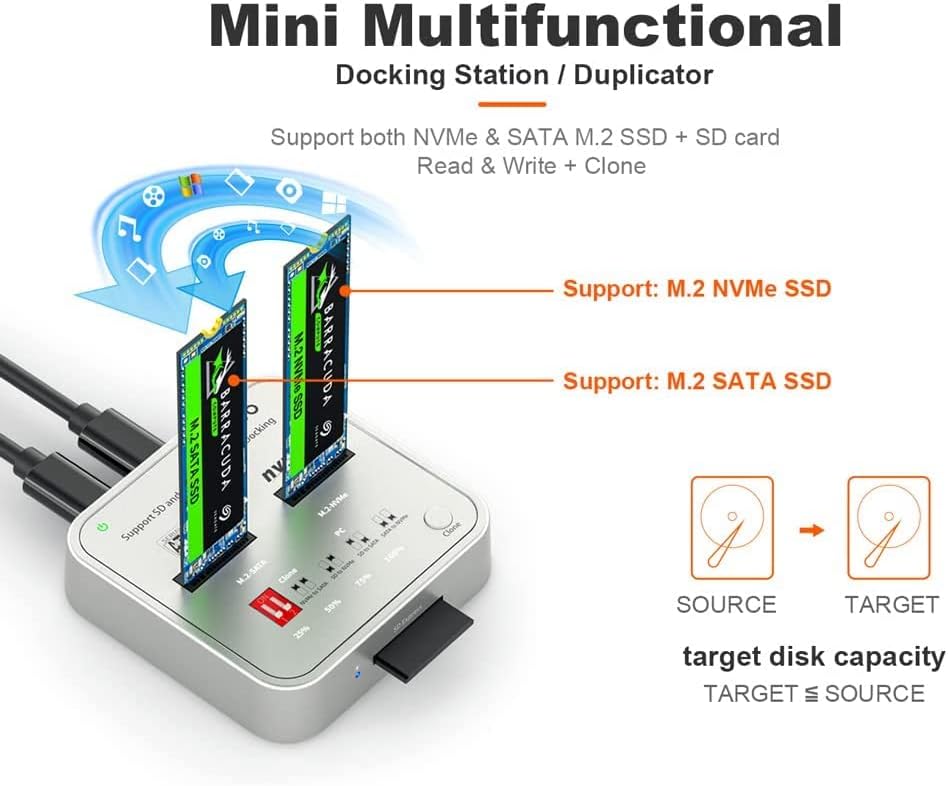
Figure 4.1: M.2 SSD Slot Identification
This image illustrates the MAIWO K3016CL docking station, highlighting the distinct slots for M.2 NVMe SSD and M.2 SATA SSD. It also shows the concept of source and target drives for cloning operations.
4.2 Connecting to Power and Host Device
- Connect the provided 5V 3A power adapter to the DC IN port on the docking station and then to a power outlet.
- For data transfer, connect the docking station to your computer (PC or Mac) using the supplied USB-C cable. The device is plug-and-play and does not require driver installation.
5. Operating Instructions
5.1 Data Transfer (PC Mode)
When connected to a computer via USB-C, the MAIWO K3016CL functions as an external SSD reader/writer. Both M.2 SSDs can be accessed simultaneously. The USB 3.1 Gen 2 Type-C interface supports data transfer speeds up to 10Gbps.
- Ensure the docking station is powered on and connected to your computer.
- The installed SSDs will appear as removable drives in your operating system.
- You can now drag and drop files, or use disk management tools to format or partition the drives.

Figure 5.1: High-Speed Data Transfer
This image shows the MAIWO K3016CL docking station connected to a laptop, illustrating its 10Gbps Super-Speed capability for data transfer. A comparison chart highlights the significant speed advantage over USB 2.0.
5.2 One-Key Offline Clone Function
The offline clone function allows you to duplicate an SSD without connecting to a computer. Ensure the target SSD capacity is equal to or greater than the source SSD capacity.

Figure 5.2: Offline Clone Function Diagram
This diagram details the four offline clone modes (NVMe to SATA, SD to NVMe, SD to SATA, SATA to NVMe) available on the MAIWO K3016CL. It also provides step-by-step instructions for initiating a clone and shows the LED progress indicators (25%, 50%, 75%, 100%).
Steps for Offline Cloning:
- Unplug Data Cable: Ensure the USB data cable is disconnected from the docking station. The device must be in standalone mode for offline cloning.
- Connect Power: Connect the 5V 3A power adapter to the docking station and a power outlet.
- Insert SSDs/SD Card:
- For M.2 to M.2 clone: Insert the Source SSD into the designated Source slot (e.g., M.2 SATA or M.2 NVMe) and the Target SSD into the other slot.
- For SD to M.2 clone: Insert the Source SD Express card into the SD slot and the Target M.2 SSD into the desired M.2 slot.
- Select Clone Mode: Use the dial key on the docking station to select the desired clone mode (e.g., NVMe to SATA, SD to NVMe). Refer to Figure 5.2 for dial key positions and corresponding modes.
- Initiate Clone: Short press the 'Clone' button twice. The 25% LED indicator will start flashing, indicating the cloning process has begun.
- Monitor Progress: The LED indicators (25%, 50%, 75%, 100%) will light up sequentially to show the cloning progress. When the 100% LED is solid, the clone is complete.
- Power Off: Once cloning is complete, power off the docking station before removing the SSDs/SD card.
Important: Data on the Target SSD will be overwritten during the cloning process. Ensure you have backed up any important data from the Target SSD before proceeding.
6. Heat Dissipation
The MAIWO K3016CL is designed with efficient heat dissipation in mind to ensure stable performance and extend the lifespan of your SSDs. It features:
- Vertical Design: Allows for natural convection and easier heat escape from the SSDs.
- Bottom Cooling Holes: Strategically placed vents at the base facilitate airflow.
- Metal Heat Dissipation Plate: An internal metal plate helps to draw heat away from the circuit board and SSDs, ensuring stable operation even during prolonged use.

Figure 6.1: Internal Design for Heat Dissipation
This image provides an exploded view of the MAIWO K3016CL, illustrating its vertical design, high-strength ABS shell, high-precision circuit board, and the crucial metal heat dissipation plate that contributes to stable and long-term operation.
7. Compatibility
The MAIWO K3016CL offers broad compatibility with various storage devices and operating systems:
- M.2 SSDs: Supports both M.2 SATA SSDs and M.2 NVMe SSDs.
- M.2 Form Factors: Compatible with M.2 SSDs of sizes 2230, 2242, 2260, 2280, and 22110.
- SD Cards: Supports SD Express 7.0/7.1 cards.
- Operating Systems: Fully compatible with Windows, macOS, and Linux operating systems.
- Devices: Can be used with laptops, desktop PCs, smart TVs, PS4, mobile phones (with OTG support), XBOX, and other compatible devices for storage expansion.

Figure 7.1: Broad Compatibility
This image illustrates the extensive compatibility of the MAIWO K3016CL, showing supported M.2 SSD sizes (2230 to 22110), various M.2 key types (M Key, B+M Key, B Key), and compatibility with PCI Express, Serial ATA, and NVMe standards. It also confirms support for Windows, Mac, and Linux operating systems.
8. Specifications
| Feature | Specification |
|---|---|
| Product Dimensions | 3.07 x 2.99 x 0.75 inches |
| Item Weight | 5.4 ounces (154 Grams) |
| Model Number | M.2 SATA/NVMe/SD Clone |
| Brand | MAIWO |
| Color | Black |
| Hardware Interface | USB 3.1 Gen 2 Type-C (10Gbps) |
| Compatible Devices | Laptops, PC, Smart TVs, PS4, Mobile Phones (OTG), XBOX |
| Total USB Ports | 1 (Type-C) |
| Power Supply | 5V 3A Power Adapter |
| Supported SSDs | M.2 SATA SSD, M.2 NVMe SSD |
| Supported SD Cards | SD Express 7.0/7.1 |
| Offline Clone Modes | NVMe to SATA, SATA to NVMe, SD to NVMe, SD to SATA |
9. Troubleshooting
If you encounter issues with your MAIWO K3016CL docking station, please refer to the following common troubleshooting steps:
- Device Not Recognized:
- Ensure the power adapter is securely connected and the device is powered on.
- Verify the USB-C cable is properly connected to both the docking station and your computer. Try a different USB port or cable.
- Check your computer's Disk Management (Windows) or Disk Utility (macOS) to see if the SSD is detected but uninitialized or unformatted.
- Ensure the M.2 SSD is correctly seated in its slot.
- Slow Transfer Speeds:
- Ensure you are connected to a USB 3.1 Gen 2 (10Gbps) compatible port on your computer. Older USB 2.0 or 3.0 ports will result in lower speeds.
- Check the health and performance of your SSDs.
- Close any background applications that might be consuming system resources or disk I/O.
- Offline Clone Fails or Does Not Start:
- Ensure the USB data cable is disconnected from the docking station. Offline cloning requires the device to be standalone.
- Verify that the target SSD's capacity is equal to or greater than the source SSD's capacity.
- Double-check that the source and target SSDs are correctly inserted into their respective slots.
- Confirm the correct clone mode is selected using the dial key.
- Press the 'Clone' button twice quickly to initiate the process.
- Overheating:
- Ensure the docking station is placed on a flat, stable surface with adequate ventilation.
- Avoid blocking the bottom cooling holes.
- Prolonged heavy use can generate heat; allow the device to cool down if it feels excessively hot.
If the issue persists after trying these steps, please contact MAIWO customer support for further assistance.
10. Maintenance
To ensure the longevity and optimal performance of your MAIWO K3016CL docking station, follow these maintenance guidelines:
- Cleaning: Use a soft, dry cloth to wipe the exterior of the device. Do not use liquid cleaners or abrasive materials.
- Storage: When not in use, store the docking station in a cool, dry place away from direct sunlight and extreme temperatures.
- Handling: Handle the device with care. Avoid dropping it or subjecting it to strong impacts.
- Power Off: Always power off the docking station and disconnect it from the power source when not in use or before moving it.
11. Warranty and Support
MAIWO products are designed for reliability and performance. For warranty information and technical support, please refer to the warranty card included with your product or visit the official MAIWO website. Keep your purchase receipt as proof of purchase for warranty claims.
For further assistance, you may contact MAIWO customer support through their official channels. Please provide your product model number (K3016CL) and a detailed description of the issue when seeking support.