
1. Introduction
This user manual provides comprehensive instructions for the installation, operation, and maintenance of your OAE 40A MPPT Solar Charge Controller. This device is designed to efficiently manage power flow from your solar panels to your battery bank, ensuring optimal charging and system longevity. It is compatible with 12V, 24V, 36V, and 48V battery systems and supports various battery types.
2. Key Features
- Automatic 12V/24V/36V/48V battery system recognition.
- Maximum PV input voltage of 150V.
- Suitable for solar panel arrays up to 570W (12V), 1130W (24V), 1710W (36V), and 2270W (48V).
- Compatibility with Sealed, Gel, Flooded, and Lithium battery types.
- Integrated battery temperature compensation function.
- Multiple protection features: overcharge, over-discharge, overheat, reverse polarity, overload, and short-circuit protection.
- RS485 communication port for Wi-Fi remote monitoring (Wi-Fi module sold separately).
3. Product Overview

Front view of the OAE 40A MPPT Solar Charge Controller, showcasing the display and control buttons.

Overview of the AP-Series MPPT Solar Charge Controller highlighting its tracing efficiency, max PV input voltage, and APP monitoring capability.
3.1. Components and Ports
Detailed diagram illustrating the main components and connection ports of the controller.
- 1. Cooling Fan: For heat dissipation.
- 2. Hang Bracket: For mounting the controller.
- 3. LCD Display: Shows system status and settings.
- 4. Menu Button: Accesses the main menu.
- 5. Down Button: Navigates down through menu options or decreases values.
- 6. Up Button: Navigates up through menu options or increases values.
- 7. Enter Button: Confirms selections or enters sub-menus.
- 8. Temperature Interface: For connecting the external temperature sensor.
- 9. Solar Panel Terminals: Connects to the solar panel array.
- 10. Battery Terminals: Connects to the battery bank.
- 11. DC Load Terminals: Connects to DC loads (if used).
- 12. RS485 Port: For communication with external devices like Wi-Fi modules.
3.2. Product Dimensions
The controller measures approximately 8.7 inches (220mm) in height, 6.3 inches (160mm) in width, and 3.1 inches (80mm) in depth.
4. Setup
4.1. Important Pre-Installation Warnings
- Always connect the battery first to the controller before connecting the solar panel array. Ensure the battery voltage is sufficient for the controller to recognize the correct system voltage.
- NEVER connect the solar panel array to the controller without a battery connected.
- DO NOT connect any Inverter, wind turbine, alternator, or external charger directly to the charge controller. Inverters should be connected directly to the battery bank.
- Ensure the solar input voltage is at least 3V higher than the battery voltage and that the total input power is within the specified range.
- Ensure all connections to and from the controller are tight to prevent loose connections and potential hazards.
- DO NOT allow the positive (+) and negative (-) terminals of the battery to touch each other.
4.2. Wiring Instructions

Visual guide for connecting solar panels, battery, and DC load to the controller.
- Connect the Battery: Connect the positive and negative terminals of your battery bank to the corresponding battery terminals on the charge controller. Observe polarity.
- Connect the Solar Panels: Connect the positive and negative leads from your solar panel array to the solar panel terminals on the controller. Ensure correct polarity and that the open-circuit voltage (Voc) of your array does not exceed 150V.
- Connect the DC Load (Optional): If you have DC loads, connect their positive and negative leads to the DC load terminals on the controller.
- Connect Temperature Sensor: Plug the included temperature sensor into the designated temperature interface. This ensures accurate battery charging based on ambient temperature.
- RS485 Communication (Optional): If using a Wi-Fi module or other communication device, connect it to the RS485 port.
4.3. Battery Type Compatibility

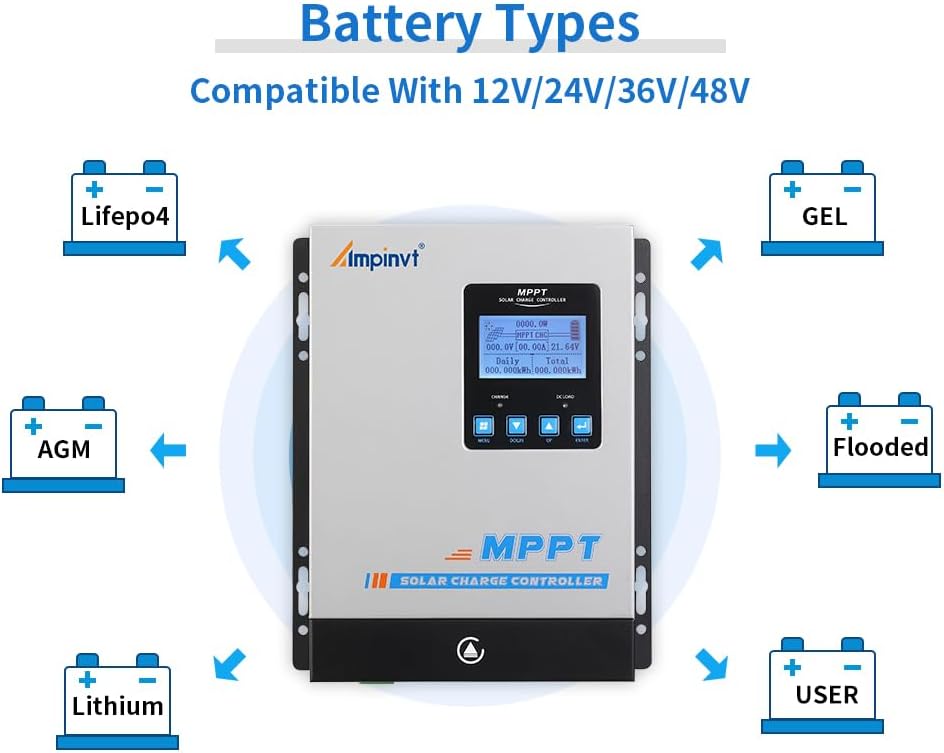
The controller is compatible with various battery chemistries including LifePO4, GEL, AGM, Flooded, and Lithium batteries, as well as a user-defined setting.
The controller supports multiple battery types. Ensure you select the correct battery type in the settings to optimize charging parameters and prolong battery life. Refer to the Operating section for instructions on how to change battery type settings.
5. Operating Instructions
The controller features an LCD display and four buttons (Menu, Down, Up, Enter) for navigation and setting adjustments.
5.1. Display Navigation
Press the 'Menu' button to cycle through different display screens showing real-time system data such as PV voltage, battery voltage, charging current, and daily/total energy generated. Use the 'Up' and 'Down' buttons to navigate within menus or adjust values. Press 'Enter' to confirm a selection or enter a sub-menu.
Video demonstrating the menu navigation and setting adjustments on the MPPT solar charge controller's LCD display.
5.2. Parameter Settings
To access advanced settings, navigate to the 'Parameter Setting' menu. A password may be required (refer to the included manual for default password). Key adjustable parameters include:
- Battery Type: Select the type of battery connected (Sealed, Gel, Flooded, Lithium, User). This is critical for correct charging.
- Rated Voltage: Set the nominal voltage of your battery system (12V, 24V, 36V, 48V).
- Charge Current: Adjust the maximum charging current.
- Floating Charge Voltage: Set the voltage at which the controller maintains the battery after it's fully charged.
- Equalization Charge Voltage: For certain battery types, this setting allows for periodic overcharging to balance cell voltages.
- Load Control Mode: Configure how the DC load output operates (e.g., always on, dusk to dawn, timer).
Always consult the detailed parameter tables in the full product manual for specific voltage and current recommendations for your battery type.
6. Maintenance
Regular maintenance ensures the longevity and optimal performance of your solar charge controller.
- Cleaning: Periodically clean the exterior of the controller with a dry cloth to remove dust and debris.
- Ventilation: Ensure adequate airflow around the controller. Maintain a space of approximately 20cm (8 inches) around the unit for proper heat dissipation.
- Cooling Fan: The controller is equipped with a cooling fan. If you hear a buzzing sound, it indicates the fan is operating to dissipate heat, which is normal. Ensure the fan is not obstructed.
- Connection Checks: Regularly inspect all wiring connections to ensure they are secure and free from corrosion. Loose connections can lead to overheating and poor performance.
- Environmental Conditions: Avoid installing the controller in direct sunlight or areas with high temperatures to prevent power loss due to overheating.
7. Troubleshooting
This section provides guidance for common issues. For complex problems, contact customer support.
| Problem | Possible Cause | Solution |
|---|---|---|
| No display or power | Battery not connected or low voltage; loose wiring. | Ensure battery is connected first and has sufficient charge. Check all wiring connections for tightness. |
| No charging from solar panels | Solar panels not connected; insufficient sunlight; PV voltage too low. | Verify solar panel connections. Check for adequate sunlight. Ensure PV voltage is higher than battery voltage. |
| Charging current is low or zero | Insufficient solar input (cloudy day); battery fully charged (floating charge). | This can be normal during cloudy conditions or when the battery is in float charge mode. |
| Controller buzzing/fan running constantly | Normal operation for heat dissipation; high ambient temperature. | Ensure proper ventilation around the controller. Avoid direct sunlight. |
| Load not working | Load control settings; over-discharge protection; overload. | Check load control settings. Verify battery voltage is above low voltage disconnect. Reduce load if overloaded. |
8. Specifications
| Feature | Specification |
|---|---|
| Model Number | OAE-40Amp |
| Rated Current | 40A |
| Battery System Voltage | Auto 12V/24V/36V/48V |
| Max PV Input Voltage | 150V |
| Max PV Input Power (12V) | 570W |
| Max PV Input Power (24V) | 1130W |
| Max PV Input Power (36V) | 1710W |
| Max PV Input Power (48V) | 2270W |
| Display Type | LED |
| Product Dimensions | 8.7"L x 3.1"W x 6.3"H (220mm x 80mm x 160mm) |
| Item Weight | 5.77 pounds (2.62 kg) |
| Material | Metal |
| Color | Silver |
| Included Components | Controller |
9. Important Safety Information
Please read and understand all safety instructions before installing or operating the OAE MPPT Solar Charge Controller. Failure to follow these instructions may result in electric shock, fire, or severe injury.
- This controller is designed for use with solar panels and batteries only. Do not connect other power sources.
- Always disconnect all power sources (solar panels and battery) before performing any installation, wiring, or maintenance on the controller.
- Install the controller in a well-ventilated area, away from flammable materials and direct sunlight.
- Use appropriate wire gauges for all connections to prevent overheating.
- Ensure proper grounding of the system.
- Do not attempt to disassemble or repair the controller yourself. Refer all servicing to qualified personnel.
- Keep children away from the solar power system components.
10. Warranty and Support
For warranty information, technical support, or service inquiries, please refer to the contact details provided with your product packaging or visit the official OAE website. Keep your purchase receipt as proof of purchase for warranty claims.