
1. Introduction
The GOBOOST Cell Phone Signal Booster is designed to enhance 2G, 3G, 4G LTE, and 5G cellular signals within your home or office environment. This device supports multiple carriers including Verizon, AT&T, and T-Mobile, operating on bands 12, 17, 2, 4, and 5. It aims to provide a stable connection, reduce dropped calls, and improve data streaming speeds.

The GOBOOST signal booster ensures stable connections and faster streaming speeds for multiple users.

Experience improved voice quality and faster data with the GOBOOST signal booster.
2. Safety Information
Please read all safety instructions before installing and operating this device. Failure to follow these instructions may result in electric shock, fire, or other serious injury.
- FCC Compliance: This is a Consumer Device. You must register this device with your wireless provider and have your provider’s consent. Most wireless providers consent to the use of signal boosters. Some providers may not consent to the use of this device on their network. If you are unsure, please contact your provider.
- Antenna Placement: You must operate this device with approved antennas and cables as specified by the manufacturer. Antenna must be installed at least 20cm (8 inches) from any person.
- Power Supply: Use only the power adapter provided with the device.
- Outdoor Installation: Exercise caution when installing the outdoor antenna. Avoid contact with power lines and ensure stable mounting.
- Interference: You must cease operating this device immediately if requested by the FCC or a licensed wireless service provider.

The FCC label confirms the device's compliance with regulatory standards.
3. Package Contents
Verify that all items are present in your package:
- GOBOOST Signal Booster Unit
- Outdoor LPDA (Yagi) Antenna
- Indoor Panel Antenna
- Coaxial Cables (for outdoor and indoor antennas)
- Power Adapter
- Mounting Hardware (U-shaped sheets, screws)
- User Manual
This video demonstrates the unboxing and shows the components included in the GOBOOST signal booster package.
4. Product Overview
The GOBOOST signal booster unit features an intelligent display and clearly labeled ports for easy setup.
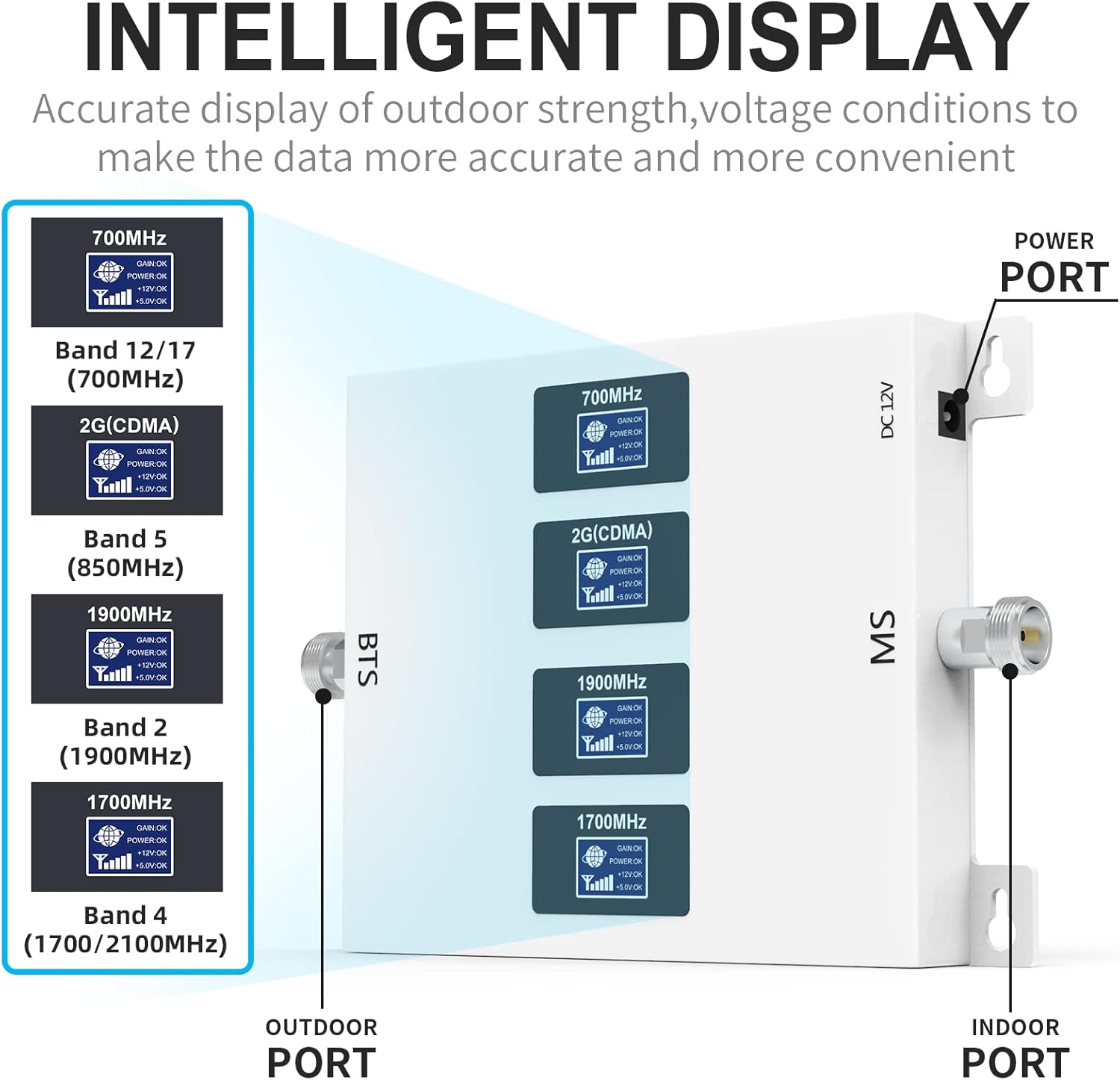
The intelligent display provides real-time information on signal strength and voltage conditions for each supported band.
- BTS Port: Connects to the outdoor antenna (Base Transceiver Station).
- MS Port: Connects to the indoor antenna (Mobile Station).
- DC 12V Port: For connecting the power adapter.
- Band Indicators: Displays signal status for 700MHz (Band 12/17), 2G (CDMA), 1900MHz (Band 2), and 1700MHz (Band 4/5). These indicators help monitor the booster's operation and signal reception.
5. Setup and Installation
Proper installation is crucial for optimal performance. Follow these steps carefully.
5.1. Pre-Installation Signal Check
Before installing, identify the strongest signal location outdoors and verify your phone's working band.
- Find Strong Signal: Use your smartphone to find an outdoor location with the strongest signal (at least 3 bars or stronger than -80dB). This is where your outdoor antenna should be placed.
- Check Phone Band (iOS): Disconnect Wi-Fi, turn on cellular data. Dial *3001#12345#* and press call. Select 'Serving Cell Info' and check 'Freq Band Indicator'.
- Check Phone Band (Android): Download an app like 'Network Cell Info Lite'. Disconnect Wi-Fi, turn on cellular data. Open the app, go to 'GAUGE' and check the signal band.

Verifying your phone's operating band ensures compatibility with the booster.
5.2. Outdoor Antenna Installation
The outdoor LPDA (Yagi) antenna captures the cellular signal from the nearest tower.
- Mounting: Fasten the outdoor LPDA antenna to a pole or mast using the provided U-shaped sheets and mounting hardware. Ensure it is securely attached.
- Cable Connection: Connect one end of the coaxial cable to the outdoor antenna.
- Waterproofing: Wrap the joint where the cable connects to the antenna with waterproof tape to protect it from weather elements.
- Direction: Point the outdoor antenna towards the cell tower identified in the pre-installation check. Adjust its direction for the strongest signal.
This video illustrates the process of mounting the outdoor LPDA antenna and connecting its cable.

The outdoor antenna should be securely mounted and pointed towards the cell tower.
5.3. Indoor Antenna Installation
The indoor panel antenna broadcasts the boosted signal within your desired coverage area.
- Placement: Install the indoor panel antenna on a wall or ceiling in the area where you need improved signal. Ensure it is positioned away from the outdoor antenna to prevent oscillation.
- Mounting: Use appropriate screws or adhesive to fix the indoor antenna securely.
This video demonstrates the installation of the indoor panel antenna on a wall.

The indoor antenna should be placed in the area requiring signal improvement.
5.4. Booster Unit Connection
Connect the antennas to the booster unit and provide power.
- Connect Outdoor Antenna: Connect the coaxial cable from the outdoor antenna to the port labeled 'BTS' on the signal booster unit. Tighten the connector securely.
- Connect Indoor Antenna: Connect the coaxial cable from the indoor antenna to the port labeled 'MS' on the signal booster unit. Tighten the connector securely.
- Antenna Separation: Ensure adequate separation between the outdoor and indoor antennas to prevent signal oscillation. A minimum vertical separation of 20 feet (6 meters) and horizontal separation of 50 feet (15 meters) is recommended, or ensure there are physical barriers like walls between them.
- Power Connection: Connect the power adapter to the 'DC 12V' port on the booster unit, then plug it into a power outlet.
This video demonstrates connecting the outdoor and indoor antenna cables to the booster unit and applying power.
6. Operating Instructions
Once all connections are made and the booster is powered on, it will automatically begin to amplify the cellular signal.
- Power On: After connecting the power adapter, the booster will turn on.
- Monitor Indicators: Observe the band indicators on the booster unit. They should light up, indicating active signal boosting for the respective bands.
- Check Signal: Check your mobile phone's signal strength in the area covered by the indoor antenna. You should notice an improvement in signal bars and data speeds.
7. Troubleshooting
If you experience issues with your signal booster, refer to the following common problems and solutions:
- No Signal Improvement:
- Ensure all cable connections are secure and properly tightened.
- Verify the outdoor antenna is pointed towards the strongest signal source (cell tower). Adjust its direction slightly.
- Check for sufficient separation between the outdoor and indoor antennas. Increase the distance or add physical barriers if necessary.
- Confirm the booster is powered on and indicator lights are active.
- Flashing or Red Indicator Lights:
- This often indicates oscillation (feedback) between the antennas. Increase the separation distance between the outdoor and indoor antennas.
- Ensure the outdoor antenna is not pointing towards the indoor antenna.
- Poor Signal Despite Booster:
- The outdoor signal might be too weak. Try repositioning the outdoor antenna to a higher location or a different spot with a stronger initial signal.
- Check for obstructions (e.g., large buildings, dense foliage) between the outdoor antenna and the cell tower.
- Ensure the indoor antenna is placed centrally in the area needing coverage and not obstructed.
- No Power:
- Check if the power adapter is securely connected to both the booster and the power outlet.
- Test the power outlet with another device to ensure it is functional.
8. Specifications
| Brand | GOBOOST |
| Model | Band 12/17/2/4/5 |
| Compatible Devices | Smartphone |
| Supported Bands | 2G, 3G, 4G LTE, 5G (Bands 12, 17, 2, 4, 5) |
| Coverage Area | Up to 5000 Square Feet |
| Gain | 70dB |
| Manufacturer | GOBOOST |
| FCC ID | 2AMPBKW17L-CP |
| IC ID | 24241-KW17LCP |
9. Warranty and Support
For warranty information, technical support, or any questions regarding your GOBOOST Cell Phone Signal Booster, please refer to the contact information provided in your product packaging or visit the official GOBOOST website. Ensure you have your product model and purchase details available when contacting support.