
Product Overview
This kit provides essential components for your vehicle's ignition system, designed to restore or enhance engine performance and fuel efficiency. It includes six Hitachi ignition coils and six NGK Laser Iridium spark plugs, engineered for durability and consistent energy transfer.
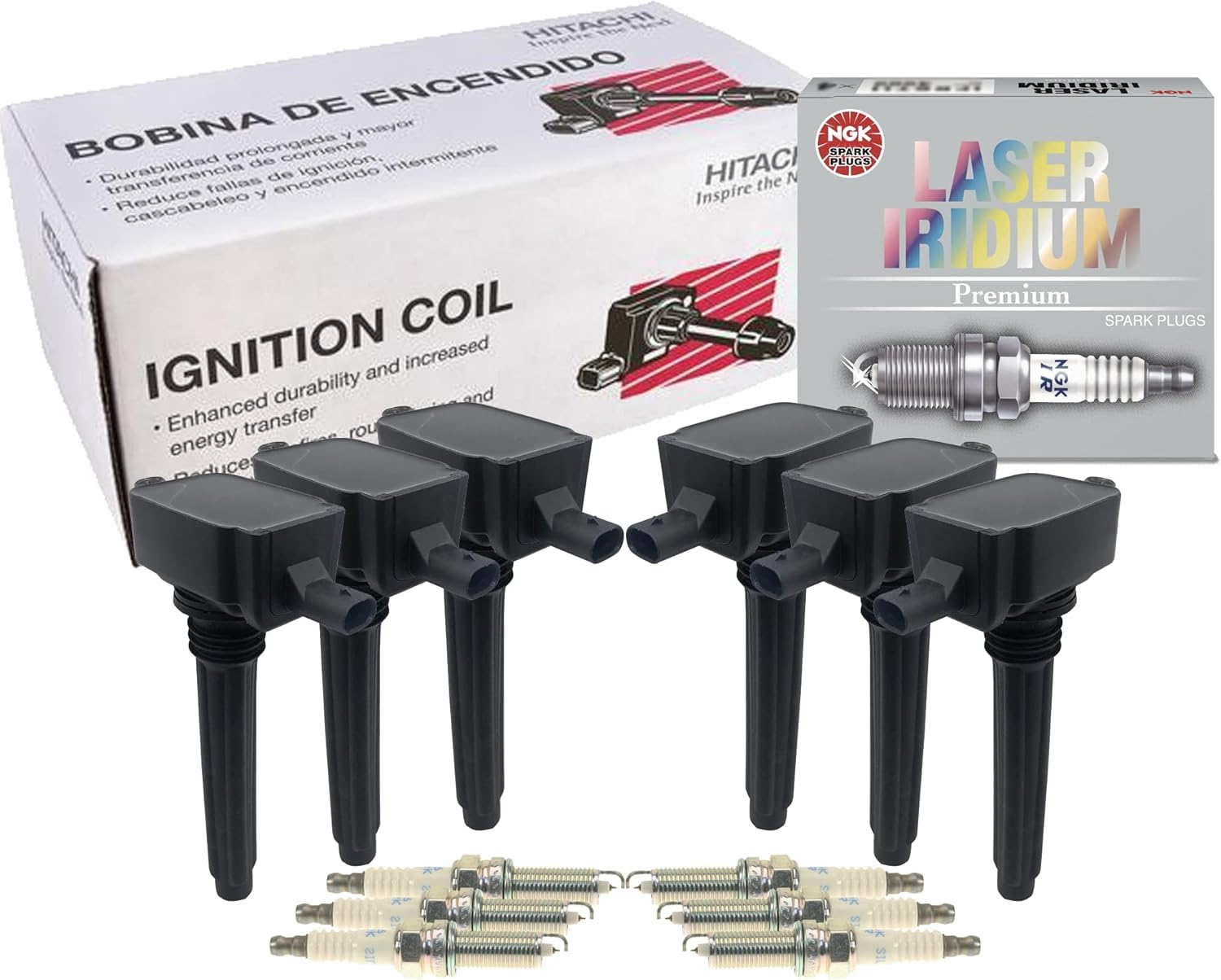
Image: The complete kit, showcasing six black Hitachi ignition coils and six NGK Laser Iridium spark plugs, alongside their product packaging. The Hitachi box is labeled "IGNITION COIL" and the NGK box "LASER IRIDIUM Premium SPARK PLUGS".
Specifications
| Component | Specification | Value |
|---|---|---|
| General | Brand | Newparts |
| Model Number | BJDJ-51464-4204404 | |
| Installation Type | Screw-In | |
| Item Weight | 5.5 Pounds | |
| OEM Part Numbers | 5149168AH, 5149168AI, 9723, SILZKR7B11, REC8WYPB3, 9030, 9752, 9686 | |
| Spark Plugs | Reach | 26.5 mm |
| Ground Electrode Core Material | Nickel Core | |
| Ground Configuration | Standard | |
| Insulator Height | 50.00 mm | |
| Resistance | 5000 Ohms | |
| Ground Electrode Tip Design | SPE | |
| Seat Type | Gasket | |
| Manufacturer Heat Range | 7 | |
| Hex Size | 5/8" | |
| Pre-Gap Size | 0.044 in | |
| Center Electrode Tip Material | Iridium | |
| Ground Electrode Quantity | 1 | |
| Center Electrode Core Material | Copper Core | |
| Thread Diameter | 0.472 in |
Compatibility
This kit is designed for various Chrysler, Dodge, Jeep, and Ram V6 engine applications, including AWD, FWD, RWD, and 4WD configurations. To ensure proper fitment for your specific vehicle, it is crucial to cross-reference the provided OEM part numbers (5149168AH, 5149168AI, 9723, SILZKR7B11, REC8WYPB3, 9030, 9752, 9686) with your vehicle's existing components or manufacturer specifications.
Installation Instructions
Proper installation is critical for optimal performance and safety. If you are unsure about any step, it is recommended to consult a qualified automotive technician.
Safety Precautions
- Always disconnect the vehicle's negative battery terminal before beginning any work on the ignition system to prevent electrical shock or damage.
- Ensure the engine is completely cool before handling ignition components.
- Wear appropriate personal protective equipment, including safety glasses and gloves.
- Work in a well-ventilated area.
Tools Required
- Ratchet and appropriate sockets (e.g., 10mm, 13mm for coil bolts, 5/8" spark plug socket).
- Torque wrench.
- Dielectric grease.
- Anti-seize compound (for spark plug threads).
- Spark plug gap tool (if necessary, though NGK Laser Iridium plugs are typically pre-gapped).
- Extension bars.
Ignition Coil Replacement Procedure
- Locate Ignition Coils: Identify the location of the ignition coils on your engine. They are typically mounted directly on top of the spark plugs or near them.
- Disconnect Electrical Connector: Carefully press the release tab and disconnect the electrical connector from each ignition coil. Avoid pulling on the wires.
- Remove Mounting Bolt: Use a socket wrench to remove the bolt(s) securing each ignition coil to the engine.
- Remove Old Coil: Gently twist and pull the old ignition coil upwards to remove it from the spark plug well. Inspect the old coil for any signs of damage or wear.
- Install New Coil: Apply a small amount of dielectric grease to the inside of the new ignition coil boot to aid in installation and prevent moisture intrusion. Carefully push the new Hitachi ignition coil onto the spark plug until it is fully seated.
- Secure Mounting Bolt: Reinstall the mounting bolt(s) and tighten them to the manufacturer's specified torque. Do not overtighten.
- Reconnect Electrical Connector: Reconnect the electrical connector to the new ignition coil, ensuring it clicks into place securely.
Spark Plug Replacement Procedure
- Remove Old Spark Plug: After removing the ignition coil, insert a spark plug socket with an extension into the spark plug well. Loosen and carefully remove the old spark plug.
- Inspect Old Plug: Examine the tip of the old spark plug for indications of engine health (e.g., carbon deposits, oil fouling, wear).
- Prepare New Plug: While NGK Laser Iridium plugs are typically pre-gapped, it is good practice to verify the gap using a spark plug gap tool against your vehicle's specifications. Adjust if necessary, but be extremely careful not to damage the iridium tip. Apply a thin layer of anti-seize compound to the threads of the new NGK spark plug, avoiding the electrode tip.
- Install New Plug: Hand-thread the new spark plug into the cylinder head to avoid cross-threading. Once finger-tight, use a torque wrench to tighten the spark plug to the vehicle manufacturer's specified torque. Refer to your vehicle's service manual for exact torque specifications.
- Repeat for All Cylinders: Repeat steps 1-11 for all remaining ignition coils and spark plugs.
- Reconnect Battery: Once all components are installed, reconnect the negative battery terminal.
- Test Vehicle: Start the engine and check for proper operation. Listen for any unusual noises or misfires.
Maintenance
Regular inspection and timely replacement of ignition components are crucial for maintaining engine performance and fuel efficiency. Consult your vehicle's owner's manual for recommended service intervals for spark plugs and ignition coils. Generally, spark plugs should be inspected and replaced according to manufacturer guidelines, often between 60,000 to 100,000 miles for iridium plugs. Ignition coils should be replaced if they show signs of failure, such as misfires or rough idling.
Troubleshooting
| Symptom | Possible Cause | Solution |
|---|---|---|
| Engine Misfire / Rough Idle | Faulty ignition coil or spark plug, incorrect installation, loose electrical connection. | Check all electrical connections. Verify spark plug gap and torque. Inspect coils for damage. Consider diagnostic scan for specific cylinder misfire codes. |
| Reduced Fuel Economy | Worn spark plugs, failing ignition coils. | Ensure spark plugs are within their service life and properly gapped. Check ignition coils for consistent performance. |
| Check Engine Light (CEL) | Various ignition system faults, including misfires. | Retrieve diagnostic trouble codes (DTCs) using an OBD-II scanner to pinpoint the exact issue. |
| Difficulty Starting | Weak spark from coils or plugs. | Inspect battery voltage. Check spark plugs and coils for proper function. |
Warranty and Support
For warranty information regarding this Newparts product, please refer to the documentation provided at the time of purchase or contact the seller directly. For technical support or further assistance, please reach out to the Newparts customer service department.