
1. Introduction
The Renogy Suntree DC Miniature Circuit Breaker is engineered to safeguard DC electrical installations from overloads and short circuits. It incorporates both thermal and magnetic tripping mechanisms for reliable protection. Upon detecting a fault, the circuit breaker automatically interrupts the electrical circuit, preventing damage to wiring and mitigating fire risks. This device can also be manually operated under its full rated load for electrical maintenance without sustaining damage. Designed for reversible connection, it supports wiring in either direction and functions effectively with bidirectional current. A built-in indicator window provides a clear visual of the circuit breaker's contact position. Its buckle design facilitates easy installation onto standard DIN rails.
2. Safety Information
Please read and understand all safety instructions before installing or operating this circuit breaker. Failure to follow these instructions may result in electrical shock, fire, or serious injury.
- Qualified Personnel Only: Installation and maintenance should only be performed by qualified electrical personnel.
- Disconnect Power: Always disconnect all power sources before working on the circuit breaker or associated wiring.
- Proper Wiring: Ensure all wiring connections are secure and comply with local and national electrical codes.
- Correct Rating: Use a circuit breaker with the correct current and voltage rating for your application.
- Environmental Conditions: Do not expose the circuit breaker to excessive moisture, dust, or extreme temperatures outside its specified operating range.
- Inspection: Regularly inspect the circuit breaker for any signs of damage or wear. Replace immediately if damage is found.
3. Product Overview and Features
The Renogy Suntree 63 Amp Single-Pole DC Circuit Breaker offers robust protection and ease of use for DC electrical systems.
- Overload and Short Circuit Protection: Protects cables and devices from damage due to excessive current.
- Thermal and Magnetic Tripping: Provides dual protection mechanisms for enhanced reliability and safety.
- Manual Disconnection: Allows for safe manual disconnection of the circuit for maintenance or system replacement.
- Resettable: After tripping, the circuit breaker can be reset without damage, eliminating the need for replacement.
- Bidirectional Current Support: Engineered for reversible connection, allowing wiring in either direction.
- Clear Indicator Window: A built-in window clearly displays the contact position (ON/OFF) of the circuit breaker.
- DIN Rail Installation: Features a buckle design for quick and easy mounting on standard DIN rails.

Image: Multiple Renogy Suntree DC Circuit Breakers, highlighting their protection and switching capabilities for DC 250V systems, along with CE, RoHS, CB, and TUV certifications.

Image: An internal view of the circuit breaker, illustrating its robust construction and components that contribute to its reliability and safety features.
4. Setup and Installation
Proper installation is crucial for the safe and effective operation of the circuit breaker. Ensure all power is disconnected before proceeding.
4.1 DIN Rail Mounting
The circuit breaker is designed for easy installation on a standard DIN rail.
- Align the top slot of the circuit breaker with the top edge of the DIN rail.
- Press the circuit breaker firmly against the DIN rail.
- Push the buckle at the bottom of the circuit breaker upwards until it clicks into place, securing the unit to the rail.

Image: Step-by-step diagram illustrating the quick installation process of the circuit breaker onto a DIN rail, showing the slot, DIN rail, and buckle mechanism.
4.2 Electrical Connection
Connect the DC wiring to the terminals of the circuit breaker. The design allows for reversible connection and supports bidirectional current flow.
- Ensure the wire gauge is appropriate for the 63 Amp rating and the expected current load.
- Strip the wire ends to the recommended length and insert them securely into the terminals.
- Tighten the terminal screws to the specified torque to ensure a firm electrical connection.
- Verify that there are no loose strands or exposed wire that could cause a short circuit.

Image: A diagram indicating the positive connection point on the circuit breaker, illustrating how wires are connected.
4.3 Sizing Tips for Circuit Breakers
Selecting the correct circuit breaker size is critical for system protection.
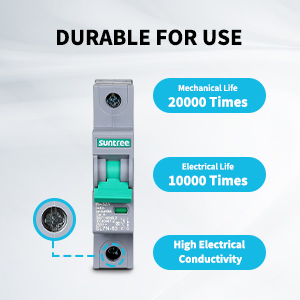
Image: A guide providing sizing tips for circuit breakers, differentiating between calculations for controllers/inverters/DC devices and solar panels.
For Controller/Inverter/DC Device:
- Determine the maximum continuous operating current (Watt/Voltage).
- Calculate the maximum current: 1.25 x maximum continuous operating current.
- Select a circuit breaker whose rated current is greater than and closest to this calculated maximum current.
For Solar Panel:
- Determine the short-circuit current of the solar panel.
- Calculate the maximum current: Short-circuit current x 1.25 x 1.25.
- Select a circuit breaker whose rated current is greater than and closest to this calculated maximum current.
5. Operating Instructions
The circuit breaker is designed for simple operation and clear status indication.
- Turning On: Push the toggle switch upwards to the "ON" position. The indicator window will show green.
- Turning Off: Push the toggle switch downwards to the "OFF" position. The indicator window will show red.
- Automatic Tripping: In case of an overload or short circuit, the circuit breaker will automatically trip to the "OFF" position, and the indicator window will show red.
- Resetting: After an automatic trip, identify and resolve the fault condition. Once the fault is cleared, push the toggle switch back to the "ON" position to reset the breaker.

Image: A visual representation of the circuit breaker's indicator window, clearly showing green for "ON" and red for "OFF" status.
6. Maintenance
The Renogy Suntree DC Circuit Breaker requires minimal maintenance due to its durable design.
- Regular Inspection: Periodically inspect the circuit breaker for any visible damage, discoloration, or loose connections.
- Cleaning: Keep the circuit breaker clean and free from dust and debris. Use a dry, soft cloth for cleaning. Do not use liquids or abrasive cleaners.
- Operational Check: Occasionally, manually switch the breaker OFF and ON to ensure smooth operation.
- Durability: The circuit breaker is designed for a long operational life, with a mechanical life of 20,000 times and an electrical life of 10,000 times.

Image: This image emphasizes the durability of the circuit breaker, detailing its mechanical life of 20,000 operations and electrical life of 10,000 operations, alongside high electrical conductivity.
7. Troubleshooting
If the circuit breaker trips or fails to operate as expected, follow these troubleshooting steps:
- Breaker Trips Repeatedly:
- Identify Overload: Disconnect some loads from the circuit to reduce the current.
- Check for Short Circuit: Inspect wiring and connected devices for any signs of a short circuit (e.g., burnt insulation, exposed wires).
- Verify Sizing: Ensure the circuit breaker's rating is appropriate for the connected load as per the sizing tips in Section 4.3.
- Breaker Does Not Reset:
- Persistent Fault: A fault condition (overload or short circuit) may still be present. Do not force the breaker to reset.
- Internal Damage: If no external fault is found and the breaker still won't reset, it may be internally damaged and requires replacement.
- No Power to Circuit:
- Check Breaker Position: Ensure the breaker is in the "ON" position (green indicator).
- Inspect Connections: Verify all wiring connections to the breaker are secure.
- Test Breaker: If possible, test the breaker with a multimeter to confirm continuity when "ON".
If troubleshooting steps do not resolve the issue, contact qualified electrical personnel or Renogy customer support.
8. Specifications
| Feature | Specification |
|---|---|
| Brand | Renogy |
| Model Number | SUNDCCB63MN1P |
| Current Rating | 63 Amps |
| Circuit Breaker Type | Standard |
| Mounting Type | DIN Rail Mount |
| Number Of Poles | 1 |
| Material | Copper |
| Item Weight | 2.9 pounds |
| Product Dimensions | 3.2 x 3 x 0.7 inches |
| Included Components | 63A 1P DC Miniature Circuit Breaker |
| UPC | 810009719687 |

Image: Detailed dimensions of the circuit breaker, indicating its physical size and weight for installation planning.
9. Warranty and Support
For warranty information, technical support, or service inquiries, please contact Renogy customer support directly. Refer to the official Renogy website for the most current contact details and warranty terms.
Renogy Official Website: www.renogy.com


