Introduction
This manual provides essential information for the installation, operation, and maintenance of your HENKYO 1 Barrel Carburetor with Automatic Choke. Designed for specific Chevrolet and GMC truck models from 1957-1962, this carburetor is a critical component for your vehicle's fuel system, ensuring proper air-fuel mixture for optimal engine performance.
Compatibility
This carburetor is specifically designed for the following vehicle models and engine configurations:
- 1961 Bel Air/Nomad Base with 3.8L (3852CC) 235Cu. In. l6 GAS OHV engine and Automatic Choke.
- 1960 Bel Air/El Camino with 3.8L (3852CC) 235Cu. In. l6 engine and Automatic Choke.
- 1957, 1958, 1959 Truck/Nomad/Bel Air with 3.8L (3852CC) 235Cu. In. l6 engine and Automatic Choke.
- Engine Type: 6 Cylinder Engine "235".
- Carburetor vacuum line port thread: 1/8-28.
If you are uncertain about compatibility with your specific engine, it is recommended to consult a local mechanic or contact the manufacturer.
Product Features
- Designed for 1957-1962 Chevrolet and GMC Truck models.
- Equipped with an automatic choke for improved cold starting.
- Precision-engineered for optimal air-fuel mixture delivery.
- Durable construction for reliable performance.
Setup and Installation
Installation of a carburetor requires mechanical expertise and specialized tools. It is highly recommended that installation be performed by a qualified automotive technician to ensure proper function and safety.
General Installation Steps (Professional Installation Recommended):
- Preparation: Disconnect the vehicle's battery. Ensure the engine is cool. Gather necessary tools and safety equipment.
- Removal of Old Carburetor: Carefully disconnect all fuel lines, vacuum lines, electrical connections, and throttle linkage from the old carburetor. Remove mounting nuts/bolts and lift the old carburetor from the intake manifold.
- Manifold Preparation: Clean the intake manifold surface thoroughly. Ensure no debris or old gasket material remains.
- Gasket Placement: Place the new carburetor base gasket onto the intake manifold. Ensure it aligns correctly with all bolt holes and passages.
- New Carburetor Installation: Carefully lower the new HENKYO carburetor onto the manifold, aligning it with the gasket and bolt holes. Secure it with the mounting nuts/bolts, tightening them evenly to the manufacturer's specifications to prevent warping.
- Connections: Reconnect all fuel lines, vacuum lines, electrical connections (if any), and throttle linkage. Ensure all connections are secure and free of leaks.
- Initial Adjustments: Perform initial adjustments for idle speed, air-fuel mixture, and choke settings as per standard automotive practices.
- Testing: Reconnect the battery. Start the engine and check for proper operation, leaks, and smooth idle. Further fine-tuning may be required.

Image: Front view of the HENKYO 1 Barrel Carburetor, showcasing its main body and automatic choke mechanism.

Image: The HENKYO carburetor installed in an engine bay, showing its integration with the air filter and surrounding engine components.

Image: Another view of the HENKYO carburetor installed, highlighting its connections and overall fit within the engine compartment.

Image: The HENKYO carburetor shown with its accompanying gaskets and mounting bracket, essential for installation.

Image: A top-down perspective of the HENKYO carburetor, displaying the internal components and the included gaskets.

Image: Side view of the HENKYO carburetor, showing the fuel inlet and vacuum ports, along with the gaskets and bracket.
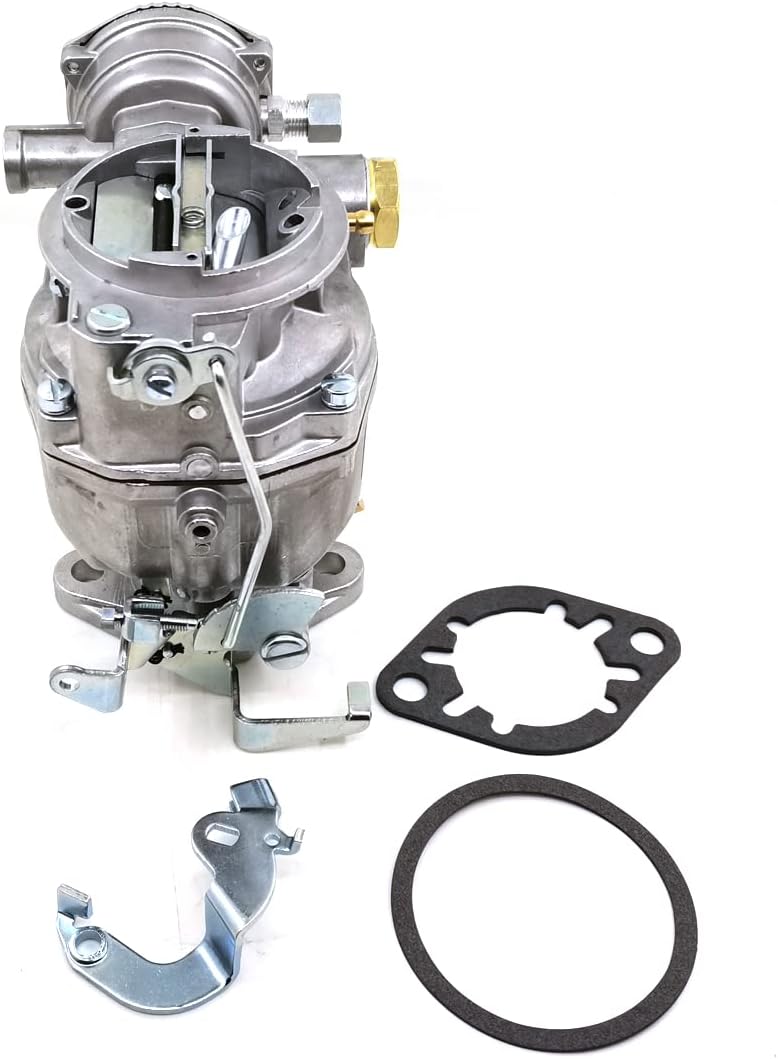
Image: A different side angle of the HENKYO carburetor, providing a clear view of its various linkages and the included installation components.
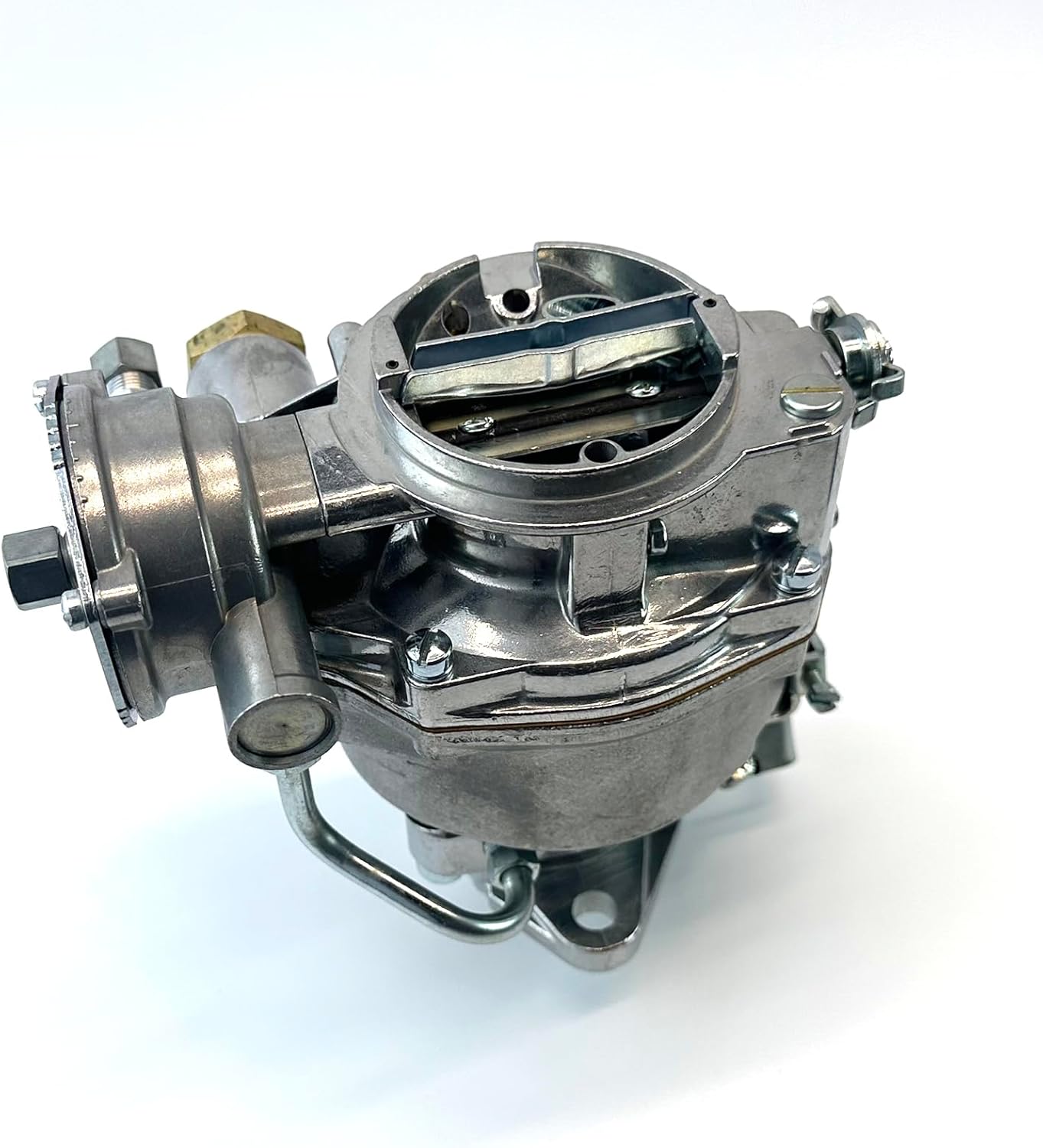
Image: Rear view of the HENKYO carburetor, showing the mounting flange and the overall compact design.
Operating Principles
The carburetor is responsible for mixing air and fuel in the correct proportions for combustion within the engine. This 1-barrel carburetor with an automatic choke ensures efficient fuel delivery across various engine speeds and temperatures. The automatic choke system assists in cold starts by enriching the air-fuel mixture, gradually leaning it out as the engine warms up to maintain optimal performance and fuel economy.
Maintenance
Regular maintenance is crucial for the longevity and optimal performance of your carburetor. While specific maintenance procedures should be performed by a qualified technician, general recommendations include:
- Fuel Quality: Always use clean, high-quality fuel to prevent deposits and clogging within the carburetor.
- Fuel Filter: Regularly inspect and replace the fuel filter to ensure clean fuel reaches the carburetor.
- Air Filter: Maintain a clean air filter to prevent dirt and debris from entering the carburetor and engine.
- Linkage Inspection: Periodically check all linkages and connections for proper movement and security.
- Professional Servicing: Consider periodic professional servicing and cleaning of the carburetor, especially if performance issues arise.
Troubleshooting
If you experience issues with your vehicle's fuel system after carburetor installation, consider the following common troubleshooting points. For complex issues, professional diagnosis is recommended.
| Symptom | Possible Cause | Solution |
|---|---|---|
| Engine hard to start (cold) | Improper choke adjustment or malfunction. | Check automatic choke operation and adjustment. Ensure no binding. |
| Rough idle or stalling | Vacuum leak, incorrect idle mixture, or clogged idle passages. | Inspect vacuum lines. Adjust idle mixture screw. Professional cleaning may be needed. |
| Poor acceleration or hesitation | Accelerator pump issue, clogged fuel passages, or incorrect float level. | Verify accelerator pump function. Check fuel filter. Consult a technician for internal adjustments. |
| Excessive fuel consumption | Rich mixture, high float level, or leaking fuel. | Check for fuel leaks. Adjust mixture. Verify float level. |
Specifications
| Attribute | Detail |
|---|---|
| Brand | HENKYO |
| Model | 1 Barrel Carburetor with Automatic Choke |
| Vehicle Service Type | Truck |
| Fuel Type | Gasoline |
| Engine Compatibility | 6 Cylinder Engine "235" (3.8L / 3852CC / 235Cu. In. l6 GAS OHV) |
| Years Compatible | 1957-1962 |
| Item Weight | 3.65 pounds |
| Package Dimensions | 7.99 x 7.13 x 6.3 inches |
| UPC | 718893005254 |
Warranty and Support
The carburetor has undergone detailed inspection prior to leaving the factory. If you encounter any issues during installation or use, please contact the seller directly via email for assistance. They are committed to providing satisfactory after-sales service.
For further technical support or if you are unsure about the carburetor's suitability for your engine, it is recommended to consult a local mechanic or reach out to the manufacturer/seller.