1. Product Overview
The HRB 6S Lipo Battery is designed for high-performance RC applications, including quadcopters, helicopters, cars, trucks, and boats. Manufactured with superior lithium polymer raw materials, these batteries offer a long cycle life and reliable power output. This package includes two 6-cell 4000mAh 60C EC5 Lipo batteries.
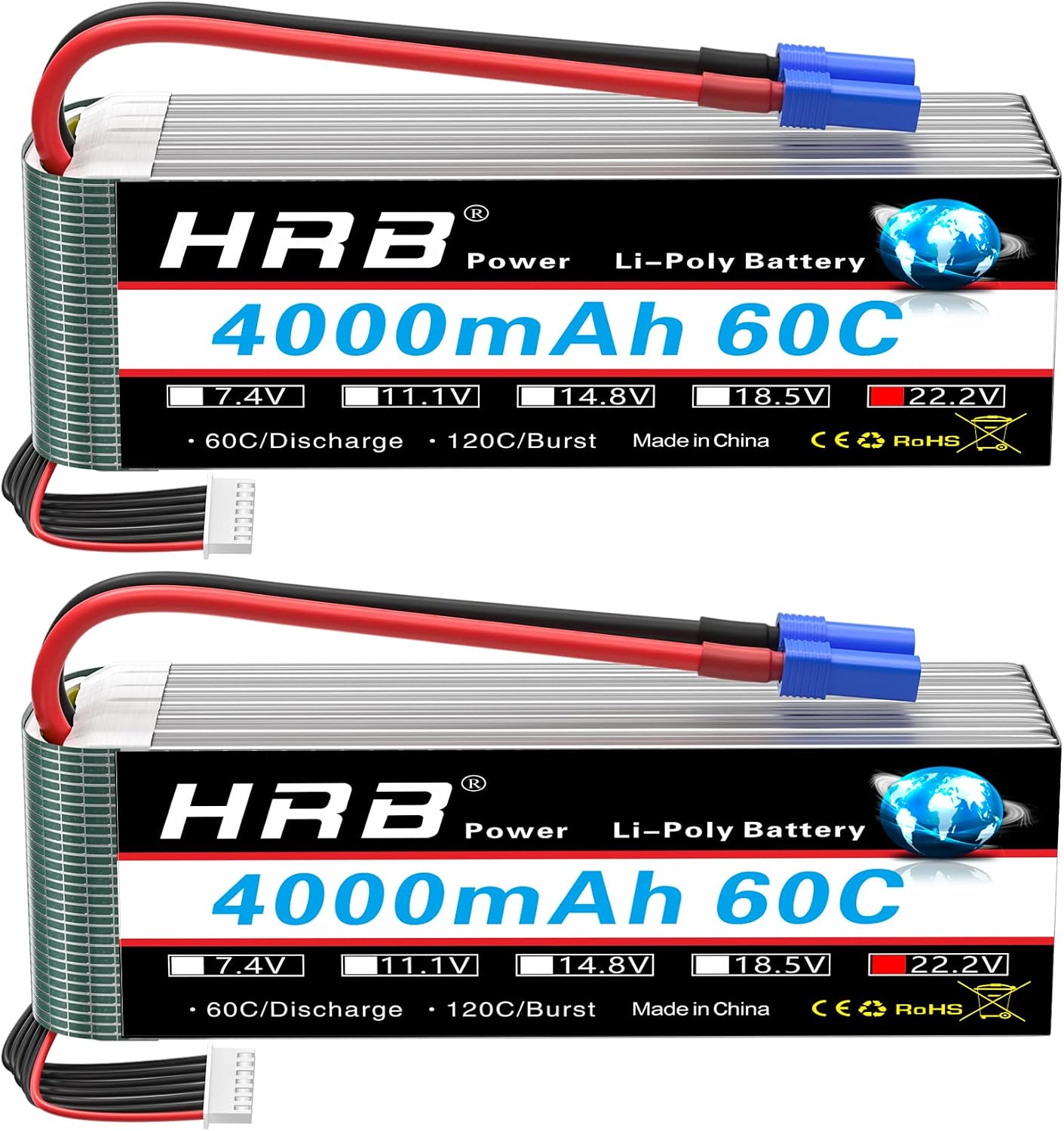
Image: Two HRB 6S Lipo Batteries, showcasing their design and EC5 connectors.
Key Features:
- High Capacity: 4000mAh for extended run times.
- High Voltage: 22.2V (6S configuration) for powerful performance.
- High Discharge Rate: 60C continuous discharge, 120C burst for demanding applications.
- Durable Construction: Made with superior lithium polymer raw materials for long cycle life.
- Wide Compatibility: Suitable for various RC models including airplanes, helicopters, cars, trucks, and boats, provided voltage, dimensions, and plug match.
- Connector Type: Equipped with EC5 connectors for secure and efficient power transfer.
2. Specifications
| Attribute | Value |
|---|---|
| Brand | HRB |
| Model Number | 8243126 |
| Battery Cell Composition | Lithium Polymer (LiPo) |
| Voltage | 22.2V (6S) |
| Capacity | 4000mAh |
| Discharge Rate | 60C (Continuous) / 120C (Burst) |
| Connector Type | EC5 |
| Balance Plug | JST-XH |
| Dimensions (L*W*H) | 135 x 42 x 49mm (5.31 x 1.65 x 1.93 inches) |
| Weight | 590g (1.3 lbs / 20.81 oz) |

Image: Detailed diagram illustrating the dimensions and key specifications of the HRB 6S 4000mAh Lipo Battery.
3. Setup and Connection
Before connecting the battery to your RC model, ensure that the model's voltage, dimensions, and connector type are compatible with the HRB 6S Lipo Battery. The battery is equipped with an EC5 main discharge connector and a JST-XH balance plug.
- Prepare your RC model: Ensure the power to your RC model is turned off before connecting or disconnecting the battery.
- Insert the battery: Carefully place the Lipo battery into the battery compartment of your RC model. Ensure it fits securely without excessive force or bending.
- Secure the battery: Use straps or other securing mechanisms within your model to prevent the battery from shifting during operation.
- Connect the plugs: Connect the EC5 main discharge plug from the battery to the corresponding EC5 connector on your RC model. Ensure a firm and correct connection. If using a balance charger, connect the JST-XH balance plug to the charger's balance port.

Image: Visual guide demonstrating the easy connection process of the HRB Lipo Battery to an RC vehicle.
4. Operating Guidelines
Proper operation is crucial for the longevity and safety of your Lipo battery. Always adhere to the following guidelines:
- Initial Charge: Fully charge new batteries before their first use.
- Discharge Limits: Do not discharge Lipo batteries below 3.0V per cell (18.0V for a 6S battery). Over-discharging can permanently damage the battery. Most ESCs (Electronic Speed Controllers) have a low-voltage cutoff feature; ensure it is set correctly for Lipo batteries.
- Temperature: Operate batteries within recommended temperature ranges. Avoid extreme heat or cold.
- Physical Damage: Do not use batteries that are swollen, punctured, or show any signs of damage.
- Compatibility: Always ensure the battery's specifications (voltage, capacity, discharge rate) are suitable for your RC model's requirements.
Video: An overview of HRB Lipo Battery manufacturing and various RC applications, including helicopters and boats, demonstrating the battery's performance in action.
5. Maintenance and Charging
Proper maintenance and charging practices are essential for maximizing the lifespan and ensuring the safety of your HRB Lipo batteries.
Charging:
- Use a Lipo-Compatible Charger: Always use a charger specifically designed for Lithium Polymer batteries.
- Safe Charge Rate: The safest charge rate for Lipo batteries is typically 0.5C-1C. For this 4000mAh battery, this translates to 2A-4A. Charging at higher rates can reduce battery life and increase risk.
- Balance Charging: Always use the balance charging feature of your charger. This ensures all cells within the battery pack are charged to the same voltage, which is critical for battery health and safety.
- Never Leave Unattended: Do not leave charging Lipo batteries unattended.
- Charge on a Non-Flammable Surface: Always charge batteries on a fire-resistant surface, away from flammable materials.

Image: Important charging attention for Lipo batteries, emphasizing the safe charge rate of 0.5C-1C (2A-4A).
Storage:
- Storage Voltage: For long-term storage, charge or discharge the battery to its storage voltage (typically 3.8V-3.85V per cell).
- Cool, Dry Place: Store batteries in a cool, dry place, away from direct sunlight and extreme temperatures.
- Fire-Resistant Bag/Container: Store Lipo batteries in a fire-resistant Lipo-safe bag or container to minimize risk in case of an incident.
6. Troubleshooting
If you encounter issues with your HRB Lipo battery, consider the following common problems and solutions:
- Battery Not Charging:
- Ensure the charger is correctly connected and powered on.
- Verify the battery's main and balance connectors are securely plugged into the charger.
- Check if the charger settings match the battery type (LiPo) and cell count (6S).
- Inspect the battery and charger cables for any visible damage.
- Reduced Run Time or Power:
- The battery may be aging or nearing the end of its cycle life.
- Ensure the battery is fully charged before use.
- Check for proper balance of cells; an unbalanced pack will perform poorly.
- Verify that the battery's discharge rate (C-rating) is sufficient for your model's power demands.
- Battery Swelling:
- Swelling indicates internal damage, often due to over-discharge, over-charge, or excessive heat.
- Immediately discontinue use of a swollen battery.
- Safely dispose of the battery according to local regulations for hazardous waste. Do NOT attempt to charge or use it.
- Overheating During Use:
- Excessive heat can be caused by over-discharging, drawing too much current, or poor ventilation in the model.
- Ensure your model's ESC and motor are compatible with the battery's specifications.
- Allow the battery to cool down completely before recharging.
If troubleshooting steps do not resolve the issue, please contact HRB customer support for further assistance.
7. Safety Information
Lithium Polymer (LiPo) batteries are powerful and require careful handling to prevent fire, injury, or property damage. Always follow these safety precautions:
- Never Leave Charging Unattended: Always monitor batteries during charging.
- Use Lipo-Specific Charger: Only use chargers designed for LiPo batteries and ensure correct settings for cell count and chemistry.
- Charge in a Safe Area: Charge on a non-flammable surface, away from combustible materials. Use a LiPo-safe bag or container.
- Avoid Over-Discharging: Do not discharge below 3.0V per cell.
- Avoid Over-Charging: Do not charge above 4.2V per cell.
- Inspect Before Use: Check batteries for swelling, punctures, or any damage before each use. Do not use damaged batteries.
- Temperature Control: Avoid charging or discharging in extreme temperatures.
- Proper Disposal: Dispose of damaged or old LiPo batteries responsibly according to local regulations. Never put them in regular trash.
- Keep Away from Children and Pets: Store batteries in a secure location out of reach.
8. Warranty and Support
HRB stands behind the quality of its products. For warranty information, technical support, or any inquiries regarding your HRB 6S Lipo Battery, please refer to the official HRB website or contact their customer service department. Keep your purchase receipt as proof of purchase for warranty claims.
For more information, visit the HRB Store on Amazon.