
1. Introduction
This manual provides essential information for the proper installation, operation, and maintenance of the youyeetoo TF03-100 Industrial High-Speed Lidar Sensor. The TF03-100 is a robust, long-range distance sensor designed for industrial applications, offering high accuracy and reliable performance in diverse environments.
2. Product Overview
The TF03-100 Lidar Sensor is engineered for precision and durability. It features a compact design with an IP67 enclosure, making it suitable for outdoor and challenging industrial settings. The sensor utilizes a pulsed time-of-flight principle for accurate distance measurement.

Figure 2.1: The youyeetoo TF03-100 Industrial High-Speed Lidar Sensor, showcasing its compact and robust design.

Figure 2.2: Diagram illustrating the key components of the TF03-100, including the Connect Terminal, Enclosure, Front Panel (Glass), and Mounting Hole.

Figure 2.3: Detailed dimensional drawing of the TF03-100 Lidar Sensor, providing measurements for integration.

Figure 2.4: Schematic diagram illustrating the 0.5-degree detection angle of the TF03-100 and the simulated light spot sizes at various distances. Note that the effective range may be reduced if the detected object's side length is smaller than the detection range.

Figure 2.5: Overview of the TF03-100's excellent performance and compact size, highlighting its range (180m), blind zone (0.1m), accuracy (<10cm), frame rate (1Hz-10KHz), and ambient light immunity (100Klux).
3. Specifications
The TF03-100 Lidar Sensor offers robust performance characteristics suitable for demanding applications.
| Feature | Specification |
|---|---|
| Operating Range | 0.1m ~ 100m (90% reflectivity), 0.1m ~ 40m (10% reflectivity), 0.1m ~ 80m (90% reflectivity & 100Klux), 0.1m ~ 30m (10% reflectivity & 100Klux) |
| Ambient Light Immunity | 100Klux |
| Accuracy | ±10cm (within 10m), 1% (10m and further) |
| Measurement Unit | cm |
| Range Resolution | 1cm |
| FOV | 0.5° |
| Frame Rate | 1 ~ 1000Hz (Default: 100Hz) |
| Supply Voltage | DC 5V ±0.5V (Standard version), 6-24V (RS485/RS232 version) |
| Average Current / Peak Current | ≤180mA |
| Power Consumption | ≤0.9W |
| Communication Level | LVTTL (3.3V) |
| Communication Interface | UART / RS485 / IO / CAN |
| Default Baud Rate | 115200 (Adjustable, 9600 ~ 921600bps) |
| Output Format | Serial port / Pixhawk / IO / CAN (Default: Serial port) |
| Enclosure Rating | IP67 |
| Data Bit | 8 |
| Stop Bit | 1 |
| Light Source | VCSEL |
| Wavelength | 905nm |
| Operating Temperature | -20°C ~ 60°C |
| Storage Temperature | -40°C ~ 85°C |
| Certification | CE, FCC, RoHS |
| Dimensions (L*W*H) | 44mm * 43mm * 32mm (1.73 x 1.69 x 1.26 inches) |
| Weight | 77g (with cables) / 2.72 ounces |
| Cable Length | 70cm |
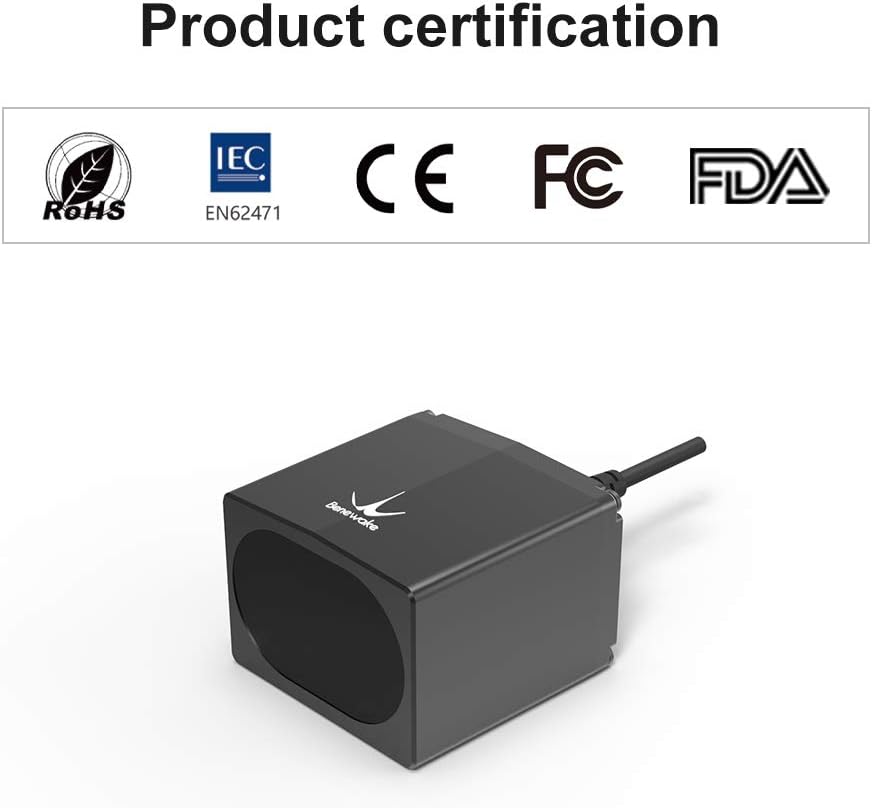
Figure 3.1: Product certifications for the TF03-100, including RoHS, IEC EN62471, CE, FC, and FDA.

Figure 3.2: The TF03 Lidar is an industrial-grade, high-speed sensor with a detection range up to 180m. It incorporates compensation algorithms for outdoor glare and other interference, ensuring normal operation in strong light, rain, fog, and snow conditions. It is compliant with CE, RoHS, FCC, and features a Class 1 laser.
4. Setup
The TF03-100 Lidar Sensor is available in two versions to accommodate different interface and power supply requirements:
- Standard Version: Supports TTL serial port and CAN interface with a 5V power supply.
- RS485/RS232 Version: Supports RS485/RS232 interface with a 6-24V power supply.
4.1. Connections
Ensure correct wiring based on your chosen interface. Refer to the product's official documentation or the provided wiki for detailed wiring diagrams specific to UART, I2C, CAN, RS485, or RS232 connections. The sensor is compatible with platforms like Pixhawk and Raspberry Pi.

Figure 4.1: Diagram showing the TF03 Lidar and its connection interface, with color-coded wires for Red (VCC), White (CAN-H/RX), Green (CAN-L/TX), Blue (UART-RX/RS485-A), Brown (UART-TX/RS485-B), Yellow (IO), and Black (GND).
4.2. Software Configuration
After physical connection, configure the sensor via its communication interface. This typically involves setting the baud rate and output format. Consult the official wiki or datasheet for specific software setup instructions and example code for integration with microcontrollers or single-board computers.
5. Operating Instructions
The TF03-100 Lidar Sensor provides real-time distance measurements. Once powered and configured, it continuously outputs ranging data through its selected communication interface.
5.1. Basic Operation
The sensor operates by emitting laser pulses and measuring the time it takes for the light to return. This time-of-flight principle allows for accurate distance calculation. The high frame rate (up to 1000Hz) ensures rapid data acquisition, crucial for dynamic applications.
5.2. Applications
The TF03-100 is versatile and can be integrated into various systems:
- Traffic Monitoring: Used for vehicle counting, speed detection, and traffic flow analysis.
- Obstacle Detection: Essential for autonomous vehicles, robots, and drones to avoid collisions.
- Level Measurement: For monitoring liquid or solid levels in tanks and silos.
- Drone Altitude Holding and Terrain Following: Provides precise altitude data for stable flight and navigation over varying terrain.
- Industrial Safety: Implemented in machinery for safety zones and distance warnings.

Figure 5.1: Visual representation of the TF03-100 Lidar Sensor's applications, including drone obstacle avoidance, vehicle counting, and industrial safety distance warning for equipment like tower cranes.
5.3. Video Resources
Outlook of TF03 Lidar Sensor
This video provides a general overview of the TF03 Lidar Sensor, showcasing its physical appearance and components.
TF03-100 Lidar for Traffic Monitoring and Drones
This video demonstrates the TF03-100 Lidar Sensor in action, specifically highlighting its capabilities for traffic monitoring and integration with drones for various tasks.
6. Maintenance
To ensure the longevity and optimal performance of your TF03-100 Lidar Sensor, follow these maintenance guidelines:
- Clean the Lens: Regularly inspect and gently clean the front panel (glass) to remove any dust, dirt, or debris that may obstruct the laser and affect measurement accuracy. Use a soft, lint-free cloth and a mild cleaning solution if necessary.
- Physical Inspection: Periodically check the sensor for any signs of physical damage, loose connections, or corrosion.
- Environmental Protection: While the TF03-100 has an IP67 rating for dust and water resistance, avoid prolonged submersion or exposure to extreme conditions beyond its specified operating temperature range.
7. Troubleshooting
If you encounter issues with your TF03-100 Lidar Sensor, consider the following troubleshooting steps:
- No Power/No Output: Verify that the sensor is receiving the correct power supply (5V for standard, 6-24V for RS485/RS232 version) and that all connections are secure.
- Inaccurate Readings: Ensure the sensor lens is clean and unobstructed. Check for strong external light sources or reflective surfaces that might interfere with measurements. Verify software configuration settings, including baud rate and output format.
- Communication Issues: Confirm that the communication interface (UART, CAN, RS485, RS232) is correctly configured in your software and that the wiring matches the interface type.
For more detailed troubleshooting guides or persistent issues, please refer to the official wiki or contact technical support.
8. Warranty and Support
For comprehensive user manuals, datasheets, and technical documentation, please visit the official youyeetoo blog: youyeetoo.com/blog/-64.
For any technical issues or support inquiries after purchase, please contact the technical team directly via email at monica@smartfire.cn. Alternatively, you can click "WayPonDEV" on the product page to ask a question.
The product typically includes a 30-day return policy for refunds or replacements, subject to the seller's terms and conditions.
9. Important Safety Information
The TF03-100 Lidar Sensor contains a VCSEL laser with a wavelength of 905nm. It is classified as a Class 1 laser product, which means it is safe under all conditions of normal use. However, always adhere to the following safety precautions:
- Do not stare directly into the laser aperture.
- Do not attempt to disassemble or modify the sensor, as this may expose you to hazardous laser radiation.
- Operate the sensor within its specified operating temperature range of -20°C to 60°C.
- Ensure proper ventilation if operating in an enclosed space to prevent overheating.