
Introduction to the Competition Mini
The Mini, often perceived as a small and unassuming vehicle, possesses a remarkable racing heritage. This guide explores the capabilities of a well-prepared Mini, demonstrating its potential to outperform larger, more powerful cars on the track. It delves into the unique characteristics that make the Mini a formidable competitor in various racing environments.
This manual draws insights from extensive experience in Mini racing, including anecdotes of competing against and surpassing vehicles like Jaguars, Porsches, Mustangs, and even GT40s. The focus is on understanding and harnessing the inherent speed and agility of the Mini for competitive success.
Author's Background

Robert Tarzwell, the author, brings a diverse background to this guide. His experiences include 10 years as a rescue medic, building and managing a resort in the Bahamas, and surviving a hurricane. He has authored over 40 books on electronics, car racing, and various other subjects. His hobbies include building electric cars, carving stone sculptures, and painting. This rich experience informs his practical approach to understanding and optimizing the Mini for competition.
Note: The image displays the back cover of the book, which features a photograph of the author, Robert Tarzwell, alongside his biographical information, highlighting his extensive expertise relevant to the subject matter.
Building and Preparation
This section details the essential steps and considerations for preparing a Mini for competition. While specific technical diagrams are not provided here, the guide emphasizes the importance of a thorough build process to achieve optimal performance and reliability on the track.
- Chassis and Body: Reinforcement and weight reduction techniques.
- Engine Tuning: Optimizing horsepower and torque for racing conditions.
- Suspension Setup: Adjustments for handling and stability.
- Braking System: Enhancements for effective stopping power.
- Safety Features: Essential modifications for driver safety in a racing environment.
The manual stresses that a well-prepared Mini is not merely about raw power but about a balanced combination of engineering, setup, and driver skill.
Operating and Racing Strategies
Driving a competition Mini requires specific techniques to maximize its potential. This section covers strategies for effective racing, drawing from real-world experiences.
The Mini Moke Experience
The Mini Moke, despite its unconventional appearance, proved to be an exceptionally fast and competitive vehicle. Its performance often led to attempts by race organizers to restrict its participation due to its overwhelming speed. This highlights the Mini's inherent capability to surprise and dominate.
During a vintage race weekend at Waterford Hills, the Mini Moke demonstrated its superior speed, outperforming competitors by over 6 seconds per lap in initial practice sessions. This led to its reclassification into higher-tier categories, including those with F5000, GT40, Mustangs, and Alfas, where it continued to excel.
Key takeaways for operating a competition Mini include:
- Understanding Vehicle Dynamics: Leveraging the Mini's lightweight and agile nature.
- Cornering Techniques: Maximizing speed through turns.
- Race Strategy: Adapting to track conditions and competitor behavior.
Maintenance and Care
Regular maintenance is crucial for the longevity and performance of a competition Mini. This section outlines general maintenance practices.
- Pre-Race Checks: Inspecting critical components before each event.
- Post-Race Inspection: Identifying and addressing wear and tear.
- Fluid Management: Regular checks and changes of engine oil, coolant, and brake fluid.
- Tire Care: Monitoring pressure and wear for optimal grip.
- Component Replacement: Timely replacement of worn parts to prevent failures.
Troubleshooting Common Issues
Even a well-built competition Mini can encounter issues. This section provides guidance on common problems and their potential solutions.
- Engine Overheating: Check coolant levels, radiator, and thermostat.
- Loss of Power: Inspect fuel delivery, ignition system, and air intake.
- Braking Inefficiency: Examine brake pads, fluid levels, and caliper function.
- Handling Instability: Verify suspension settings, tire pressure, and alignment.
- Electrical Malfunctions: Check wiring, fuses, and battery connections.
For complex issues, consulting with experienced Mini mechanics or referring to specialized technical manuals is recommended.
Specifications (General Guidance for Competition Mini)
This guide provides principles for building a competition Mini. Specific dimensions and weights will vary based on the base Mini model and modifications. However, general characteristics of a competition Mini often include:
- Chassis Type: Reinforced monocoque or space frame.
- Engine Displacement: Typically 998cc to 1275cc, highly tuned.
- Power Output: Significantly increased from stock, often exceeding 100 bhp for 1275cc engines.
- Weight: Minimized through lightweight components and interior stripping, often under 600 kg.
- Suspension: Adjustable coil-over or specialized rubber cone systems.
- Brakes: Upgraded disc brakes on all four wheels.
The book itself, "Building A Competition Mini," has a print length of 80 pages and dimensions of 8.5 x 0.19 x 11 inches, weighing 9.3 ounces. This physical book serves as the detailed reference for the information presented here.
Warranty and Support
As this document serves as an instructional guide based on the book "Building A Competition Mini," there is no direct product warranty for a physical item. For support related to the content of the book, readers are encouraged to consult the author's published works or relevant automotive forums and communities dedicated to Mini racing and modification.
Additional Resources
For further information and visual aids, please refer to the book's cover and back cover details.
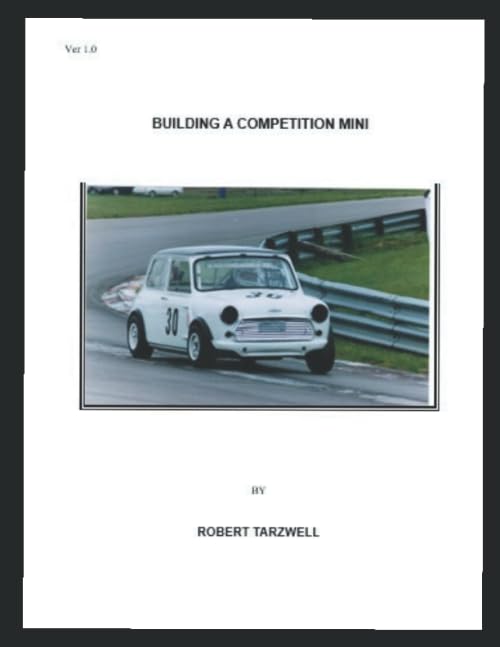
Front cover of the "Building A Competition Mini" book, featuring the title and author.
Back cover of the book, providing the author's biography and a summary of the book's content.


