
1. Introduction
The ESP32-WROOM-32D is a powerful, generic Wi-Fi + Bluetooth + BLE (Bluetooth Low Energy) Microcontroller Unit (MCU) module designed for a wide range of applications. These applications span from low-power sensor networks to demanding tasks such as voice encoding, music streaming, and MP3 decoding. This module integrates a dual-core processor, extensive peripheral support, and robust wireless connectivity, making it suitable for Internet of Things (IoT) projects and embedded system development.
This manual provides essential information for setting up, operating, and maintaining your ESP32-WROOM-32D modules.
2. Package Contents
Upon opening the package, verify that all components are present and undamaged. The standard package for this product includes:
- 5 x ESP-WROOM-32D Modules
If any items are missing or damaged, please contact your vendor or Luabby Smart support.

Image 2.1: Five ESP-WROOM-32D modules as typically supplied in a package. Each module is a compact, rectangular component with integrated antenna and pin headers.
3. Key Features
The ESP32-WROOM-32D module offers a comprehensive set of features for wireless communication and processing:
- Integrated Wi-Fi: Supports 802.11 b/g/n standards for robust wireless network connectivity.
- Dual-Mode Bluetooth: Includes both classic Bluetooth and Bluetooth Low Energy (BLE) for versatile device pairing and communication.
- High Performance: Powered by a dual-core Tensilica Xtensa LX6 microprocessor.
- Low Power Consumption: Optimized for battery-powered applications and energy-efficient operation.
- Rich Peripheral Set: Features GPIO, ADC, DAC, I2C, SPI, UART, PWM, and more for interfacing with various sensors and actuators.
- Compact Design: Small form factor suitable for integration into space-constrained projects.
4. Setup and Hardware Overview
This section provides an overview of the module's physical characteristics and general setup considerations.

Image 4.1: Front view of a single ESP-WROOM-32D module, showing the Espressif branding, Wi-Fi, CE, and FCC certifications, along with a QR code.
4.1 Pinout Diagram
Understanding the pinout is crucial for connecting the ESP32-WROOM-32D module to external components and development boards. The module features a standard 38-pin layout.

Image 4.2: Back view of the ESP-WROOM-32D module, clearly displaying the pin labels for various GPIOs, power, and communication interfaces. Key pins include GND, 3V3, EN, and numerous IO pins (e.g., IO23, IO22, TXD0, RXD0).
4.2 Power Supply
The ESP32-WROOM-32D module operates on a 3.3V power supply. Ensure that the power source is stable and can provide sufficient current for both the module and any connected peripherals, especially during Wi-Fi and Bluetooth transmission peaks.
4.3 Initial Connection
To begin development, connect the ESP32-WROOM-32D module to a compatible development board (e.g., an ESP32 DevKitC) or a custom PCB. Ensure correct pin alignment for power (3V3, GND) and communication interfaces (e.g., UART for programming). A USB-to-serial converter is typically required for programming if not using a development board with an integrated one.
5. Operating Principles
The ESP32-WROOM-32D module is designed for flexible operation, supporting various modes for Wi-Fi and Bluetooth connectivity.
5.1 Wi-Fi Operation
The module can operate in several Wi-Fi modes:
- Station Mode (STA): Connects to an existing Wi-Fi access point.
- Access Point Mode (AP): Creates its own Wi-Fi network, allowing other devices to connect to it.
- STA + AP Mode: Operates as both a station and an access point simultaneously.
Programming environments like the Espressif IoT Development Framework (ESP-IDF) or Arduino IDE provide libraries and examples for configuring and utilizing these Wi-Fi modes.
5.2 Bluetooth Operation
The ESP32-WROOM-32D supports both classic Bluetooth (Bluetooth BR/EDR) and Bluetooth Low Energy (BLE).
- Classic Bluetooth: Suitable for higher data throughput applications like audio streaming or data transfer with legacy Bluetooth devices.
- Bluetooth Low Energy (BLE): Ideal for low-power, short-range communication, commonly used in IoT devices for sensor data transmission or device control.
Developers can implement various Bluetooth profiles and services using the provided SDKs.
6. Maintenance
The ESP32-WROOM-32D module is a robust electronic component designed for long-term operation with minimal maintenance. However, adhering to best practices can extend its lifespan and ensure reliable performance.
- Environmental Conditions: Operate the module within its specified temperature and humidity ranges. Avoid exposure to extreme temperatures, direct sunlight, or high moisture.
- Cleanliness: Keep the module free from dust, dirt, and corrosive substances. If cleaning is necessary, use a soft, dry brush or compressed air. Avoid liquid cleaners.
- Static Discharge: Always handle the module with appropriate ESD (Electrostatic Discharge) precautions to prevent damage to sensitive components.
- Firmware Updates: Regularly check for and apply firmware updates from Espressif or your chosen development framework to benefit from performance improvements, bug fixes, and security enhancements.
7. Troubleshooting
This section addresses common issues encountered during the use of the ESP32-WROOM-32D module.
- Module Not Powering On:
- Verify the 3.3V power supply connection and ensure it is stable.
- Check GND connections.
- Ensure the EN (Enable) pin is pulled high (typically through a resistor to 3.3V) for normal operation.
- Failed to Upload Firmware:
- Confirm correct wiring of TX, RX, and GND to your USB-to-serial converter.
- Ensure the module is in programming mode (GPIO0 pulled low during boot, EN toggled).
- Check serial port selection and baud rate in your programming software.
- Install necessary USB-to-serial drivers.
- Wi-Fi Connection Issues:
- Double-check Wi-Fi SSID and password.
- Ensure the module is within range of the access point.
- Verify antenna connection (if using an external antenna with ESP32-WROOM-32U variant).
- Check for IP address conflicts on the network.
- Bluetooth Not Discoverable/Connecting:
- Ensure Bluetooth functionality is enabled in your firmware.
- Check that the module is in the correct advertising or scanning mode.
- Verify the other Bluetooth device is also in discoverable/pairing mode.
For persistent issues, consult the Espressif documentation, community forums, or contact technical support.
8. Specifications
The following table details the technical specifications of the ESP32-WROOM-32D module:
| Feature | Specification |
|---|---|
| Model Number | ESP32-WROOM-32D |
| Wireless Communication Standard | 802.11 b/g/n (Wi-Fi), Bluetooth v4.2 BR/EDR and BLE |
| CPU Manufacturer | Espressif Systems |
| CPU | Xtensa dual-core 32-bit LX6 microprocessor |
| Operating Voltage | 2.7V to 3.6V (typically 3.3V) |
| Flash Memory | 4MB SPI Flash |
| Connectivity Technology | Wi-Fi, Bluetooth |
| Product Dimensions | 1 x 0.71 x 0.08 inches (25.4 x 18 x 2 mm) |
| Item Weight | 0.071 ounces (2 grams) |
| Operating Temperature | -40°C to +85°C |
8.1 Recommended PCB Land Pattern
For integrating the ESP32-WROOM-32D module onto a custom Printed Circuit Board (PCB), it is essential to follow the recommended land pattern to ensure proper electrical and mechanical connections. The diagram below illustrates the suggested dimensions in millimeters.
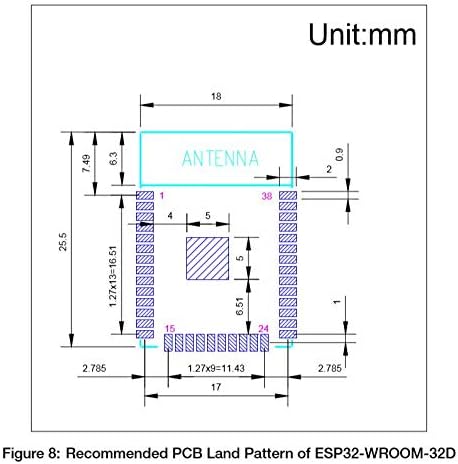
Image 8.1: Recommended PCB Land Pattern of ESP32-WROOM-32D, showing dimensions in millimeters for pad placement and module outline. This diagram is critical for custom PCB design and manufacturing.
9. Warranty Information
Specific warranty details for the Luabby Smart ESP-WROOM-32D module are not provided in the product information. For warranty inquiries, please refer to the purchase documentation or contact Luabby Smart customer service directly.
10. Support and Contact
For further assistance, technical support, or to explore other products, please visit the official Luabby Smart store or contact their customer service department.
- Luabby Smart Store: Visit the Luabby Smart Store on Amazon