
1. Introduction
The ANENG V01B is a battery-powered, true-RMS, auto-ranging digital multimeter designed for accurate electrical measurements. It features a 4000-count LCD display with backlight and a built-in flashlight for enhanced visibility in various working conditions.
This manual provides essential information for the safe and effective use of your ANENG V01B multimeter, including setup, operation, maintenance, and troubleshooting.

Figure 1: ANENG V01B Digital Multimeter with display dimensions (44.5mm / 1.75in width, 27mm / 1.06in height) and test leads (790mm / 31.1in length).
2. Safety Information
WARNING: To avoid electric shock or personal injury, read and understand all safety information before using this product.
- Do not input voltage when the multimeter is set to Current Mode, Resistance Mode, Diode Mode, Continuity Mode, or Temperature Mode.
- Do not input voltage exceeding 36V DC or 25V AC when measuring current.
- Always ensure the test leads are properly connected and the function dial is set to the correct measurement range before testing.
- Inspect test leads for damage before each use. Do not use if insulation is damaged or bare metal is exposed.
- Do not operate the meter if it appears damaged or if it is not operating properly.
- Adhere to local and national safety codes.
3. Setup
3.1 Battery Installation
The ANENG V01B multimeter requires batteries for operation. Follow these steps to install or replace the batteries:
- Ensure the multimeter is turned OFF.
- Locate the battery slot on the back of the product.
- Open the battery cover.
- Insert the required batteries, observing the correct polarity (+ and -).
- Close the battery cover securely.

Figure 2: Battery slot and product back shell with retractable bracket and flashlight.
3.2 Connecting Test Leads
Proper connection of test leads is crucial for accurate and safe measurements.
- Insert the black test lead into the "COM" (Common) input jack.
- For most voltage, resistance, capacitance, frequency, and diode measurements, insert the red test lead into the "VΩHz" input jack.
- For current measurements up to 400mA, insert the red test lead into the "mA" input jack.
- For current measurements up to 10A, insert the red test lead into the "10A" input jack.

Figure 3: Test lead input interfaces: COM, VΩHz, mA, and 10A.
4. Operating Instructions
4.1 Panel Function Introduction
Familiarize yourself with the multimeter's controls and display elements:

Figure 4: Multimeter panel with labeled functions.
- Rotary Dial: Selects the primary measurement function (e.g., V for voltage, Ω for resistance, A for current).
- SEL Button: Used for function conversion (e.g., switching between AC/DC voltage, or different sub-functions within a dial setting).
- AUTO POWER OFF: Indicates automatic power-off feature.
- HOLD/* Button: Data retention (freezes the current reading on the display) and activates/deactivates the backlight.
- NCV: Non-Contact Voltage detection.
- LCD Display: Shows measurement readings, units, and various indicators.
- Power On/Off: Integrated into the rotary dial (OFF position).
4.2 Basic Measurement Functions
The ANENG V01B offers various measurement capabilities:
- DC Voltage Measurement: Turn the rotary dial to the 'V' position. Connect the red test lead to the positive terminal and the black test lead to the negative terminal of the circuit or component. The display will show the DC voltage reading.

Figure 5: Example of measuring DC voltage from a 9V battery.
- AC Voltage Measurement: Turn the rotary dial to the 'V' position. Press the 'SEL' button to switch to AC voltage mode if necessary. Connect the test leads across the AC voltage source.
- Resistance Measurement (Ω): Turn the rotary dial to the 'Ω' position. Ensure the circuit is de-energized before measuring resistance. Connect the test leads across the component.
- Capacitance Measurement: Turn the rotary dial to the capacitance symbol. Ensure the capacitor is discharged before measurement.
- Current Measurement (A/mA): Select the appropriate 'A' or 'mA' range on the rotary dial. Connect the multimeter in series with the circuit. Observe safety warnings regarding maximum input voltage.
- Frequency (Hz) and Duty Cycle: Select the 'Hz' position.
- Diode Test and Continuity: Select the diode/continuity position. Use 'SEL' to switch between modes.
- Non-Contact Voltage (NCV): Select the 'NCV' position. Bring the top of the multimeter near an AC voltage source to detect its presence without direct contact.
4.3 Special Features
- Backlight/Flashlight: Press and hold the 'HOLD/*' button to activate the backlight. The flashlight is located on the back of the unit and can be used in low-light conditions.

Figure 6: Back of the product showing the high brightness flashlight and NCV sensing point.
- Auto-Ranging: The multimeter automatically selects the appropriate measurement range, simplifying operation.
- Data Hold: Press the 'HOLD/*' button briefly to freeze the current reading on the display. Press again to release.
5. Maintenance
5.1 Cleaning
Wipe the case with a damp cloth and mild detergent. Do not use abrasives or solvents. Keep the input terminals free of dirt and moisture.
5.2 Battery Replacement
When the battery indicator appears on the display, replace the batteries as described in Section 3.1. Always use the specified battery type.
5.3 Fuse Replacement
If the current measurement function stops working, the fuse may need replacement. Refer to the specifications for the correct fuse type and rating. Fuse replacement should only be performed by qualified personnel.
6. Troubleshooting
6.1 Millivolt Value Jump
It is a normal phenomenon for the millivolt (mV) range of the multimeter to show a non-zero reading when the test leads are not connected to a circuit. This can be caused by:
- Excessive changes in ambient temperature and humidity.
- Strong electric or magnetic field interference.
To verify if the meter returns to zero, dial the multimeter to the mV range, insert the corresponding input hole into the red and black pen line, and short-circuit the red and black test leads. The display should then show zero or a very small, stable value.
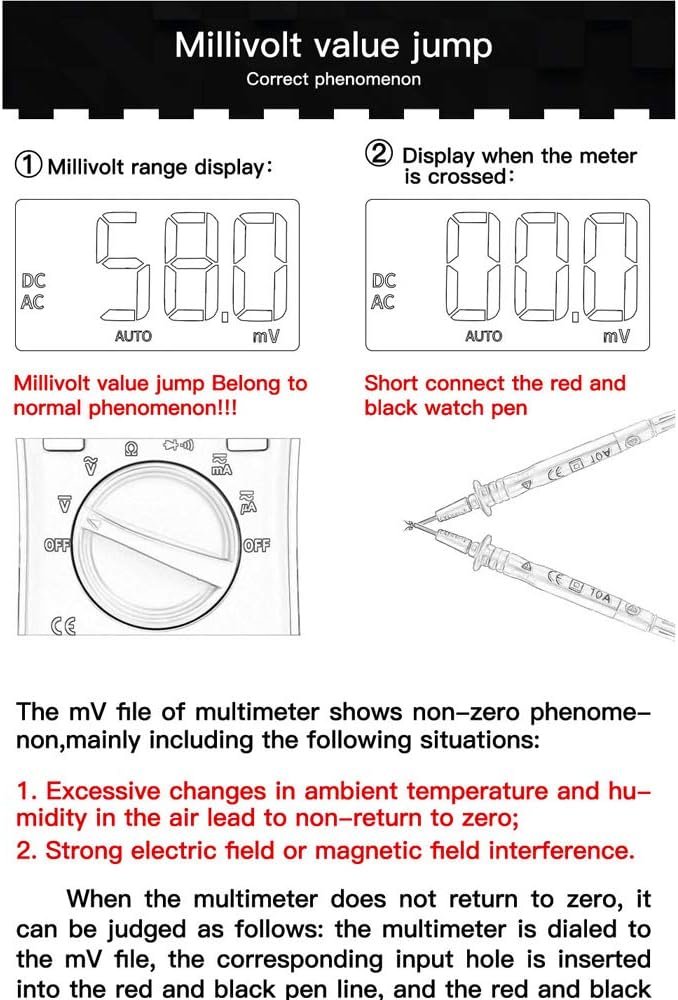
Figure 7: Millivolt range display and method to check for zero return by shorting test leads.
6.2 General Issues
- No Display: Check battery installation and charge level. Replace batteries if necessary.
- Incorrect Readings: Ensure test leads are correctly connected to the appropriate input jacks. Verify the rotary dial is set to the correct measurement function and range.
- No Response: Turn the multimeter off and then on again. If the issue persists, replace batteries.
7. Specifications
| Feature | Specification |
|---|---|
| Model | ANENG V01B |
| Display | 4000 Counts LCD |
| Measurement Type | Digital Multimeter (True-RMS, Auto-Ranging) |
| DC Voltage | Yes |
| AC Voltage | Yes |
| DC Current | Yes |
| AC Current | Yes |
| Resistance | Yes |
| Capacitance | Yes |
| Frequency | Yes |
| Diode Test | Yes |
| Continuity Test | Yes |
| NCV (Non-Contact Voltage) | Yes |
| Backlight | Yes |
| Flashlight | Yes |
| Power Source | Battery-powered |
| Color | Blue |
| UPC | 630282728851 |
| ASIN | B0831BWKWL |
8. Warranty and Support
Specific warranty information and customer support details are not provided in the available product data. Please refer to the product packaging, the manufacturer's official website, or contact your retailer for warranty terms and technical support inquiries.


