
1. Introduction
Thank you for choosing the XTUGA A4 4-Channel Audio Mixer. This compact and versatile mixing console is designed for various audio applications, including home music production, webcasting, and live sound. It features 4 channels, Bluetooth connectivity, USB recording and playback, 48V phantom power for condenser microphones, and built-in effects. This manual provides detailed instructions for setup, operation, maintenance, and troubleshooting to ensure optimal performance and longevity of your device.
2. Safety Information
- Power Supply: Use only the specified power adapter or a reliable USB power source that meets the voltage and current requirements (greater than 5V and 1.5A). Incorrect power can damage the device or cause noise.
- Water and Moisture: Do not expose the unit to rain, moisture, or extreme humidity. Avoid placing liquid containers on or near the mixer.
- Ventilation: Ensure adequate ventilation around the unit. Do not block ventilation openings.
- Heat: Keep the unit away from heat sources such as radiators, heat registers, stoves, or other heat-producing appliances.
- Cleaning: Disconnect power before cleaning. Use a dry, soft cloth. Do not use liquid cleaners or aerosols.
- Servicing: Do not attempt to service this unit yourself. Refer all servicing to qualified service personnel.
3. Package Contents
Please check the package contents upon unboxing to ensure all items are present:
- XTUGA A4 4-Channel Audio Mixer
- USB Power Cable
- USB Power Adapter

Image: The XTUGA A4 Audio Mixer shown with its included USB power cable and USB power adapter.
4. Product Overview
The XTUGA A4 mixer features a compact design with essential controls for audio mixing. Key features include:
- 4 Input Channels: Two MIC/LINE (XLR/TRS combo) inputs with 48V phantom power and two stereo LINE (RCA) inputs.
- Bluetooth Connectivity: Wirelessly stream audio from your smartphone or other Bluetooth-enabled devices.
- USB Audio Interface: Connect to a computer for recording and playback. Supports U-Disk (USB drive) for MP3/WAV/WMA/FLAC playback and direct recording.
- Built-in Effects: Adjustable DELAY and REPEAT effects for vocal enhancement.
- Monitoring: Dedicated PHONES output for headphone monitoring.
- EQ Control: HIGH and LOW equalization for each input channel.

Image: Front view of the XTUGA A4 Audio Mixer, illustrating its Bluetooth connectivity feature with a smartphone icon.
5. Setup
5.1 Powering the Mixer
The A4 mixer can be powered via USB. For stable performance and to avoid noise, ensure your power source provides at least 5V and 1.5A.
- USB Power Adapter: Connect the provided USB cable to the mixer's USB port and the USB power adapter, then plug into a wall outlet. This is the recommended method for optimal performance.
- Computer USB Port: Connect the USB cable directly to a computer's USB port. Note that some computer USB ports may not provide sufficient power, potentially leading to noise or unstable operation.
- Power Bank: For portable use, connect the USB cable to a power bank with sufficient output.

Image: Illustration of three ways to power the XTUGA A4 mixer: via a computer's USB port, a wall power adapter, or a portable power bank. A note emphasizes the requirement for a USB power supply of at least 5V and 1.5A.
5.2 Connecting Audio Devices
Refer to the diagram below for a general connection overview.

Image: A comprehensive diagram illustrating how to connect various audio equipment to the XTUGA A4 mixer, including condenser microphones, dynamic microphones, wireless microphones, a computer, a power amplifier, passive speakers, and headphones.
5.2.1 Input Connections
- Microphones (Channels 1 & 2): Connect XLR or 1/4" TRS cables from your microphones to the MIC/LINE inputs. For condenser microphones requiring phantom power, ensure the +48V switch is engaged.
- Line-Level Devices (Channels 3 & 4): Connect devices like CD players, media players, or other line-level sources using RCA cables to the LEFT and RIGHT LINE inputs.

Image: A close-up view of the mixer's input section, demonstrating the connection of both a 1/4-inch TRS cable and an XLR cable into the MIC/LINE combo jacks.
5.2.2 Output Connections
- Main Output: Connect the L/R MAIN RCA outputs to your power amplifier, active speakers, or recording device.
- Headphones: Connect your headphones to the PHONES 1/4" TRS output for monitoring.
6. Operating Instructions
6.1 Basic Mixing
- GAIN Control: Adjust the input sensitivity for each MIC/LINE channel. Set it so the PEAK LED flashes only occasionally during the loudest parts of the signal.
- HIGH/LOW EQ: Use these knobs to adjust the treble (HIGH) and bass (LOW) frequencies for each channel.
- EFX Send: Controls the amount of signal sent from each channel to the built-in effects processor.
- MAIN Output: Adjusts the overall volume of the main mix.
- PHONES Output: Adjusts the volume for the headphone output.
- +48V Phantom Power: Activate this switch for condenser microphones that require phantom power. Ensure microphones are connected before activating.
6.2 Bluetooth Operation
To connect a Bluetooth device:
- Press the MODE/BT button on the USB/Bluetooth section until the display shows "BT".
- On your smartphone or Bluetooth device, search for available devices and select "XTUGA A4" (or similar name).
- Once paired, audio from your device will play through channels 3/4. Adjust the volume using the 3-4/USB knob.
6.3 USB Playback (U-Disk)
To play audio files from a USB flash drive:
- Insert a USB flash drive (U-Disk) containing MP3/WAV/WMA/FLAC files into the USB port.
- The mixer will automatically detect and begin playing files. Use the playback controls (play/pause, next/previous) on the mixer.
- Adjust the volume using the 3-4/USB knob.

Image: The XTUGA A4 mixer with a USB flash drive inserted into its USB port, highlighting its U-Disk functionality for playing MP3/WAV/WMA/FLAC files and recording audio.
6.4 USB Recording to Computer
The mixer can send its main stereo mix to a computer for recording.
- Connect the mixer to your computer via the USB cable.
- Your computer should recognize the mixer as an audio input device. Select it in your recording software (e.g., Audacity, GarageBand, OBS).
- Adjust input levels on the mixer and in your software. The mixer will send a stereo mix of all active channels to the computer.

Image: A diagram illustrating the connection for recording. A computer sends background music to the audio mixer, and the audio mixer's output is recorded by a computer program.
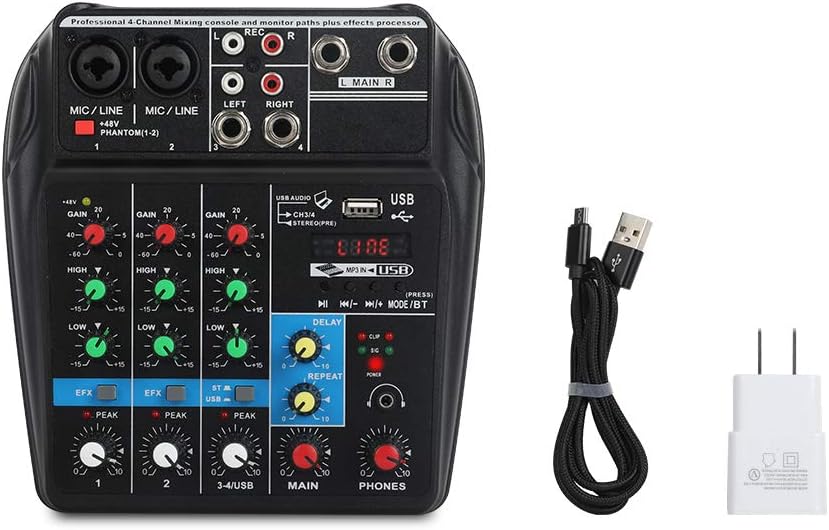
Image: A visual guide detailing the process of recording audio to a computer. Steps include connecting the USB cable, setting the mixer to 'Record' status, pressing record in a computer program (like GoldWave), and then playing back the recorded audio.
6.5 Effects (DELAY & REPEAT)
The mixer includes built-in delay and repeat effects:
- DELAY: Adjusts the delay time of the effect.
- REPEAT: Controls the number of repetitions for the delay effect.
- Use the EFX send knobs on individual channels to control how much of that channel's signal is sent to the effects processor.
6.6 Product Video Demonstration
Watch this video for a visual demonstration of the XTUGA A4 Audio Mixer's features and operation.
Video: A demonstration of the XTUGA A4 4-Channel Audio Mixer, showcasing its various features, connections, and operational aspects. This video provides a visual guide to understanding the product's capabilities.
7. Maintenance
- Cleaning: Regularly wipe the mixer's surface with a soft, dry cloth. Avoid using abrasive cleaners or solvents.
- Storage: When not in use, store the mixer in a clean, dry environment away from direct sunlight and extreme temperatures.
- Cable Care: Handle cables carefully. Avoid sharp bends or excessive pulling, which can damage connectors or internal wiring.
8. Troubleshooting
| Problem | Possible Cause | Solution |
|---|---|---|
| No power | Incorrect or insufficient USB power supply. | Ensure the USB power adapter is properly connected to a wall outlet. If using a computer USB, try a different port or a dedicated USB power adapter (recommended). Verify the power source provides at least 5V and 1.5A. |
| No sound or low volume | Incorrect connections, low gain/volume settings, phantom power off for condenser mics. | Check all input and output cable connections. Increase GAIN for input channels, MAIN volume, and PHONES volume. Ensure +48V phantom power is engaged for condenser microphones. |
| Humming or static noise | Ground loop, insufficient power, poor quality cables, interference. | Use the provided USB power adapter plugged into a wall outlet instead of a computer USB port. Ensure all cables are good quality and properly shielded. Try isolating the mixer from other electronic devices. |
| USB recording/playback issues (disconnects, not recognized) | Faulty USB cable, computer port issues, driver conflicts. | Try a different USB cable and a different USB port on your computer. Restart your computer. Ensure your operating system has the latest audio drivers. |
| Cannot record multiple microphones to separate tracks | The mixer outputs a stereo mix, not individual tracks. | This mixer is designed to output a combined stereo mix to your computer. It does not support multi-track recording of individual inputs. For multi-track recording, a dedicated multi-channel audio interface is required. |
9. Specifications
- Item Model Number: A4
- Item Weight: 1.5 pounds
- Product Dimensions: 3.15 x 9.45 x 9.45 inches
- Number of Channels: 4
- Hardware Interface: Bluetooth, USB
- Connectivity Technology: Bluetooth
- Power Source: Corded Electric (USB)
- Voltage: 48 Volts (for Phantom Power)
- Output Connector Type: XLR (implied for mic inputs), RCA (Main Out), TRS (Phones Out)
10. Warranty and Support
For warranty information, technical support, or service inquiries, please contact the seller or manufacturer directly through the platform where the product was purchased. Keep your purchase receipt as proof of purchase.
