
1. Introduction
The Ximimark MQ135 Air Quality Sensor Hazardous Gas Detection Module is designed for detecting various harmful gases in the air. This module provides accurate and reliable readings for pollutants such as ammonia, benzene, smoke, and other volatile organic compounds. It is suitable for integration into air quality monitoring systems, environmental sensing, and safety alarms.

Image 1.1: Three Ximimark MQ135 Air Quality Sensor Modules. Each module features a blue PCB with a metal mesh sensor housing and pin headers for connectivity.
2. Key Features
- Dual Panel Design: High-quality design with power indicator and TTL signal output indication.
- TTL Output: Provides a low-level valid signal, suitable for microcontroller IO port access.
- Analog Output: Voltage increases with higher gas concentration.
- Wide Detection Range: Suitable for ammonia, aromatic compounds, sulfur, benzene vapor, and other harmful gases. Gas-sensitive element test concentration range: 10 to 1000ppm.
- Reliability: Long service life, stable, and reliable performance with fast response and recovery characteristics.
3. Technical Specifications
The following table details the technical specifications of the MQ135 sensor module:

Image 3.1: Detailed technical specifications for the MQ135 sensor, including product model, type, detecting gases, concentration range, circuit conditions, and test conditions.
| Parameter | Value |
|---|---|
| Product Model | MQ135 |
| Product Type | Semiconductor gas sensor |
| Detecting Gas | Ammonia, Sulphide, Benzene Vapor, Smoke, other VOCs |
| Detection Concentration Range | 10-1000ppm (Ammonia, Toluene, Hydrogen) |
| Loop Voltage (Vc) | ≤24V DC |
| Heating Voltage (VH) | 5.0V ± 0.2V AC or DC |
| Load Resistance (RL) | Adjustable |
| Heating Resistance (RH) | 31Ω ± 3Ω (at room temperature) |
| Heating Power (PH) | ≤900mW |
| Surface Resistance (Rs) | 2KΩ - 20KΩ (in 100ppm NH3) |
| Sensitivity (S) | Rs (in air) / Rs (100ppm NH3) ≥ 5 |
| Concentration Slope (α) | ≤ 0.6 (R100ppm / R50ppm NH3) |
| Standard Test Conditions (Temperature & Humidity) | 20°C ± 2°C; 65% ± 5%RH |
| Preheating Time | No less than 48 hours |
| Dimensions | 0.79"D x 1.26"W x 0.87"H |
| Item Weight | 0.02 Kilograms (approx. 0.63 ounces) |
| Material | Copper (sensor element) |
4. Setup and Installation
The MQ135 module is designed for easy integration into various electronic projects, particularly with microcontrollers like Arduino. Follow these steps for basic setup:
- Identify Pins: The module typically has 4 or 6 pins. Common pins include VCC (Power), GND (Ground), DOUT (Digital Output), and AO (Analog Output).
- Power Connection: Connect VCC to a 5V power supply and GND to the ground of your microcontroller or power source.
- Analog Output (AO): Connect the AO pin to an analog input pin on your microcontroller (e.g., A0 on Arduino) to read varying gas concentrations.
- Digital Output (DOUT): Connect the DOUT pin to a digital input pin on your microcontroller. This pin provides a threshold-based signal (low when gas concentration exceeds a set point). The threshold can often be adjusted using the onboard potentiometer.
- Preheating (Burn-in): Before accurate readings can be obtained, the sensor requires a preheating period. Power the sensor for at least 48 hours. This process stabilizes the sensor's characteristics. After preheating, allow it to settle for about an hour before taking critical measurements.
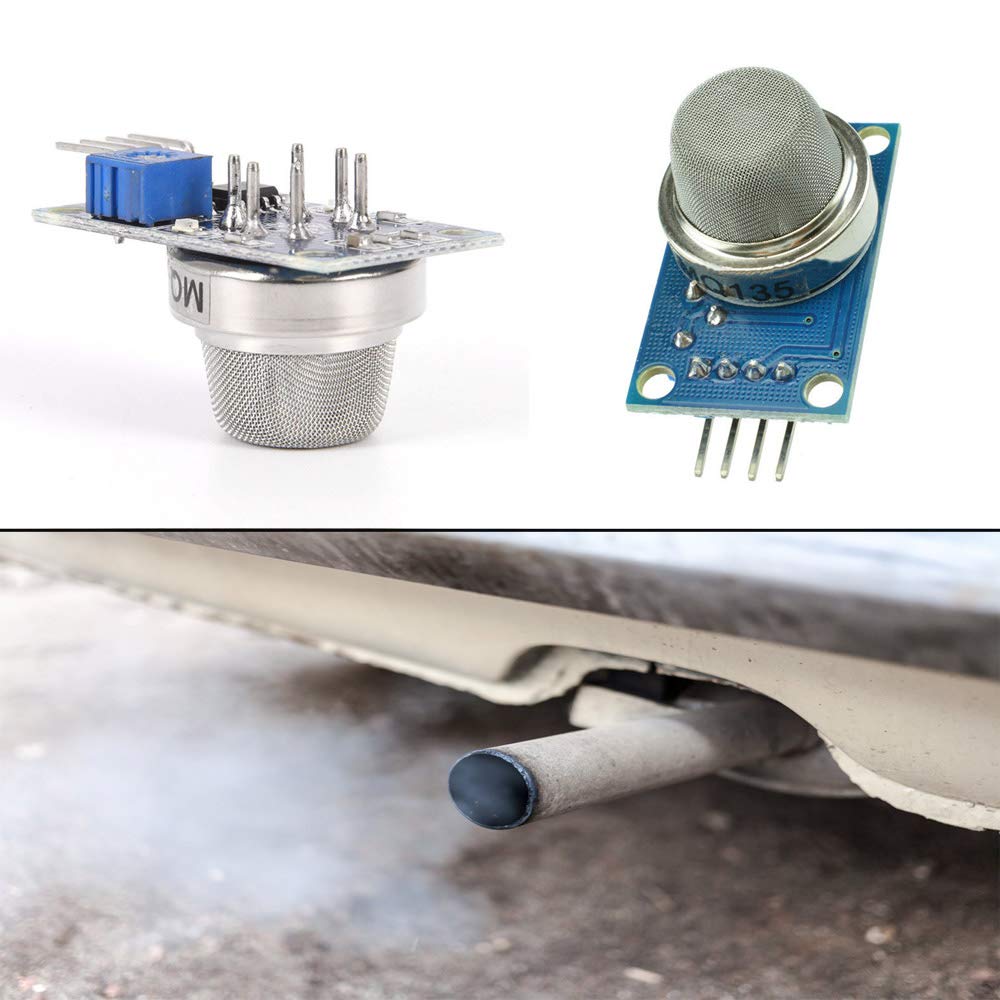
Image 4.1: Top view of an MQ135 sensor module showing its pin headers and an onboard potentiometer for adjustment. Below, a car exhaust pipe emits fumes, illustrating a potential application for gas detection.
5. Operating Instructions
The MQ135 sensor operates by detecting changes in the conductivity of its tin dioxide (SnO2) sensing material. When harmful gases are present, the conductivity increases, which is then converted into an electrical signal.
- Analog Reading: The Analog Output (AO) provides a voltage proportional to the gas concentration. Higher concentrations result in higher voltage readings. This output is suitable for precise measurement and logging.
- Digital Threshold: The Digital Output (DOUT) provides a binary signal. When the detected gas concentration exceeds a preset threshold (adjustable via the onboard potentiometer), the DOUT pin goes low. This is useful for triggering alarms or simple on/off indications.
- Calibration: For accurate readings, especially after the preheating period, calibration is recommended. This typically involves exposing the sensor to known concentrations of gases or using a clean air reference to establish baseline values. Refer to online resources and community forums for specific calibration procedures for the MQ135 sensor with your chosen microcontroller platform.

Image 5.1: An MQ135 sensor module positioned against a background of industrial smoke stacks, symbolizing its application in detecting air pollutants. The image highlights the sensor's role in environmental monitoring.

Image 5.2: An MQ135 sensor module shown alongside a dense plume of dark smoke, visually representing the sensor's capability to detect smoke and other airborne contaminants.
6. Maintenance
The MQ135 sensor module is generally low-maintenance. However, consider the following for optimal performance and longevity:
- Keep Clean: Ensure the sensor's metal mesh housing is free from dust, dirt, and moisture. Avoid direct contact with liquids.
- Avoid Contaminants: Do not expose the sensor to high concentrations of corrosive gases or extreme temperatures for prolonged periods, as this can degrade the sensing element.
- Stable Environment: Operate the sensor in a stable environment within its specified temperature and humidity ranges (20°C ± 2°C; 65% ± 5%RH) to ensure consistent readings.
- Re-calibration: If the sensor is moved to a new environment or if readings become inconsistent over time, consider re-calibrating it.
7. Troubleshooting
| Issue | Possible Cause | Solution |
|---|---|---|
| Inaccurate or fluctuating readings | Insufficient preheating (burn-in period). Sensor not calibrated. Environmental interference. | Ensure the sensor has been powered for at least 48 hours. Perform calibration in a clean air environment and with known gas concentrations. Shield the sensor from drafts or sudden temperature changes. |
| No output from AO or DOUT pins | Incorrect wiring. No power to the module. Faulty module. | Verify all wiring connections (VCC, GND, AO, DOUT). Check power supply to the module. Test with a different module if available. |
| Digital output (DOUT) always high/low | Potentiometer setting incorrect. No gas detected/gas always present. | Adjust the onboard potentiometer to set the digital threshold. Ensure the sensor is exposed to the target gas for testing. |
| Sensor not responding to gas | Sensor element degradation. Incorrect gas type. | Ensure the sensor is designed to detect the specific gas. If the sensor is old or has been exposed to harsh conditions, it may need replacement. |
8. Safety Information
- This module is intended for experimental and hobbyist use. It should not be used as a primary safety device in critical applications where human life or significant property is at risk.
- Always ensure proper ventilation when working with gases, even in small quantities.
- Do not touch the sensor element directly, as oils from skin can affect its performance.
- Ensure power connections are correct to prevent damage to the module or connected devices.
9. Warranty and Support
For specific warranty information, please refer to the retailer or manufacturer's official website at the time of purchase. General technical support and community resources for Arduino and MQ-series sensors are widely available online.