
Introduction to Your Repair Manual
This manual provides detailed service and repair procedures for Ford Super Duty F-250, F-350 Pick-Ups, and Excursion models manufactured between 1999 and 2010. It is designed for both the professional mechanic and the do-it-yourself enthusiast, offering clear, step-by-step instructions and illustrations to guide you through various maintenance and repair tasks.
Before beginning any work, please read the relevant sections thoroughly to understand the procedures and safety precautions involved. Always use appropriate tools and safety equipment.
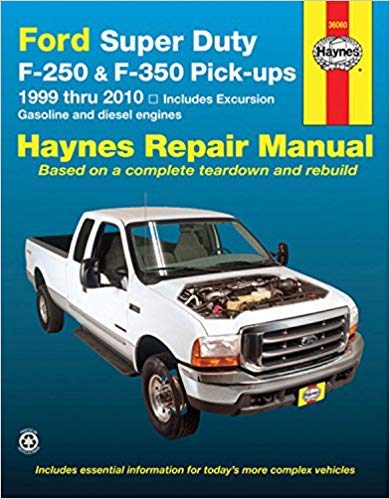
Image: Front cover of the Ford Super Duty F-250 & F-350 Pick-Ups and Excursion 1999-2010 Repair Manual. The cover features a blue background with an image of a Ford Super Duty truck and the title prominently displayed.
General Information and Safety
This section covers essential information applicable to all repair procedures. It includes safety warnings, general workshop practices, and advice on selecting the correct tools. Understanding these fundamentals is crucial for safe and effective vehicle maintenance.
- Safety Precautions: Guidelines for working with automotive systems, including handling fluids, electrical components, and heavy parts.
- Tool Usage: Recommendations for essential hand tools, specialized tools, and diagnostic equipment.
- Vehicle Identification: Locating and understanding VIN (Vehicle Identification Number) and other identification plates.
Engine Systems
Detailed instructions for servicing and repairing the various engine types available in the 1999-2010 Ford Super Duty and Excursion models. This includes procedures for:
- Engine Overhaul: Disassembly, inspection, and reassembly of engine components.
- Fuel System: Maintenance and repair of fuel injection, fuel pumps, and related components.
- Ignition System: Spark plug replacement, coil pack testing, and ignition timing.
- Cooling System: Radiator, water pump, thermostat, and hose replacement.
- Exhaust System: Manifold, catalytic converter, and muffler service.
Transmission and Drivetrain
This section covers the maintenance and repair of both automatic and manual transmissions, transfer cases, drive shafts, and differentials for two-wheel drive (2WD) and four-wheel drive (4WD) configurations.
- Fluid Changes: Procedures for transmission, transfer case, and differential fluid replacement.
- Component Removal/Installation: Instructions for removing and installing transmissions, transfer cases, and drive shafts.
- Clutch System: For manual transmission models, including clutch plate, pressure plate, and release bearing replacement.
Chassis, Suspension, and Brakes
Guidance on maintaining and repairing the vehicle's structural and dynamic components, ensuring safe handling and stopping power.
- Brake System: Disc brake service (pads, rotors, calipers), drum brake service, and ABS (Anti-lock Braking System) diagnostics.
- Steering System: Power steering pump, steering gear, and linkage components.
- Suspension: Shock absorbers, springs, control arms, and alignment procedures.
- Wheels and Tires: Rotation, balancing, and tire pressure monitoring.
Electrical System
This section provides comprehensive information on the vehicle's electrical components, including wiring diagrams, diagnostic procedures, and component replacement.
- Battery and Charging System: Battery testing, alternator service, and starter motor replacement.
- Lighting: Headlights, taillights, interior lights, and wiring.
- Fuses and Relays: Location, identification, and replacement.
- Wiring Diagrams: Detailed schematics for various circuits to aid in troubleshooting.
Bodywork and Interior
Instructions for minor repairs and maintenance of the vehicle's exterior and interior components.
- Exterior Panels: Removal and installation of bumpers, grilles, and trim.
- Doors and Windows: Window regulator repair, door panel removal, and lock mechanisms.
- Interior Components: Dashboard, seats, and console removal for access or repair.
Maintenance Schedules
This section outlines recommended service intervals and procedures to keep your Ford Super Duty or Excursion in optimal condition. Adhering to these schedules can prevent major issues and extend the life of your vehicle.
- Routine Checks: Oil level, tire pressure, fluid levels, and light operation.
- Scheduled Services: Oil and filter changes, air filter replacement, fuel filter replacement, and spark plug intervals.
- Component Inspections: Brake wear, suspension components, and exhaust system integrity.
Troubleshooting
A guide to diagnosing common problems based on symptoms. This section helps identify potential causes and directs you to the relevant repair procedures within the manual.
- Engine Problems: Starting issues, misfires, overheating, and unusual noises.
- Brake Issues: Squealing, grinding, pulling, or soft pedal.
- Electrical Faults: Non-functional lights, power windows, or accessories.
- Transmission Concerns: Shifting problems or fluid leaks.
Specifications
This section provides critical technical data, including torque specifications, fluid capacities, and component dimensions, essential for accurate repairs and maintenance.
| Category | Description | Value/Range |
|---|---|---|
| Engine Oil Capacity | Varies by engine type (e.g., 7.3L Diesel, 6.8L V10) | Refer to specific engine chapter |
| Tire Pressure | Recommended cold tire inflation pressure | Refer to vehicle placard |
| Spark Plug Gap | For gasoline engines | Refer to engine specifications |
| Brake Rotor Minimum Thickness | Front and Rear | Refer to brake system chapter |
Note: All specifications are provided for reference. Always consult the specific chapter for your vehicle's year and engine configuration for precise values.
Warranty and Support
This repair manual is a third-party publication and is not directly affiliated with Ford Motor Company. As such, it does not come with a product warranty from the vehicle manufacturer. For information regarding your vehicle's original manufacturer warranty, please refer to your vehicle's owner's manual or contact an authorized Ford dealership.
For support related to the content of this specific manual, including clarifications on procedures or errata, please refer to the publisher's contact information typically found on the copyright page of the physical book or their official website. The publisher aims to provide accurate and helpful information, but cannot be held responsible for errors or omissions, or for the results of repairs performed using this manual.
Always prioritize safety and consult a certified professional mechanic if you are unsure about any repair procedure.


