
1. Introduction
This manual provides detailed instructions for the Hilitand 3-24V Active Piezoelectric Buzzer. This device is designed to produce a continuous audio signal when powered, making it suitable for various alarm and notification applications. It integrates a multivibrator, piezoelectric buzzer chip, impedance matching unit, resonator, and a protective shell.
2. Product Features
- Audio Output: Utilizes a multivibrator circuit to generate a continuous audio tone when power is applied.
- Integrated Design: Composed of a multivibrator, piezoelectric buzzer chip, impedance matching unit, resonator, and a durable shell.
- Easy Control: Designed for straightforward operation; connects directly to a rated power source for continuous sound.
- Sound Pressure Level: Produces an audible alert with a sound pressure level ranging from 85 to 95 decibels.
- Wide Application: Suitable for integration into computers, printers, photocopiers, alarm systems, electronic toys, automotive electronic equipment, telephones, timers, and other electronic products.
3. Specifications
| Specification | Value |
|---|---|
| Brand | Hilitand |
| Model Number | Hilitandfkqu52ovmr |
| Voltage Range | 3-24 Volts DC |
| Sound Level | 85-95 Decibels |
| Material | Plastic |
| Item Weight | 0.352 ounces |
| Product Dimensions | 3.94 x 3.94 x 3.94 inches (approximate packaging dimensions) |
Note: The buzzer's effective operating voltage range is 3V to 24V DC. Performance may vary at the lower end of this range.

Figure 3.1: Detailed dimensions of the active buzzer, showing measurements for mounting and overall size.
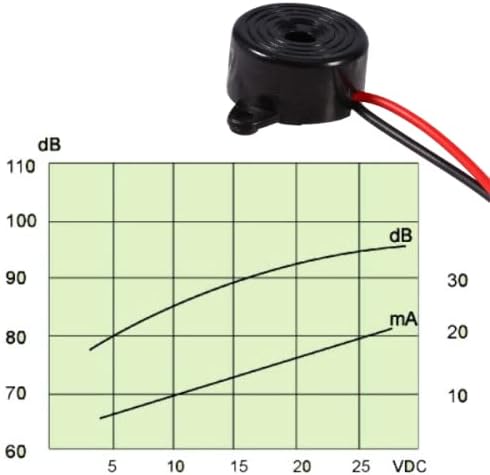
Figure 3.2: Performance graph illustrating sound output (dB) and current draw (mA) across the operating voltage range (VDC).
4. Setup and Installation
The Hilitand active buzzer is designed for simple integration into electronic circuits. Follow these steps for proper setup:
- Identify Connections: The buzzer features two wires: a red wire for the positive (+) terminal and a black wire for the negative (-) terminal.
- Power Source: Connect the red wire to the positive output of your DC power source (3-24V). Connect the black wire to the negative output or ground of your DC power source.
- Mounting: The buzzer housing includes mounting tabs with holes for secure installation using screws or other fasteners.

Figure 4.1: Front view of the active buzzer, showing the sound output opening and attached wires.

Figure 4.2: Detail of the buzzer's connection wires, indicating polarity (red for positive, black for negative).
Video 4.1: Demonstration of the Hilitand 3-24V Active Buzzer, showing its physical appearance and the simple wiring for operation.
5. Operation
Once correctly wired to a DC power source within the 3-24V range, the Hilitand active buzzer will emit a continuous sound. There are no additional controls or settings required for basic operation. The sound will cease when power is removed from the buzzer.
6. Maintenance
The Hilitand active buzzer requires minimal maintenance. Keep the device clean and free from dust and moisture. Avoid exposing it to extreme temperatures or corrosive environments, which could affect its performance and lifespan. Ensure all electrical connections remain secure.
7. Troubleshooting
- No Sound:
- Verify that the power source is supplying voltage within the 3-24V DC range.
- Check that the red wire is connected to positive (+) and the black wire to negative (-) correctly.
- Ensure all connections are secure and there are no breaks in the wiring.
- Low Sound Output:
- Confirm the input voltage is sufficient. While rated for 3-24V, optimal sound output is typically achieved at higher voltages (e.g., 5V and above).
- Ensure the buzzer is not obstructed by any materials that could dampen the sound.
- Intermittent Sound:
- Inspect wiring for loose connections or damaged insulation.
- Check the stability of the power supply.
8. Important Notes
- Please allow for minor measurement variations (1-3mm) due to manual measurement.
- Product images are for illustrative purposes. The actual item may have slight visual differences.