
BOYA BY-DMR7
BOYA BY-DMR7 On-Camera Shotgun Microphone User Manual
Model: BY-DMR7
Introduction
The BOYA BY-DMR7 is a broadcast-quality supercardioid condenser microphone designed for use with DSLR cameras and camcorders. It features an integrated flash recorder capable of capturing 24-bit/48 kHz WAV audio files directly to a MicroSDHC card (up to 32 GB, sold separately). This manual provides comprehensive instructions for setting up, operating, and maintaining your BY-DMR7 microphone to ensure optimal performance.

Image: The BOYA BY-DMR7 microphone with its foam windscreen, showcasing its compact design and integrated controls.
What's in the Box
Please check the package contents to ensure all items are present:
- BOYA BY-DMR7 Shotgun Microphone
- Foam Windscreen
- 3.5mm Gold-Plated Audio Cable
- User Manual (this document)

Image: All components included with the BY-DMR7: the microphone unit, the foam windscreen, and the coiled 3.5mm audio cable.
Product Overview
Familiarize yourself with the various parts and controls of the BY-DMR7 microphone:
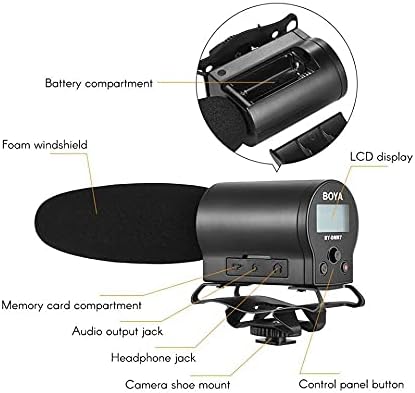
Image: Detailed diagram highlighting key components of the BY-DMR7, including the battery compartment, LCD display, control panel, and various input/output jacks.
- Foam Windscreen: Reduces wind noise and plosives.
- Microphone Barrel: Houses the supercardioid condenser microphone element.
- LCD Display: Shows recording status, battery level, and menu options.
- Control Panel Buttons: For menu navigation, recording, and playback.
- Headphone Jack (3.5mm): For real-time audio monitoring.
- Audio Output Jack (3.5mm): Connects to camera's audio input.
- Memory Card Compartment: For MicroSDHC card insertion.
- Battery Compartment: Holds 2 AA batteries.
- Integrated Shockmount: Reduces handling noise.
- Camera Shoe Mount: Attaches to standard camera hot/cold shoe.
Setup
1. Battery Installation
The BY-DMR7 requires two (2) AA batteries for operation.
- Locate the battery compartment on the side of the microphone unit.
- Slide open the battery compartment cover.
- Insert two AA batteries, ensuring correct polarity (+/-) as indicated inside the compartment.
- Close the battery compartment cover securely.
2. MicroSDHC Card Installation
A MicroSDHC card (up to 32 GB) is required for recording audio.
- Locate the memory card compartment.
- Gently insert a MicroSDHC card into the slot until it clicks into place. Ensure the card is oriented correctly.
- To remove, push the card in slightly until it springs out.
3. Mounting the Microphone
The BY-DMR7 can be mounted on a camera's hot/cold shoe.
- Slide the camera shoe mount of the microphone onto your camera's hot/cold shoe.
- Tighten the locking wheel on the shoe mount to secure the microphone in place.

Image: The BY-DMR7 microphone securely attached to a DSLR camera, ready for use.

Image: The BY-DMR7 microphone mounted on a different camera body, demonstrating its versatility.

Image: The BY-DMR7 microphone attached to a camcorder, illustrating its compatibility with various video recording devices.
4. Connecting to Camera
Use the supplied 3.5mm audio cable to connect the microphone to your camera's audio input.
- Connect one end of the 3.5mm audio cable to the Audio Output Jack on the BY-DMR7.
- Connect the other end of the cable to the Microphone Input jack on your camera or camcorder.
5. Attaching Foam Windscreen
Slide the foam windscreen over the microphone barrel to reduce unwanted wind noise during outdoor recordings or plosives from close-up speech.
Operating Instructions
1. Powering On/Off
- To power on the device, press and hold the power button (usually part of the control panel) until the LCD display illuminates.
- To power off, press and hold the power button again until the display turns off.
2. Recording Audio
The BY-DMR7 features one-button recording for ease of use.
- Ensure a MicroSDHC card is inserted and batteries are charged.
- Press the dedicated Record button (often marked with a red dot or 'REC'). The recording indicator on the LCD will show that recording is active.
- To stop recording, press the Record button again. The file will be saved automatically to the MicroSDHC card.
3. Monitoring Audio
Use the 3.5mm headphone output to monitor your audio in real-time.
- Connect a pair of headphones to the Headphone Jack on the microphone.
- Adjust the monitoring volume if available through the menu system.
4. Using the Low-Cut Filter
The low-cut filter helps reduce unwanted low-frequency noise such as rumble or air conditioning hum.
- Access the menu system via the control panel buttons.
- Navigate to the audio settings or filter options.
- Enable or disable the low-cut filter as needed for your recording environment.
5. Menu Navigation and Settings
The LCD display and control panel buttons allow you to adjust various settings.
- Use the navigation buttons (e.g., up/down arrows, 'Menu', 'OK') to browse through options on the LCD.
- Common settings include input gain, headphone volume, low-cut filter, and file management.
6. Playback and File Transfer
- Playback: Use the control panel buttons to navigate to recorded files and initiate playback directly on the device through the headphone jack.
- File Transfer: To transfer recorded WAV files, remove the MicroSDHC card from the BY-DMR7 and insert it into a compatible card reader connected to a computer. The files can then be copied like any other data.
Maintenance
- Cleaning: Use a soft, dry cloth to clean the exterior of the microphone. Do not use liquid cleaners or solvents.
- Storage: When not in use for extended periods, remove the batteries to prevent leakage. Store the microphone in a cool, dry place, away from direct sunlight and extreme temperatures.
- Foam Windscreen: The foam windscreen can be gently cleaned with mild soap and water if it becomes dirty. Ensure it is completely dry before reattaching.
Troubleshooting
| Problem | Possible Cause | Solution |
|---|---|---|
| Microphone does not power on. | Dead or incorrectly inserted batteries. | Replace batteries with fresh AA batteries, ensuring correct polarity. |
| No audio recording. | No MicroSDHC card inserted, card full, or card error. | Insert a MicroSDHC card, check available space, or try formatting the card (this will erase all data). |
| Poor audio quality / excessive noise. | Wind noise, low-cut filter off, incorrect gain settings, or environmental noise. | Ensure foam windscreen is used. Enable low-cut filter. Adjust input gain. Record in a quieter environment. |
| No audio monitoring through headphones. | Headphones not connected properly, headphone volume too low, or faulty headphones. | Check headphone connection. Increase headphone volume. Test with another pair of headphones. |
| Microphone not recognized by camera. | Audio cable not connected properly, or camera audio input settings. | Ensure 3.5mm audio cable is securely connected to both microphone and camera. Check camera's audio input settings (e.g., external mic enabled). |
Specifications
| Feature | Detail |
|---|---|
| Microphone Form Factor | Shotgun |
| Polar Pattern | Supercardioid (Unidirectional) |
| Audio Sensitivity | 45 dB |
| Signal-to-Noise Ratio | 78 dB |
| Noise Level | 110 dB |
| Recording Format | 24-bit/48 kHz WAV audio files |
| Storage Media | MicroSDHC card (up to 32 GB) |
| Headphone Output | 3.5mm stereo jack |
| Audio Output | 3.5mm jack |
| Power Source | 2 AA batteries |
| Item Dimensions (L x W x H) | 9.8 x 3.86 x 1.97 inches |
| Item Weight | 5.3 ounces (approx. 150 grams) |
| Material | Foam (windscreen) |
| Compatible Devices | DSLR cameras, camcorders, MiniSDHC cards |
Warranty and Support
Information regarding product warranty and customer support is not provided within this manual. Please refer to the manufacturer's official website or contact your retailer for details on warranty coverage, technical support, and service options for your BOYA BY-DMR7 microphone.
For further assistance, you may visit the BOYA Store on Amazon.
Related documentsBY-DMR7


Ask a question about this manual
Ask about setup, troubleshooting, compatibility, parts, safety, or missing instructions. Manuals+ will review the question and use this page’s manual context to help answer it.